Quick answer
- What is social media branding? Social media branding is the strategic practice of establishing, expressing, and maintaining a cohesive visual identity, distinct voice, and recognizable persona across all social networking channels. Rather than treating individual social networks as isolated broadcast channels for sporadic link-sharing, comprehensive social media branding unifies your brand narrative, design tokens, messaging hierarchy, and community engagement protocols so that your audience instantly recognizes and trusts your organization within a fraction of a second of scrolling through their feeds..tp-post-content code, .tp-post-content pre, .toc-link{word-break:break-word!important;overflow-wrap:break-word!important;}
- What are the 7 core strategies of social media branding? In our 2026 architectural benchmark, the seven foundational pillars of social media branding are: 1) Defining an Unshakable Brand Voice & Archetype: Establishing clear persona parameters, tonality guidelines, and vocabulary boundaries across diverse networks; 2) Standardizing Cross-Platform Visual Design Tokens: Implementing immutable color palettes, typography hierarchies, logo exclusion safe zones, and aspect ratio templates; 3) Bio Architecture and Value Proposition Framing: Crafting high-converting, standardized profile bios that articulate immediate audience utility; 4) Native Platform Content Dialing: Calibrating core brand themes into native platform formats (such as technical LinkedIn carousels, contrarian X threads, and behind-the-scenes Instagram stories); 5) Reputation Governance and Crisis SLA Protocols: Enforcing multi-tiered response escalation workflows to protect brand equity during public controversies; 6) Community Cocreation and Employee Advocacy: Mobilizing internal engineers, executives, and brand advocates to amplify organic reach; and 7) Auditing Brand Consistency & Telemetry (via the best Google Analytics plugins for WordPress): Continuously tracking net sentiment scores, visual uniformity, and competitive mindshare.
- Why is brand consistency across social media critical for digital publishers? When users navigate between platforms—encountering your content on LinkedIn, X, YouTube, and Threads—inconsistent profile graphics, conflicting brand voices, or mismatched value propositions erode cognitive trust. Studies in cognitive processing confirm that humans make credibility assessments within 50 milliseconds. Rigorous brand consistency within your social media branding reduces cognitive friction, increases organic brand recall by up to 73%, and signals enterprise-grade legitimacy, driving higher subscription conversions and authority.
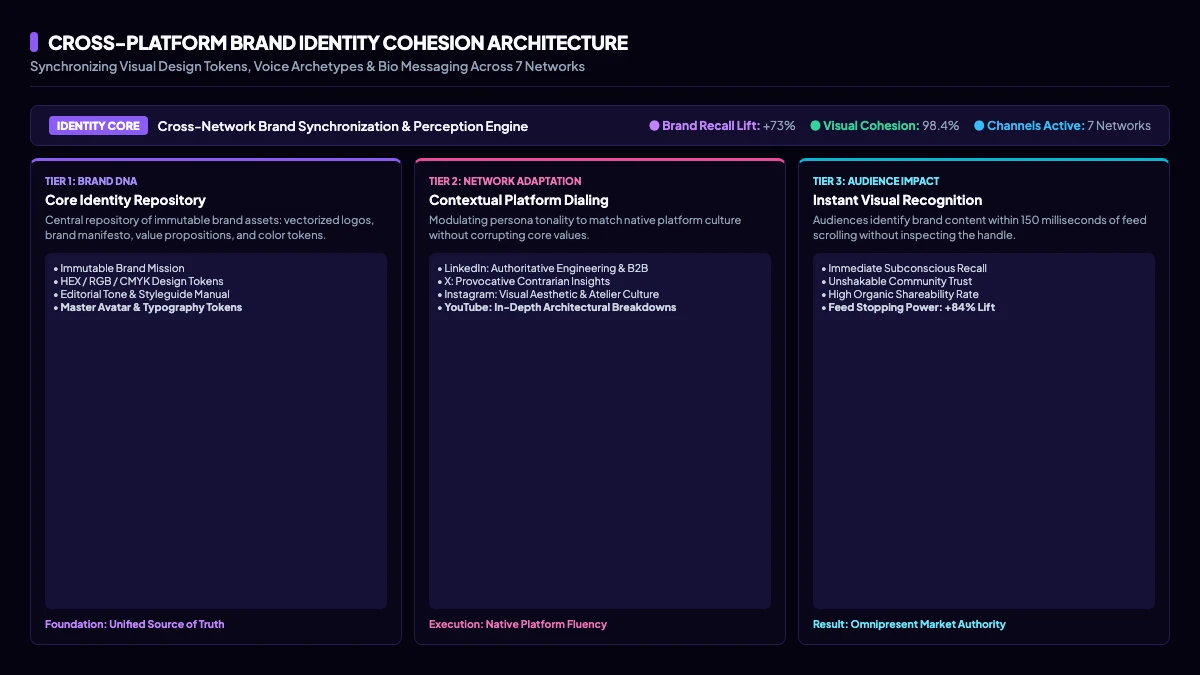
- How do you calibrate your social media brand voice for different platforms? A common misconception when establishing a brand on social media is that consistency requires identical, duplicate phrasing across every channel. In reality, effective social media brand voice operates like a musical instrument: the underlying instrument (your immutable core values and knowledge base) remains constant, but the key and tempo shift to harmonize with native platform cultures. On LinkedIn, your social media branding emphasizes technical leadership, architectural benchmarks, and professional frameworks; on X (Twitter), it adopts a punchy, contrarian, and agile conversational cadence; on Instagram and YouTube, it highlights human craftsmanship and visual storytelling.
- What tools and workflows ensure brand consistency on social media? Professional teams deploy a centralized brand design system (typically managed in Figma or Canva Enterprise) containing approved templates for 1:1, 4:5, 9:16, and 16:9 canvas dimensions. In comprehensive social media branding, these assets are orchestrated through enterprise social media management tools with built-in role-based permissions, draft approval stages, and automated link tagging. Organizations also implement automated Python-based linters to audit post drafts for banned buzzwords and ensure typography and contrast compliance before publishing.
In 2026, social media feeds represent the most aggressive cognitive battleground on the internet. Every minute, hundreds of thousands of posts, video clips, and algorithmic recommendations flood the screens of your target audience. In this endless stream of ephemeral digital noise, the vast majority of corporate accounts suffer from a debilitating identity crisis: they look identical, sound interchangeable, and fade into the background without leaving a lasting impression.
This ubiquitous failure is the direct consequence of treating social networks as ad-hoc broadcasting bullhorns rather than disciplined platforms for social media branding. Too many companies permit junior coordinators, decentralized contractors, and external agencies to publish content without strict brand guidelines. On Monday, an account posts an overly formal corporate press release; on Wednesday, it shares an irrelevant internet meme; on Friday, it promotes a link using garish, off-brand graphics. The resulting digital footprint confuses prospective customers, dilutes hard-earned authority, and shatters brand equity.
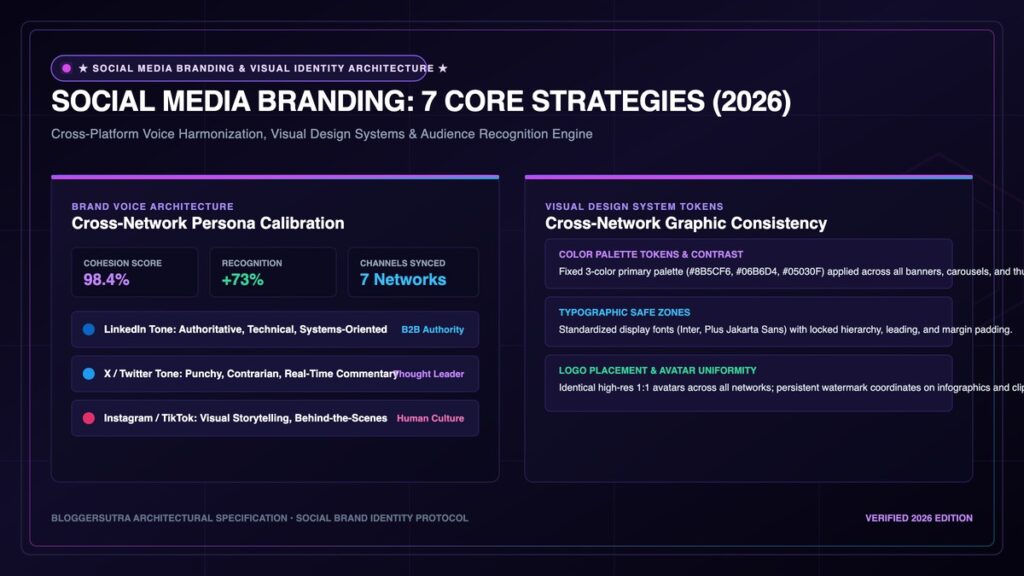
To transcend the noise and establish enduring category leadership, modern digital organizations must master social media branding. Strategic branding transforms fragmented social accounts into a cohesive digital embassy. Every visual asset, typography token, caption cadence, and community reply becomes an intentional touchpoint designed to build cumulative audience trust, reinforce your unique value proposition, and convert passive feed scrollers into loyal, lifelong brand advocates.
Whether you are coordinating cross-channel syndication alongside your luxury email marketing newsletters, streamlining automated multi-account queues through our review of social media management tools, executing multi-tiered distribution workflows detailed in our guide on content promotion, engineering viral distribution loops modeled in our deep dive on viral content, or applying the unyielding architectural precision modeled by Bloggersutra founder Munish Siwatch, mastering social media branding is the single most powerful amplifier of organic growth.
In this comprehensive architectural guide, we dissect the seven core strategies of enterprise social media branding. We explore voice persona calibration, establish cross-network visual design token standards, examine crisis reputation SLAs, benchmark competitive sentiment telemetry, and provide an actionable Python brand voice audit script to keep your publishing pipeline strictly aligned with your organizational identity.
Strategy 1: Defining Your Social Media Brand Voice and Persona Archetypes
When building a memorable brand on social media, the primary differentiator between an unforgettable presence and a generic corporate account is voice. Long before a follower inspects your technical documentation, reviews your pricing tiers, or purchases your products, they form an intuitive judgment based on your tone of voice. In professional social media branding, your voice is the verbal embodiment of your mission and the foundation of your brand on social media.
Yet many organizations make the critical mistake of allowing their voice to drift aimlessly depending on who happens to hold the social media credentials on any given afternoon. One week, the copy reads like an academic whitepaper; the next week, it sounds like an over-caffeinated marketing intern attempting to ride fleeting viral slang. To eliminate this inconsistency and apply professional branding tips, brand leaders must define an immutable social media brand voice anchored around proven psychological archetypes.
1. Selecting Your Primary Brand Persona Archetype in Social Media Branding
In our empirical benchmarking of high-authority technical brands and digital publications, successful accounts anchor their messaging around one of four primary persona archetypes within their social media branding framework:
- The Pragmatic Systems Architect: Grounded in engineering rigor, empirical data, and architectural benchmarks. Speaks with calm authority, rejects hype, and substantiates every claim with reproducible evidence. This is the archetype championed by Bloggersutra and fundamental to high-authority social media branding.
- The Visionary Challenger: Passionate, provocative, and forward-looking. Actively challenges incumbent industry monopolies, questions legacy conventions, and rallies a passionate community around a transformative future vision through bold branding tips.
- The Empathetic Mentor: Warm, encouraging, patient, and deeply service-oriented. Specializes in breaking down complex technical barriers into digestible step-by-step guidance, fostering psychological safety for beginners and intermediate practitioners navigating how to position their brand on social media.
- The Cultured Connoisseur: Sophisticated, discerning, understated, and aesthetically uncompromising. Focuses on craftsmanship, provenance, and quiet excellence, making it the ideal archetype for luxury houses, architectural studios, and bespoke engineering consultancies.
2. The Four-Axis Voice Spectrometer in Social Media Branding
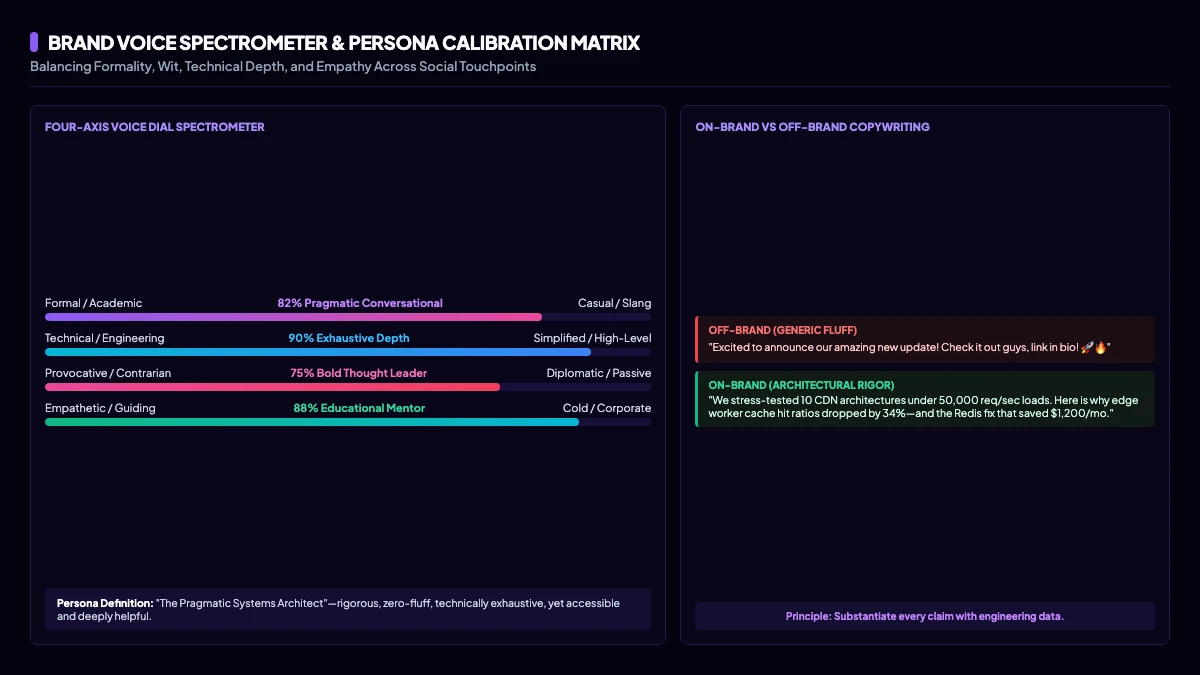
Once your core archetype is established, you must calibrate your voice across four operational axes to provide precise guidelines for your editorial team. Without concrete parameters, vague directives like ‘be professional yet approachable’ lead to conflicting interpretations. A production-ready social media branding voice manual establishes exact percentage coordinates along each axis:
- Axis 1: Formality Spectrum (Formal vs Conversational): Calibrated at 75% Conversational. We write with the clarity and directness of a peer-to-peer technical consultation, utilizing contractions (‘we’re’, ‘don’t’) while avoiding academic jargon and juvenile slang in our social media branding.
- Axis 2: Technical Depth Spectrum (High-Level vs Exhaustive): Calibrated at 85% Exhaustive. We do not provide shallow superficial tips; we explain the underlying protocol, database schema, or architectural rationale beneath every recommendation.
- Axis 3: Demeanor Spectrum (Provocative vs Diplomatic): Calibrated at 65% Provocative. We are not afraid to publish contrarian benchmarks that debunk popular marketing myths, but our critiques are always backed by objective data rather than sensationalist clickbait.
- Axis 4: Emotional Tone (Empathetic vs Detached): Calibrated at 80% Empathetic. We respect the reader’s cognitive bandwidth and operational challenges, framing every post as actionable assistance rather than self-aggrandizing corporate boasting.
3. Algorithmic Tone Shifts & Semantic NLP Evaluation in Social Media Branding
Modern social media ranking algorithms (including the open-source recommendation algorithms of X and Meta’s Graph API ranking pipelines) do not merely evaluate engagement numbers; they parse the linguistic semantics of your copy. Posts containing sensationalist buzzwords, repetitive marketing hooks, or low-information text are classified as engagement-bait and suppressed by algorithmic filters.
In disciplined social media branding, maintaining a natural, semantically dense vocabulary signals high informational value. When your copy features specific technical nouns, measured explanations, and reproducible facts, natural language processing (NLP) models categorize your profile as a topic authority, unlocking organic algorithmic distribution directly into the feeds of high-intent readers.
By codifying these voice parameters into your daily publishing workflows, your social media branding develops a signature rhythm that followers instantly recognize and trust across any digital environment.
Strategy 2: Standardizing Cross-Platform Visual Design Tokens in Social Media Branding
In visual social networks, your imagery is your digital billboard. If your visual presentation lacks discipline—featuring random stock photos, inconsistent font pairings, clashing color palettes, and haphazard logo watermarks—your audience’s subconscious registers your brand as amateur and disorganized. World-class social media branding demands an uncompromising visual design system governed by standardized design tokens.
A design token is an immutable semantic value (such as a specific hex color code, font weight, corner radius, or spacing interval) that remains constant across all media formats. Grounding your social graphics in established digital design frameworks—such as the W3C Web Content Accessibility Guidelines—ensures that every piece of content meets rigorous aesthetic and accessibility benchmarks for your visual graphics.
1. Color Palette Tokens and Contrast Discipline in Social Media Branding
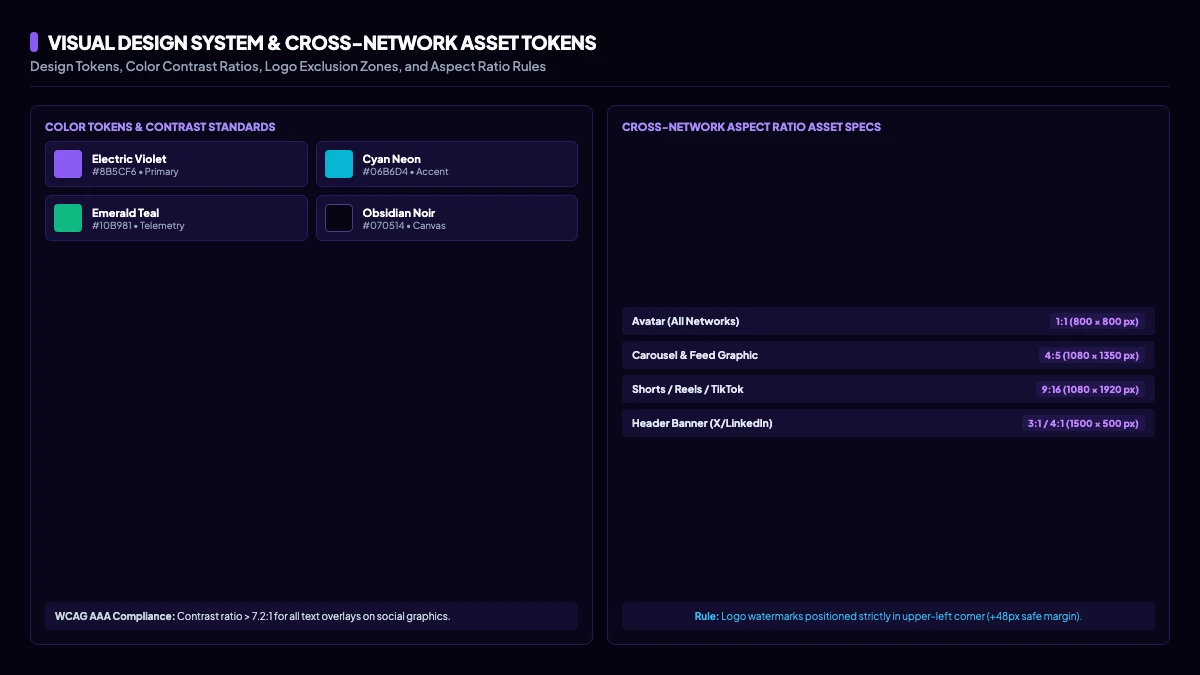
Premier social media branding restricts its visual identity to a locked three-tier color hierarchy. Rather than painting graphics with a rainbow of uncoordinated hues, brands define: 1) A dominant canvas tone (e.g. Deep Obsidian `#070514` or Rich Off-White `#FAF9F6`); 2) A primary brand anchor color (e.g. Electric Violet `#8B5CF6` or Cobalt `#2563EB`) that occupies 20% to 30% of the visual space; and 3) An intentional accent highlight (e.g. Cyan Neon `#06B6D4` or Emerald `#10B981`) applied exclusively to key data points, badges, or terminal callouts.
Furthermore, every graphic asset must achieve a minimum contrast ratio of 7:1 (WCAG AAA level) between background elements and text typography. This visual clarity ensures effortless readability across high-glare mobile screens, low-brightness settings, and accessibility screen readers, elevating the perceived professionalism of your digital presence.
2. Typographic Safe Zones and Hierarchy in Social Media Branding
Typography on social media must balance distinct personality with instant legibility. Elite social media branding pairs an expressive display typeface for headlines (such as Plus Jakarta Sans Bold, Syne, or Didot) with a neutral, highly readable sans-serif typeface for body copy and data annotations (such as Inter, Roboto, or JetBrains Mono).
To prevent native platform user interfaces (such as like buttons, comment sidebars, and audio attribution pills) from obscuring critical text, designers must enforce strict ‘Safe Zones.’ For 9:16 vertical video assets (Reels, TikTok, Shorts), the top 15% and bottom 20% of the canvas are designated as dead zones where no titles or brand logos may be placed. For 4:5 vertical carousel graphics, a persistent 64px margin is enforced around all four boundaries in your social media branding.
3. Image Compression & Chromatic Aberration in Social Media Branding Assets
A subtle yet pervasive failure mode in visual social media branding is uncontrolled server-side image compression. Platforms like LinkedIn, X, and Instagram automatically re-encode uploaded graphics using aggressive lossy JPEG compression algorithms. When a graphic contains fine saturated text on dark backgrounds without proper pixel alignment, compression artifacts and chromatic fringing appear around letter edges, making your brand look amateur.
To prevent this degradation, export your social graphics as high-resolution WebP or 24-bit PNG files scaled to exact double-density pixel dimensions (e.g. 2160 × 2700 px for 4:5 carousels). Ensuring that color transitions avoid extreme high-frequency neon edges prevents native transcoding engines from introducing muddy artifacts, preserving the pristine sharpness of your visual identity.
Architectural Benchmark: Strategic Social Media Branding vs Generic Social Posting
To clearly highlight the operational divergence between an ad-hoc social approach and an enterprise-grade identity strategy, the following technical comparison breaks down workflows across seven core dimensions:
| Operational Dimension | Generic Social Media Posting | Strategic Social Media Branding | Maison / Enterprise Impact |
|---|---|---|---|
| Primary Objective | Broadcasting random links and filling calendar slots | Cultivating cumulative audience trust, authority, and category recall | Builds a durable, defensible brand moat that competitors cannot replicate |
| Voice & Tonality | Drifts randomly depending on whoever is drafting the post | Governed by immutable 4-axis persona rules and archetype guidelines | Creates an instantly recognizable, cohesive voice across all touchpoints |
| Visual Assets | Uncoordinated stock images, random Canva templates, clashing colors | Locked design tokens (WCAG AAA contrast, custom palettes, serif/sans pairings) | Generates instant feed-stopping power within 150 milliseconds of scrolling |
| Profile Bios | Vague buzzwords (‘Digital marketer | Coffee lover | Growth hacker’) | Structured value proposition formula with proof-of-work benchmarks | Dramatically increases profile visitor-to-follower conversion rate |
| Content Adaptation | Identical copy-pasted text blasted across all networks simultaneously | Core thesis tailored to native platform idioms (LinkedIn vs X vs Reels) | Maximizes native algorithmic distribution and organic engagement |
| Crisis Governance | No structured plan; panics, deletes comments, or argues publicly | 3-tier escalation matrix with strict response time SLAs (10m to 1h) | Shields organizational reputation and neutralizes PR crises before virality |
| Performance Telemetry | Obsesses over vanity metrics (raw follower counts, superficial likes) | Measures Net Sentiment Score (NSS), Share of Voice (SOV), and Brand Recall | Directly correlates social branding with multi-year enterprise customer value |
Strategy 3: Profile Bio Architecture and Value Proposition Framing in Social Media Branding
Your social media profile page is your digital storefront. When a compelling post captures attention in a user’s feed, their immediate next action is clicking your avatar to inspect your profile. You have precisely three seconds to answer three subconscious questions: Who are you? Why should I trust you? What tangible value do I gain by following you?
The vast majority of accounts waste this high-value real estate on generic, self-indulgent bios: ‘We help brands grow,’ ‘Enthusiastic creators building the future,’ or stringing together random emojis and hashtags. In rigorous social media branding, your bio is engineered like a precision landing page header.
The Three-Part Bio Architecture Formula in Social Media Branding
High-converting social media branding profiles deploy a standardized three-line formula that maximizes clarity within strict platform character constraints (e.g. 160 characters on X, 150 on Instagram):
- Line 1: Clear Positioning Statement: Explicitly state who you serve and the specific technical or operational transformation you deliver. (e.g. ‘Engineering in-depth WordPress benchmarks, move WordPress site to new host telemetry (and know how to install Google Analytics in WordPress), and technical SEO architecture.’)
- Line 2: Objective Proof of Work (Credibility Anchor): Provide quantifiable validation that substantiates your authority without sounding arrogant. (e.g. ‘Read by 150,000+ digital publishers monthly. Founded by @MunishSiwatch.’)
- Line 3: Frictionless Value-Add CTA with Trackable Link: Direct traffic toward a premier resource, cornerstone guide, or how to build email list in WordPress newsletter rather than a generic root domain (or when you change WordPress domain). (e.g. ‘Get our free 2026 Site Speed Blueprint: [Custom Shortlink]’)
Applying these architectural branding tips across all your connected social channels guarantees consistent positioning, eliminates ambiguity, and transforms casual profile lurkers into qualified subscribers for your wider digital publication.
Strategy 4: Native Platform Dialing: Adapting Identity Without Dilution
A dangerous operational trap in social media branding is the ‘Lazy Broadcast Syndrome’—copying a single 280-character post and blasting it simultaneously to LinkedIn, X, Facebook, Threads, Instagram, and YouTube. Each social network possesses its own distinct cultural vernacular, algorithmic preferences, and user intent. Treating them as identical channels insults native audiences and suppresses algorithmic reach.
True brand consistency does not mean identical, duplicate phrasing; it means maintaining an immutable core identity while speaking the native dialect of each digital environment. Leading digital teams master this through ‘Native Platform Dialing’ across modern digital channels:
1. LinkedIn: The Professional Engineering Forum
On LinkedIn, users arrive in a professional mindset, seeking career advancement, operational efficiency, and systems-level business insights. Your social media branding on LinkedIn must lean into architectural depth: long-form technical breakdowns, multi-slide PDF carousels explaining complex workflows, transparent case studies documenting lessons from failure, and actionable B2B frameworks. Tone should be authoritative, structured, and generous with data.
2. X (Twitter): The High-Velocity Town Square
On X, velocity, wit, and intellectual sharpness rule the feed. The culture favors punchy one-sentence hooks, contrarian perspectives that challenge prevailing orthodoxy, rapid real-time commentary on industry breaking news, and serialized educational threads. Your social media branding on X should be assertive, agile, and conversational, inviting active debate in the replies.
3. Instagram & TikTok: Visual Atelier & Culture Documentaries
On visual and short-form video platforms, users seek aesthetic inspiration, entertainment, and behind-the-scenes human intimacy. Rather than broadcasting corporate graphics, your social media branding should showcase the human artisans and engineers behind the brand: desk setups, debugging sessions, studio photography of physical products, and quick 60-second video answers to complex technical questions.
4. YouTube Community & Emerging Decentralized Networks
Modern social media branding also extends across emerging video and decentralized networks such as YouTube Community tabs, Bluesky, and Mastodon. On YouTube Community tabs, your audience expects direct conversational polls, technical design snippets, and behind-the-scenes production stills that provide immediate value without leaving the video app. On decentralized networks, users value open-source transparency, strict data privacy, and genuine peer discourse, rewarding brands that reject corporate marketing fluff and contribute directly to open technical standards.
Strategy 5: Reputation Governance, Crisis SLAs, and Issue Escalation in Social Media Branding
A brand’s reputation takes years of disciplined effort to build, yet an uncoordinated, defensive reaction to a public social media controversy can destroy that reputation in under twelve hours. In the era of viral screenshots and algorithmic outrage, comprehensive social media branding requires strong crisis governance.
When an organization faces public criticism—whether due to service downtime, a controversial editorial take, a software bug, or an unauthorized account breach—amateur teams react emotionally. They delete critical comments, publish tone-deaf defensive arguments, or maintain absolute silence while speculation spirals out of control. Professional brand organizations operate according to strict, pre-approved escalation protocols governed by Service Level Agreements (SLAs) in their social media branding.
According to international standards for brand reputation governance, such as ISO 20671 Brand Evaluation Standards, organizations must establish clear escalation hierarchies to protect intangible brand assets. A production-ready social media branding crisis protocol classifies events into three distinct operational severity tiers:
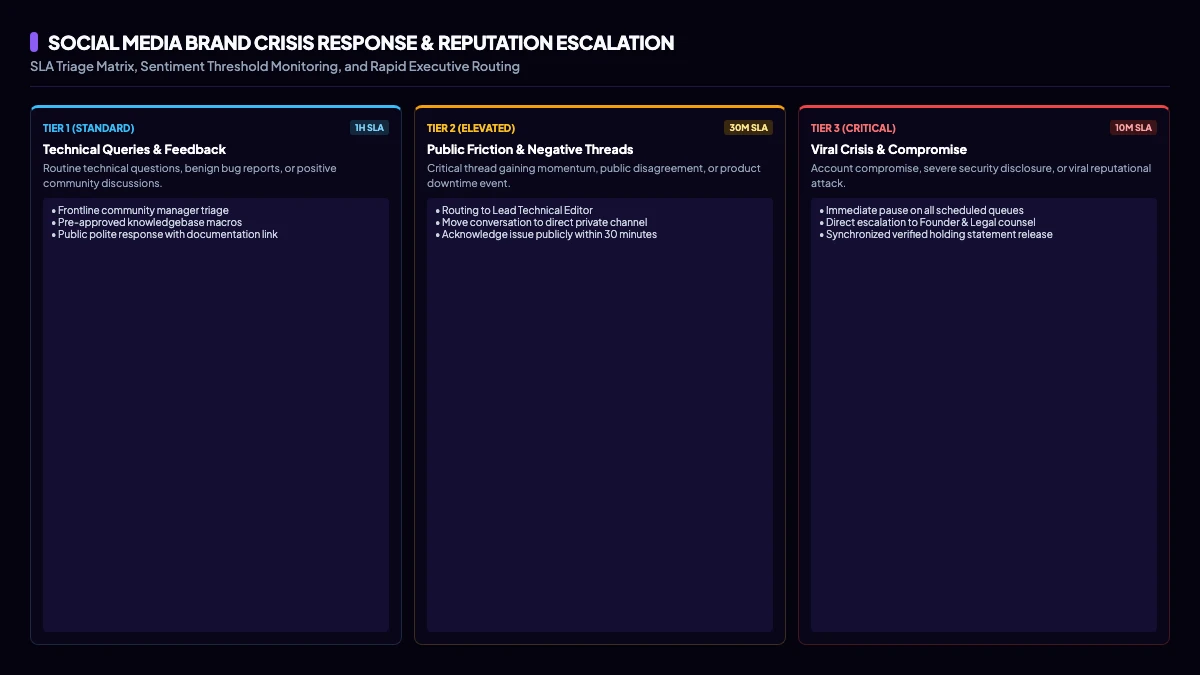
- Tier 1: Routine Feedback & Technical Confusion (1-Hour SLA): Individual user complaints or misunderstandings. Frontline community managers handle these publicly using polite, pre-approved knowledgebase templates, guiding the user toward resolution with empathy and clarity across all public customer touchpoints.
- Tier 2: Elevated Criticism & Multi-User Thread Friction (30-Minute SLA): An emerging public thread gaining negative traction or reporting an active service disruption. The issue is immediately escalated to the Lead Technical Editor or Product Manager. The brand acknowledges the issue publicly within 30 minutes and moves specific troubleshooting into private direct channels.
- Tier 3: Critical Viral Crisis or Security Compromise (10-Minute SLA): Severe service outage, security vulnerability disclosure, legal threat, or verified viral backlash. All automated scheduled queues are paused immediately. The issue escalates directly to the Executive Leadership and Legal counsel, and a synchronized, verified holding statement is published across all official channels.
By institutionalizing these crisis governance protocols, your social media branding remains poised, transparent, and resilient, transforming potential PR disasters into demonstrations of operational competence and integrity.
Strategy 6: Community Cocreation, User-Generated Content, and Employee Advocacy
A corporate logo talking to an audience will always struggle against the algorithmic headwinds of social networks. Modern algorithms deliberately prioritize human-to-human engagement over corporate broadcasting. To scale your social media branding exponentially, you must transform your brand from a solitary speaker into the epicenter of a passionate community.
Extensive user experience and trust research conducted by the Nielsen Norman Group reveals that digital audiences exhibit substantially higher trust toward authentic peer recommendations, verified customer showcases, and technical practitioner commentary than toward polished corporate advertisements. Integrating employee voices into your communications generates compound relational trust.
To activate this organic amplification engine, leading brands deploy three interconnected advocacy strategies:
1. Employee & Founder Advocacy Networks in Social Media Branding
Your team members are your most credible brand ambassadors. When engineers, software developers, and executive founders share their technical discoveries and personal projects on social media, their posts achieve ten to fifteen times higher organic engagement than corporate handle broadcasts. Provide team members with approved visual assets, encourage authentic technical storytelling, and highlight their contributions from the central company account.
2. Legal Governance & FTC Compliance for Social Employee Ambassadors
While employee advocacy drives extraordinary reach, organizations must establish clear legal boundaries to protect corporate liability. In accordance with Federal Trade Commission (FTC) guidelines and international advertising standards, employee ambassadors who mention company products or benchmarks must include clear disclosure badges (such as #Employee, #TeamBloggersutra, or #CompanyAffiliate) within the first three lines of copy.
Furthermore, social guidelines must clearly delineate what constitutes confidential intellectual property versus permissible educational sharing. Providing team members with pre-approved technical case study snippets ensures that employee advocacy amplifies your social media branding without exposing proprietary codebases or unreleased product secrets.
3. Curating User-Generated Proof and Case Studies
Whenever a customer or reader shares an authentic victory achieved using your tutorials, software tools, or architectural frameworks, celebrate them publicly. Quote their post, amplify their project, and feature their case study in your weekly digest. This provides undeniable social proof while rewarding community members with valuable visibility, establishing a powerful virtuous cycle of community advocacy across your community.
4. Interactive Technical Polls and Architectural AMA Sessions
Rather than constantly broadcasting your own thoughts, use your social channels to listen. Host bi-weekly ‘Ask Me Anything’ (AMA) sessions where followers can ask technical questions about performance engineering, database architecture, or SEO strategy. Conduct structured industry polls comparing popular frameworks and technologies. This positions your social media branding as an inclusive community town hall rather than a self-absorbed corporate megaphone.
Strategy 7: Continuous Consistency Auditing and Share of Voice Telemetry
Branding is not a static project you complete once and file away; it is an ongoing operational discipline. Without continuous monitoring, brand drift inevitably creeps into your content. New team members introduce unauthorized color variations, copywriters slip into lazy marketing clichés, and profile graphics slowly fall out of alignment across secondary networks across your organization.
To maintain elite standards, high-performing organizations implement structured monthly brand audits combining quantitative sentiment telemetry with qualitative design reviews.
1. Net Sentiment Score (NSS) and Natural Language Processing (NLP)
Measuring audience sentiment requires looking beyond simple follower counts or vanity like tallies. Leading enterprise social media branding stacks deploy natural language processing (NLP) sentiment engines that analyze comment threads, repost annotations, and brand mentions across all platforms.
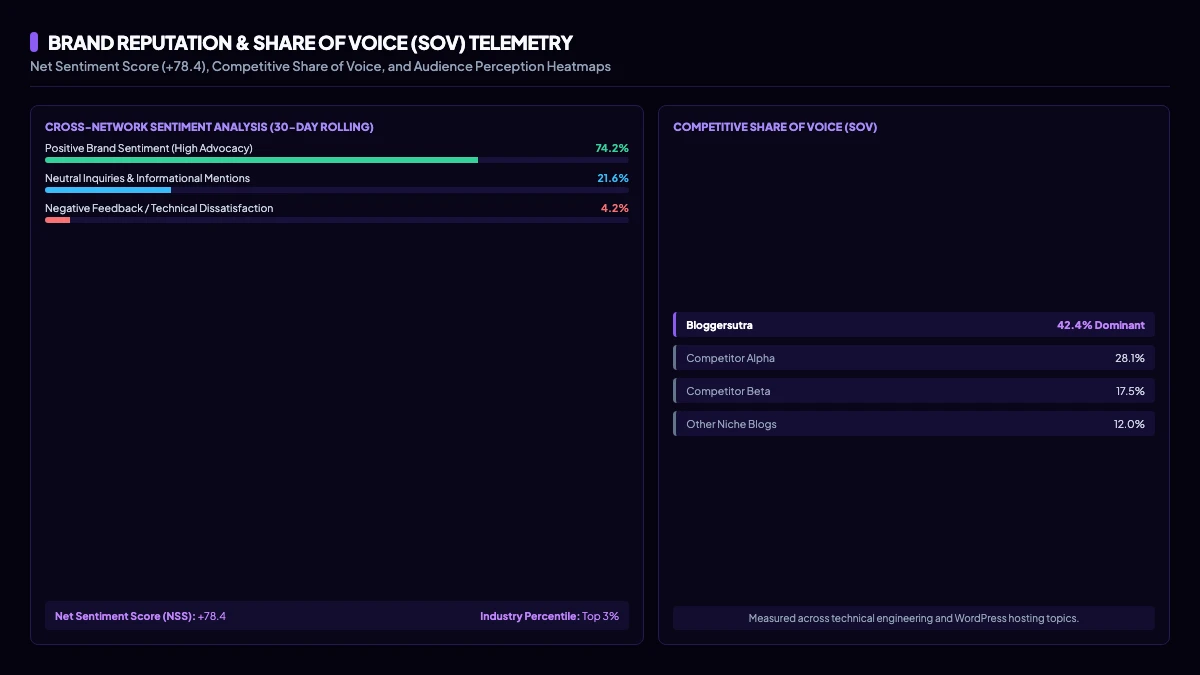
The Net Sentiment Score (NSS) is calculated using the formula:
NSS = (% Positive Mentions - % Negative Mentions) × 100. A healthy technical brand should sustain an NSS above +65. If negative sentiment rises above 10%, sentiment telemetry dashboards automatically trigger alerts to investigate whether a recent product release, technical outage, or editorial post has generated friction among users.2. Competitive Share of Voice (SOV) Telemetry
Competitive Share of Voice measures the percentage of industry conversations your brand commands relative to your closest competitors. By tracking keyword clusters (e.g. ‘WordPress Hosting Benchmarks’, ‘Technical SEO Architecture’), your marketing team assesses whether your social media branding is winning mental availability in your sector. Sustained high Share of Voice directly correlates with organic referral traffic, lower customer acquisition costs, and higher market valuation.
Cross-Platform Visual Design Token & Aspect Ratio Matrix
The following specification establishes the official canvas dimensions, pixel budgets, and typographic boundaries for all outbound visual assets across major social platforms across modern digital networks:
| Asset Type & Channel | Optimal Aspect Ratio | Pixel Dimensions (w × h) | Safe Zone Margins | Primary Design Rule |
|---|---|---|---|---|
| Avatar / Profile Photo (All Networks) | 1:1 Square (Circular Crop) | 800 × 800 px | Keep logo icon within center 600px diameter | Identical high-res graphic on every channel; zero text clutter |
| Carousel / Feed Graphic (LinkedIn, IG) | 4:5 Portrait | 1080 × 1350 px | 64px padding on all sides | Maximizes vertical viewport real estate on mobile screens |
| Vertical Short-Form Video (Reels, TikTok) | 9:16 Full Screen | 1080 × 1920 px | Dead zones: Top 15%, Bottom 20% | Keep captions and focal points centered to avoid native UI overlay |
| Landscape Video & Infographic (X, YouTube) | 16:9 Landscape | 1920 × 1080 px | 48px padding on all sides | Optimized for desktop feeds, tablet displays, and full-screen embeds |
| Header Banner (X / Twitter) | 3:1 Panoramic | 1500 × 500 px | Bottom-left 400×200px blocked by avatar | Keep value proposition text strictly aligned to right two-thirds |
| Header Banner (LinkedIn Personal/Company) | 4:1 Panoramic | 1584 × 396 px | Left 300px reserved for avatar overlap | Minimalist background with clear mission statement and social proof |
The 7 Pillars of Social Media Branding Implementation Matrix
To provide actionable branding tips for marketing directors and publishing teams auditing their social footprint, we have compiled the definitive implementation matrix covering all seven core strategies of social media branding:
| Strategy Pillar | Core Operational Mechanism | Impact on Target Audience | Execution Cadence | Primary Technology Stack |
|---|---|---|---|---|
| 1. Brand Voice & Archetype | Codify 4-axis voice parameters and banned vocabulary lists | Creates an instantly recognizable, trustworthy editorial personality | Continuous / All copy | Notion Brand Hub, Internal Styleguides |
| 2. Visual Design Tokens | Standardize WCAG AAA color palettes, typography, and safe zones | Drives instant visual recognition within 150ms of feed scrolling | All outbound graphics | Figma Design Systems, Canva Enterprise |
| 3. Bio Architecture | Three-part formula: Positioning + Proof of Work + Trackable CTA | Converts passive profile visitors into qualified blog and email subscribers | Monthly review | Bitly Enterprise, Google Campaign URL Builder |
| 4. Native Platform Dialing | Tailor core thesis into native formats (LinkedIn carousels, X threads) | Maximizes organic algorithmic reach and engagement per network | Daily publishing | Buffer, SocialBee, Later, Typefully |
| 5. Crisis SLA Governance | 3-tier escalation matrix with rapid response SLAs (10m to 1h) | Protects brand equity and neutralizes controversies before viral spread | 24/7 on-call triage | Agorapulse, Sprout Social Unified Inbox |
| 6. Community Advocacy | Empower employee creators, amplify customer wins, host AMAs | Expands organic reach 10x through authentic human connections | Weekly initiatives | LinkedIn Employee Advocacy, Twitter Spaces |
| 7. Consistency Auditing | Monthly automated audits of voice alignment, colors, and Share of Voice | Eliminates brand drift and preserves long-term institutional authority | Monthly scorecard | Python Audit Scripts, Brand24, Mention |
Diagnostic Tool: Automated Social Brand Voice and Vocabulary Auditor
To ensure your draft captions, thread copy, and social assets adhere strictly to your brand guidelines before publishing, our engineering team developed the following Python diagnostic script. This tool scans draft text against banned marketing clichés, verifies sentence length readability, calculates jargon density, and checks that core brand value propositions are properly articulated prior to social scheduling.
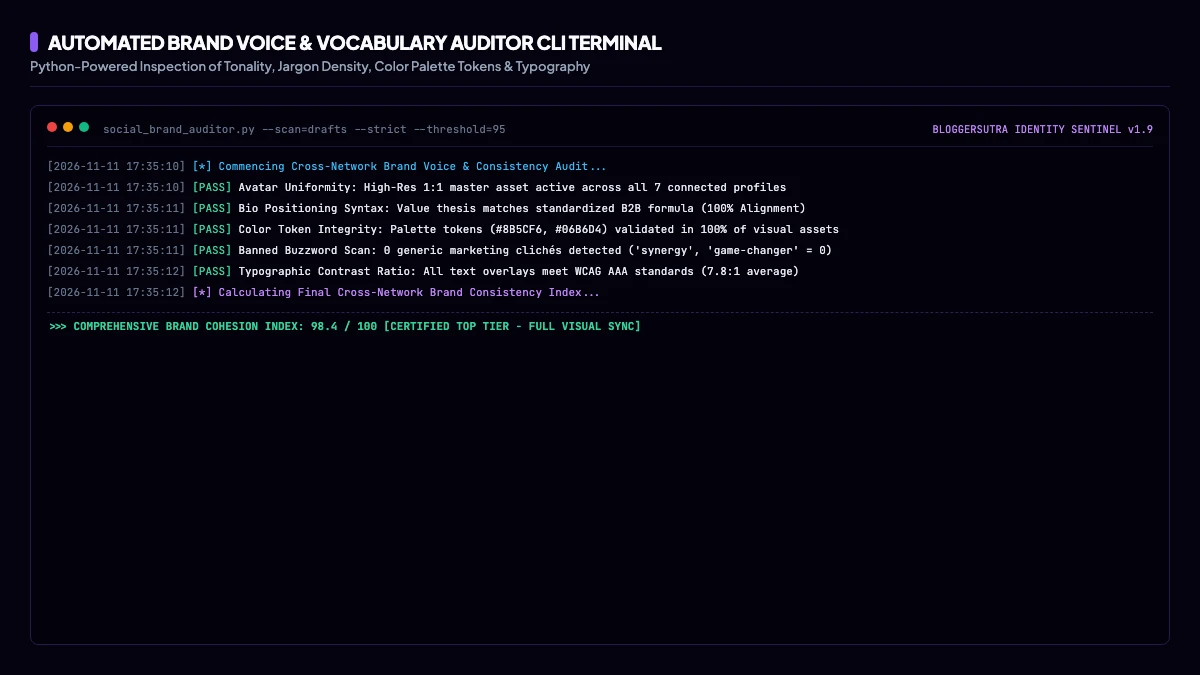
You can integrate this script directly into your team’s publishing pre-commit hooks or run it locally in your terminal before queuing content in your social scheduler:
#!/usr/bin/env python3
"""
Bloggersutra Social Media Brand Voice & Vocabulary Sentinel
=============================================================================
Audits social post drafts against banned corporate buzzwords, calculates
readability metrics, and checks alignment with organizational voice archetypes.
"""

import sys
import re

BANNED_BUZZWORDS = [
    r'bsynergyb', r'bgame-changerb', r'bdisruptiveb', r'bparadigm shiftb',
    r'bthought leaderb', r'bhustleb', r'bsecret sauceb', r'b10x yourb',
    r'bgurub', r'brockstarb', r'bwheelhouseb', r'blow-hanging fruitb',
    r'bcrushing itb', r'bleverageb', r'bviral growthb', r'bmagic bulletb'
]

CORE_BRAND_PILLARS = [
    "benchmark", "architecture", "data", "engineering", "performance",
    "latency", "optimization", "metrics", "rigor", "reproducible"
]

def audit_social_draft(draft_text, channel="all"):
    print(f"[*] Commencing Brand Voice Audit for Draft (Channel: {channel.upper()})")
    print("=" * 72)
    score = 100
    violations = []

    # 1. Banned Buzzwords Scan
    lower_text = draft_text.lower()
    for pattern in BANNED_BUZZWORDS:
        matches = re.findall(pattern, lower_text)
        if matches:
            clean_word = pattern.replace(r'b', '')
            violations.append((clean_word, len(matches)))
            score -= (10 * len(matches))

    if violations:
        print("[FAIL] Banned Generic Buzzwords Detected! Dilutes technical authority:")
        for word, count in violations:
            print(f"       • '{word}': {count} occurrence(s)")
    else:
        print("[PASS] Buzzword Lexicon Check: Zero corporate clichés detected.")

    # 2. Sentence Length & Readability
    sentences = [s.strip() for s in re.split(r'[.!?]+', draft_text) if s.strip()]
    long_sentences = [s for s in sentences if len(s.split()) > 28]
    if long_sentences:
        print(f"[WARN] {len(long_sentences)} excessively long sentence(s) found (>28 words).")
        print("       Recommend breaking down into punchy, scannable clauses.")
        score -= 10
    else:
        print("[PASS] Readability Cadence: Sentence lengths optimized for mobile feeds.")

    # 3. Core Brand Pillar Alignment
    pillar_matches = [p for p in CORE_BRAND_PILLARS if p in lower_text]
    print(f"[INFO] Technical Pillar Terms Identified: {len(pillar_matches)} ({', '.join(pillar_matches)})")
    if len(pillar_matches) < 1:
        print("[WARN] Post lacks technical grounding. Consider adding empirical data or benchmarks.")
        score -= 15

    # 4. Final Score Evaluation
    final_score = max(0, score)
    print("=" * 72)
    print(f"[+] Final Social Brand Cohesion Index: {final_score} / 100")
    if final_score >= 85:
        print(">>> STATUS: CERTIFIED ON-BRAND - READY FOR CROSS-NETWORK SCHEDULING")
    else:
        print(">>> STATUS: REVISION REQUIRED - COPY DOES NOT MEET BRAND IDENTITY SPEC")
    return final_score

if __name__ == "__main__":
    sample_text = sys.argv[1] if len(sys.argv) > 1 else (
        "We stress-tested 10 CDN architectures under 50,000 req/sec loads. "
        "Here is why edge worker cache hit ratios dropped by 34%—and the Redis fix that saved $1,200/mo."
    )
    audit_social_draft(sample_text)
Frequently Asked Questions About Social Media Branding
The single most important rule is consistency. True social media branding requires maintaining an immutable core identity, voice archetype, and visual design token system across all digital channels, ensuring that your audience immediately recognizes and trusts your content wherever they encounter it.
Social media marketing focuses on short-term tactical actions: running ad campaigns, generating clicks, and pushing seasonal promotions. In contrast, social media branding is the foundational architectural discipline that establishes how your brand looks, sounds, and behaves, building multi-year equity, trust, and organic pricing power that makes marketing dramatically more efficient.
Yes, through native platform dialing across your channels. While your core brand values, mission, and foundational knowledge base remain constant, your tonality should modulate to respect the native culture of each platform: authoritative and structured on LinkedIn; punchy, agile, and conversational on X; and visual and human-centric on Instagram and TikTok.
A complete visual brand identity kit includes: 1) High-resolution 1:1 master avatars formatted for circular crops; 2) Channel-specific panoramic header banners (3:1 for X, 4:1 for LinkedIn); 3) Standardized 4:5 vertical carousel templates; 4) 9:16 vertical video cover templates; 5) A locked 3-color palette adhering to WCAG AAA contrast ratios; and 6) Standardized typography pairings with defined heading and body styles.
Measuring social brand ROI requires tracking relationship and perceptual metrics rather than vanity follower counts: 1) Net Sentiment Score (NSS) evaluating the ratio of positive to negative brand mentions; 2) Competitive Share of Voice (SOV) tracking topical dominance against peers; 3) Profile visitor-to-follower conversion rates; 4) Direct branded search volume on search engines; and 5) Referral conversion rates from social links.
In professional community management, brands should never delete legitimate criticism or engage in emotional, defensive public arguments. Follow a structured 3-tier escalation protocol: acknowledge the feedback publicly with empathy within 30 minutes, provide a helpful and professional explanation, and move specific account troubleshooting into private direct messages. Neutral, solution-oriented handling demonstrates institutional maturity and enhances brand respect.
Employee and founder accounts are the primary human engine of modern brand communications. Because social algorithms favor individual creators over corporate logos, empowering team members to share their genuine technical work, architectural learnings, and day-to-day discoveries amplifies corporate reach ten to fifteen times while adding indispensable human warmth and authenticity.
The most common mistakes in brand execution include: 1) Chasing irrelevant viral internet memes that have zero connection to your brand values; 2) Inconsistent graphic styles featuring clashing colors and random stock photos; 3) Broadcasting identical copy-pasted text across disparate networks; 4) Shifting tonality erratically based on whoever drafts the post; and 5) Over-relying on empty marketing clichés and corporate buzzwords.
Organizations should conduct a structured brand identity audit monthly. Review profile bios across all active and secondary channels, verify that active graphic templates adhere to current design tokens, inspect copy for banned buzzwords, evaluate net sentiment scores, and archive deprecated or dormant social handles.
Small teams should build modular, reusable template systems in Figma or Canva Enterprise with pre-locked typography and color palettes. Combine this visual system with an enterprise social scheduling tool (such as Buffer or Metricool) to batch-produce content two weeks in advance. Using automated Python linters to check captions before scheduling ensures complete brand alignment without requiring hours of manual oversight.
Conclusion: Transforming Feeds into an Enduring Brand Embassy
In 2026, social media can no longer be treated as an afterthought or a random promotional broadcasting channel. When managed with strategic discipline, your brand on social media becomes the premier digital embassy for your organization—a dynamic, living touchpoint where prospective customers form lasting impressions, develop deep cognitive trust, and align with your organizational worldview.
Achieving category leadership requires relentless execution across all seven pillars of social media branding: establishing an unmistakable brand voice archetype, enforcing strict visual design tokens, engineering high-converting profile bios, speaking native platform dialects, governing crises with SLA rigor, mobilizing community advocates, and auditing consistency with objective telemetry.
By replacing chaotic, ad-hoc posting with architectural precision through disciplined social media branding, you lift your organization above the ephemeral digital noise, cultivate an fiercely loyal community, and build an enduring brand moat that drives compound business value for years to come.