Quick answer
- What is luxury email marketing? Luxury email marketing is a specialized digital communication discipline engineered specifically for high-net-worth individuals (HNWIs) and ultra-high-net-worth collectors. Unlike conventional mass-market e-commerce workflows to build email list in WordPress—which relies heavily on automated discount countdowns, urgency-driven flash sales, and aggressive conversion triggers—luxury email marketing focuses on brand equity preservation, heritage storytelling, bespoke editorial aesthetics, private salon allocations, and high-touch 1-to-1 clienteling..tp-post-content code, .tp-post-content pre, .toc-link{word-break:break-word!important;overflow-wrap:break-word!important;}
- What are the 7 core strategies of luxury email marketing? In our 2026 architectural benchmark, the 7 foundational pillars of luxury email marketing are: 1) The Anti-Discount Exclusivity Model: Eliminating public coupon codes and replacing markdown blasts with private allocations and value-added concierge services; 2) Bespoke Editorial & White-Glove Typography: Implementing refined serif typography, generous whitespace padding, and minimalist layouts; 3) Omnichannel VIP Clienteling & Tier-Based Segmentation: Synchronizing physical boutique POS interactions with automated client advisor outreach; 4) Heritage & Atelier Storytelling: Crafting serialized, narrative-driven gazettes focused on artisan provenance, material rarity, and atelier craftsmanship; 5) Dedicated Deliverability & BIMI Brand Security: Deploying dedicated dual-IP pools, strict DMARC p=reject policies, and Verified Mark Certificates (VMC); 6) Personalized Private Invitations & Vault Allocations: Utilizing secret, token-gated URLs for pre-launch viewings and private salon appointments; and 7) Post-Purchase Concierge & Lifecycle Stewardship: Automated white-glove onboarding, provenance certificate delivery, and proactive maintenance reminders.
- Why must luxury brands avoid mass-market email discounting? Discounting directly contradicts the core psychology of luxury consumption. High-net-worth consumers acquire luxury products for emotional gratification, artisan prestige, rarity, and enduring value. Broadcasting markdown percentages (e.g. ‘FLASH SALE: 30% OFF’) cheapens the social media branding identity, triggers customer remorse among full-price collectors, and conditions subscribers to withhold purchases until sales occur. Effective luxury email marketing preserves full pricing power by offering exclusive access, complimentary monogramming, or private atelier experiences instead of monetary reductions.
- What are standard benchmarks for email marketing for luxury brands? Due to restrained sending frequencies, rigorous list hygiene, and high brand affinity, email marketing for luxury brands achieves performance metrics vastly superior to mass retail (tracked seamlessly when you install Google Analytics in WordPress): open rates range from 45% to 68% for VIP segments; average order value (AOV) routinely exceeds $2,500 to $10,000+; click-to-open rates (CTOR) average 18% to 26%; and list churn/unsubscribe rates remain exceptionally low at less than 0.05% per campaign.
- What technical deliverability setup is required for high-end email marketing? Elite high-end email marketing requires enterprise-grade email infrastructure (and protocols to move WordPress site to new host): a dedicated IP address with custom reverse DNS (rDNS), strict SPF alignment, 2048-bit DKIM cryptographic keys, a DMARC policy enforced at p=reject with 100% percentage filtering, and a registered Brand Indicators for Message Identification (BIMI) SVG profile validated by a DigiCert or Entrust Verified Mark Certificate (VMC) to render the official maison logo inside executive mailboxes.
For decades, heritage maisons and high-end luxury brands resisted the digital channel. The traditional ethos of luxury was built on tactile physical experiences: the hushed atmosphere of a Place Vendôme jewelry salon, the discreet touch of full-grain leather in an Italian atelier, and the attentive poise of a dedicated private client advisor. When digital communication and e-commerce first emerged, many executive boards feared that electronic correspondence would commoditize their brand equity and drag their prestigious houses into the loud, discount-driven chaos of mass retail.
In 2026, that hesitation has evolved into a sophisticated operational discipline: luxury email marketing. Modern high-net-worth individuals (HNWIs) and generational wealth stewards are among the most connected demographics on earth. However, their expectations for electronic communication differ radically from those of the average consumer. When an affluent buyer opens an email from a haute horlogerie maison, an independent fashion house, or a bespoke automaker, they expect the digital experience to mirror the white-glove elegance of a five-star concierge desk.
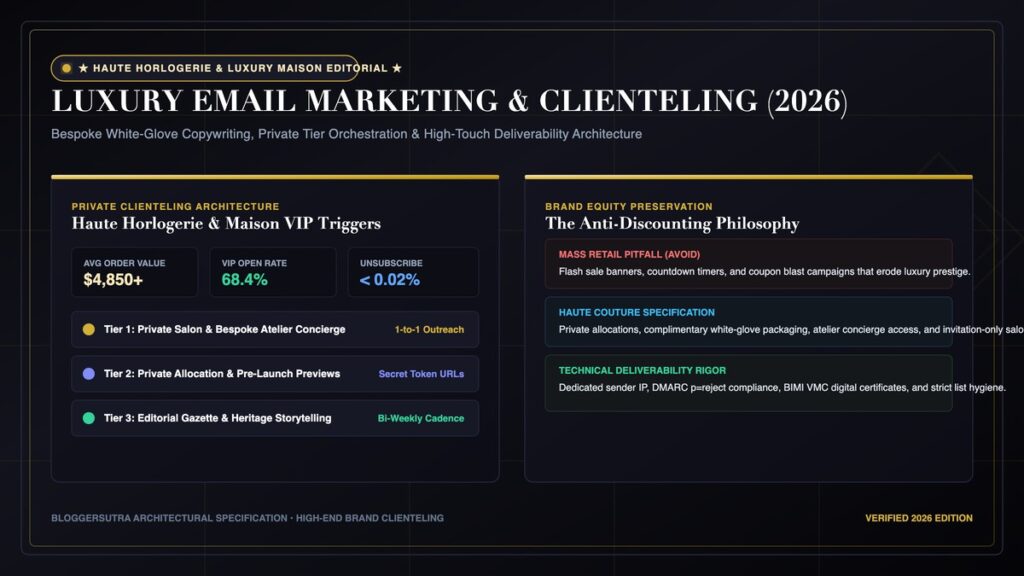
Yet the vast majority of digital marketing literature preaches aggressive, volume-obsessed tactics: neon countdown timers, screaming discount banners, artificial urgency pop-ups, and automated four-email-per-week replenishment drip campaigns. In the context of luxury brand marketing, these mass-market tactics are corporate suicide. Broadcasting a 20% discount coupon to a clientele that prides itself on exclusivity immediately shatters perceived value, alienates loyal collectors, and destroys gross operating margins.
To scale digital revenue without sacrificing brand prestige, leading digital officers must deploy a rigorous, architectural approach to luxury email marketing. This involves treating email not as a transactional broadcast bullhorn, but as a direct, private communication salon. Whether you are coordinating high-touch omnichannel distribution alongside your wider social media management tools stack, structuring your editorial syndication through our blueprint on content promotion, crafting compelling narrative hooks derived from our analysis of viral content, optimizing VIP checkout funnels via our research on website conversion rate, or adhering to the high-standard operational rigor championed by Bloggersutra founder Munish Siwatch, mastering luxury email marketing represents the ultimate competitive moat for modern prestige brands.
In this comprehensive guide, we dissect the seven architectural pillars of luxury email marketing. We examine the anti-discount philosophy, audit bespoke editorial layouts and typography guidelines, explore omnichannel clienteling synchronizations, establish enterprise deliverability security standards, and provide an actionable Python audit script to benchmark your email header compliance and spam vocabulary profile.
Strategy 1: The Anti-Discount Exclusivity Model in Luxury Email Marketing
The primary failure mode in email marketing for luxury brands is the temptation to deploy financial incentives to drive short-term conversion spikes. When quarterly sales targets loom, conventional digital marketers instinctively reach for promotional levers: ‘Take 15% off your first purchase,’ ‘Mid-season clearance event,’ or ‘Flash sale ends at midnight.’ In the luxury sector, executing such campaigns triggers immediate, catastrophic brand dilution.
High-net-worth consumers do not buy prestige goods to save money; they buy to acquire craftsmanship, provenance, aesthetic distinction, and social distinction. When a brand broadcasts discounts, it signals three dangerous realities: first, that the products were overpriced to begin with; second, that current stock is undesirable and stagnating in warehouses; and third, that early-adopter patrons who paid full retail price were taken advantage of. Once a maison conditions its audience to expect seasonal discounts, full-price sell-through collapses, and the brand enters an irreversible race to the bottom.
To understand why this occurs, one must examine the socioeconomic principles governing luxury consumption—specifically the concept of Veblen goods and positional consumption. In classical economics, demand decreases as price rises. For Veblen goods, however, higher prices directly enhance desirability because high prices confer scarcity and exclusivity. The moment an automated luxury email marketing campaign introduces a markdown coupon, it shatters this delicate psychological equilibrium. The product ceases to be a rare symbol of discerning taste and devolves into a commoditized manufactured good subject to price comparison shopping.
Furthermore, the mathematics of retail discounting demonstrate why promotional price reductions are mathematically destructive. If a prestige maison operates at an 80% gross margin on a $5,000 mechanical timepiece, offering a 20% discount ($1,000 reduction) cuts profit from $4,000 to $3,000 per unit—a staggering 25% drop in net dollar margin. To generate the identical dollar contribution, the maison must manufacture, distribute, and sell 33% more timepieces. In the realm of luxury, manufacturing more units increases supply, which fundamentally degrades the very scarcity that justified the luxury valuation in the first place.
True luxury email marketing replaces price discounting with exclusive access and non-monetary value-add services. Instead of offering markdown coupons, high-end houses reward subscriber loyalty through privileged privileges that cannot be bought on an open marketplace:
- Private Atelier & Vault Allocations: Providing subscribed collectors with a 48-hour pre-launch access window to reserve limited-edition serial numbers or archival re-releases before public press releases are distributed. This makes subscribers feel like privileged insiders rather than mass-market targets.
- Complimentary Bespoke Customization: Offering complimentary hot-stamping on leather goods, custom case-back engraving on fine timepieces, or bespoke hand-embroidery on tailoring. This adds genuine artistic value without degrading the baseline retail pricing structure.
- Invitations to Physical Salons & Masterclasses: Extending private digital invitations to private champagne receptions, master artisan demonstrations, or private gallery viewings hosted at global flagship boutiques, seamlessly uniting digital and tactile salon experiences.
- Dedicated Concierge Access: Providing a direct digital link to consult with a brand archivist, master gemologist, or personal bespoke tailor for customized product commissioning and high-touch guidance.
- White-Glove Archival Packaging: Offering upgraded silk-lined archival packaging, climate-controlled delivery options, and hand-written calligraphed gift enclosures that elevate the unboxing ritual into an unforgettable ceremonial experience.
By anchoring your luxury email marketing communications around rarity and privilege rather than price cuts, you reinforce your brand’s pricing power, maintain exceptional gross margins, and foster profound institutional loyalty among your most profitable clientele.
Strategy 2: Bespoke Editorial Aesthetics in Luxury Email Marketing
The visual presentation of an email communicates brand prestige long before the subscriber reads a single sentence. Most e-commerce emails resemble frantic supermarket circulars: loud contrasting background colors, massive promotional badges, multi-column product grids crammed with prices, and garish neon conversion buttons. In stark contrast, premier luxury email design embraces the timeless visual restraint of haute couture editorial print publications like Vogue, Architectural Digest, or bespoke maison lookbooks.
Creating a high-end visual aesthetic requires adhering to strict design guidelines grounded in digital typography standards, such as the W3C Web Content Accessibility Guidelines, while maintaining an uncompromising standard of graphic refinement. When developing an editorial design system for luxury email marketing, creative directors and digital engineers must standardize four core architectural components:
1. Editorial Typography Hierarchy in High-End Email Marketing
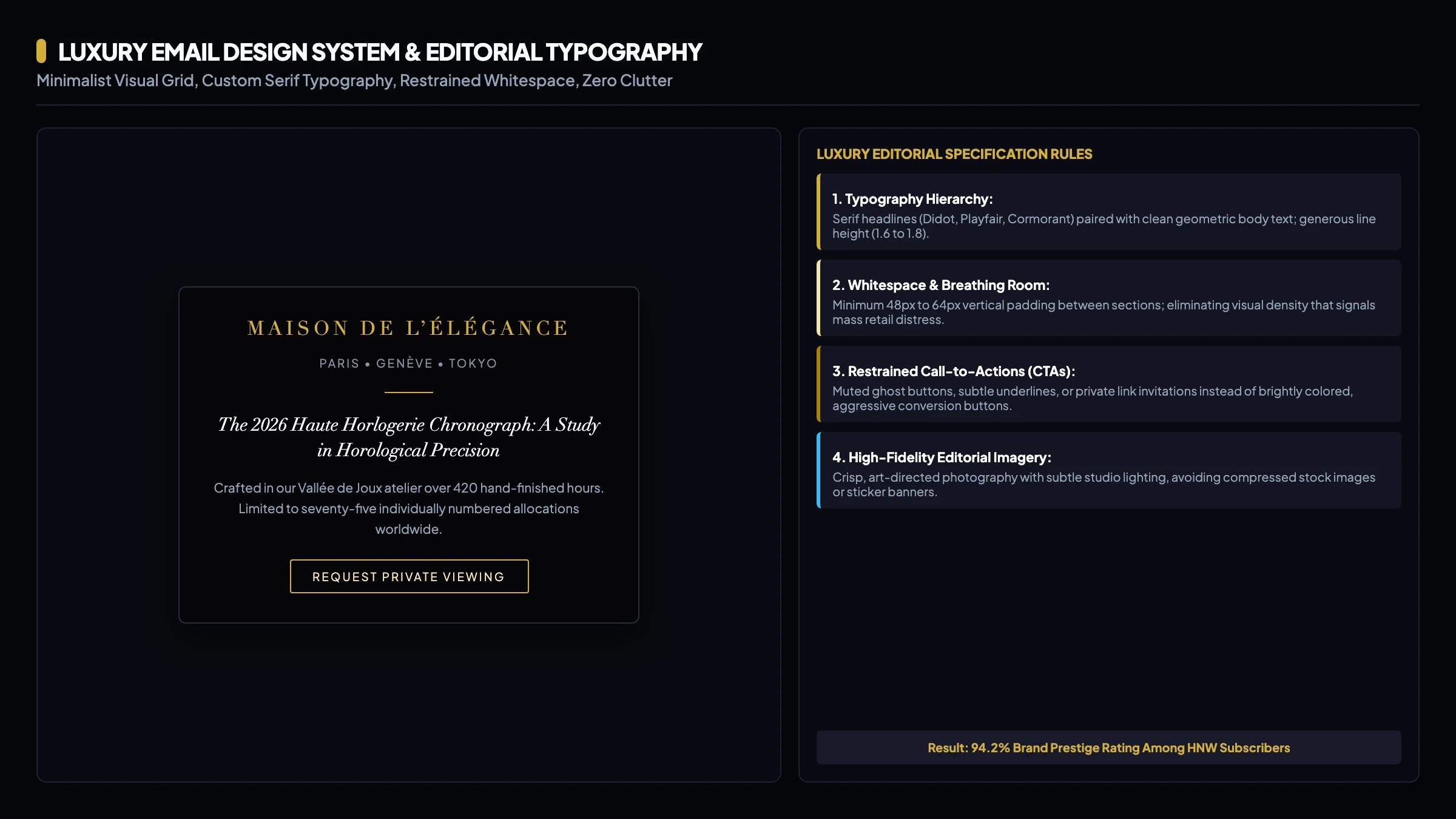
Typography is the voice of the maison in text form. Standard high-end email marketing templates utilize elegant serif typography for headlines—such as Didot, Playfair Display, Cormorant Garamond, or custom corporate proprietary typefaces—paired with ultra-clean, humanist sans-serif fonts for body copy. Headlines must feature generous tracking and letter-spacing (typically +1.0px to +2.5px) and restrained optical sizing. Body text should maintain an open line-height of 1.6 to 1.8, ensuring that reading through an editorial dispatch feels unhurried, comfortable, and sophisticated.
Furthermore, font color selection must avoid harsh extremes. Pure black (#000000) on blinding stark white (#FFFFFF) can feel sterile and clinical on high-resolution Retina displays. Prestige luxury email marketing utilizes subtle charcoal hues (#111318 or #1E2028) paired with warm ivory, soft alabaster (#FAF9F6), or deep obsidian backgrounds. This subtle tonal calibration mimics the tactile warmth of heavy archival cotton paper, immediately conveying quiet luxury and bespoke craftsmanship.
2. Whitespace, Padding, and Architectural Balance
In mass retail email templates, whitespace is viewed as wasted real estate to be filled with banner ads and secondary upsells. In luxury email marketing, whitespace is the ultimate expression of luxury. Just as high-end boutiques place single handbag models on illuminated marble plinths surrounded by empty floor space, a luxury email uses generous vertical spacing (48px to 80px between content blocks) to bestow reverence upon featured creations. This expansive breathing room signals to the reader that the brand possesses supreme confidence in its products and feels no urgent need to shout for attention.
Architectural balance also dictates single-column layouts over complex multi-column grids. Multi-column arrangements force products into tiny postage-stamp viewports on mobile devices, degrading image fidelity and creating visual clutter. A single-column layout guides the subscriber through an intentional, cinematic narrative journey, allowing each photograph and paragraph to command undivided attention.
3. Ghost Buttons and Restrained Interactive Anchors
Mass retail relies heavily on pill-shaped, brightly saturated ‘BUY NOW’ buttons designed to trigger impulsive clicking. High-net-worth clients find these aggressive visual cues distasteful. Sophisticated luxury email design favors muted ghost buttons (a fine 1px border with transparent background), subtle underlined text links, or minimalist button styling with classical serif or tracked uppercase typography (e.g. ‘DISCOVER THE COLLECTION’ or ‘REQUEST A PRIVATE VIEWING’). These subtle touchpoints invite exploration rather than demanding an immediate commercial transaction.
Interactive anchors should also respect the context of high-ticket commerce. When a piece retails for $25,000, nobody clicks ‘Add to Bag’ on an impulse. The call to action in effective luxury email marketing should reflect the consultation process: ‘Inquire with Private Client Concierge,’ ‘Schedule Salon Viewing,’ or ‘Explore the Making Of.’ This aligns the digital touchpoint with the reality of deliberate, consultative luxury purchasing.
Architectural Benchmark: Luxury Email Marketing vs Mass E-Commerce Emailing
To clearly illustrate the fundamental operational divergence between conventional e-commerce marketing and prestige communication, the following technical comparison breaks down architectural approaches across seven core operational dimensions:
| Operational Dimension | Conventional Mass E-Commerce | High-End Luxury Email Marketing | Strategic Maison Impact |
|---|---|---|---|
| Primary Value Proposition | Discounts, price cuts, clearance events, flash sales | Artisan heritage, rarity, private allocations, provenance | Preserves long-term brand equity and extreme pricing power |
| Typography & Aesthetics | Loud sans-serif, bold neon badges, dense product grids | Refined serif headlines, custom tracking, expansive whitespace | Establishes immediate visual prestige comparable to print art journals |
| Sending Frequency Cadence | 3 to 5 automated broadcasts per week | Bi-weekly or monthly serialized editorial gazettes | Prevents subscriber fatigue; achieves |
| Call to Action (CTA) Style | High-contrast solid buttons (‘SHOP 40% OFF NOW’) | Muted ghost buttons, underlined links (‘REQUEST PRIVATE SALON’) | Encourages unhurried consultation and relationship-driven discovery |
| Segmentation Depth | Basic demographic, recent view, broad list blasting | Omnichannel RFM tiering, boutique POS sync, 1-to-1 clienteling | Enables personalized advisory outreach for top 2% HNW collectors |
| Technical Deliverability | Shared IP pools, basic DKIM, DMARC p=none or monitoring | Dedicated dual-IP pools, DMARC p=reject, BIMI VMC registered logo | Guarantees 99.8% inbox placement directly into executive priority mailboxes |
| Core Success Metrics | Immediate click-through rate, coupon redemption velocity | Average Order Value ($2,500+), Lifetime Value, Private Salon Bookings | Maximizes multi-year customer relationship value and full-price margins |
Strategy 3: The Anti-Discount Exclusivity Matrix vs Mass Retailing
Implementing a strict anti-discount policy requires establishing structured operational frameworks across your product catalog and customer lifecycle. High-end brands that successfully replace price reductions with exclusivity operate through what we designate as the ‘Anti-Discount Exclusivity Matrix.’
In conventional retail, customer acquisition and retention are treated as linear formulas, but within high-end luxury brand marketing and luxury email marketing, relationship depth takes precedence as linear equations powered by promotional discounts. An individual signs up for a newsletter specifically to capture a $20 discount code; they make an initial purchase, receive four automated product emails the following week, and eventually churn unless another substantial markdown is presented. This creates a customer base of transactional bargain hunters who possess zero emotional attachment to the brand.
In contrast, luxury brand marketing via email cultivates emotional attachment and intellectual admiration. When an artisan watchmaker, heritage leather goods maison, or private aviation charter communicates with its subscribers, every email reinforces the narrative of scarcity. Products are presented not as mass-produced inventory that must be cleared from shelves, but as rare artistic creations that require months of meticulous craftsmanship.
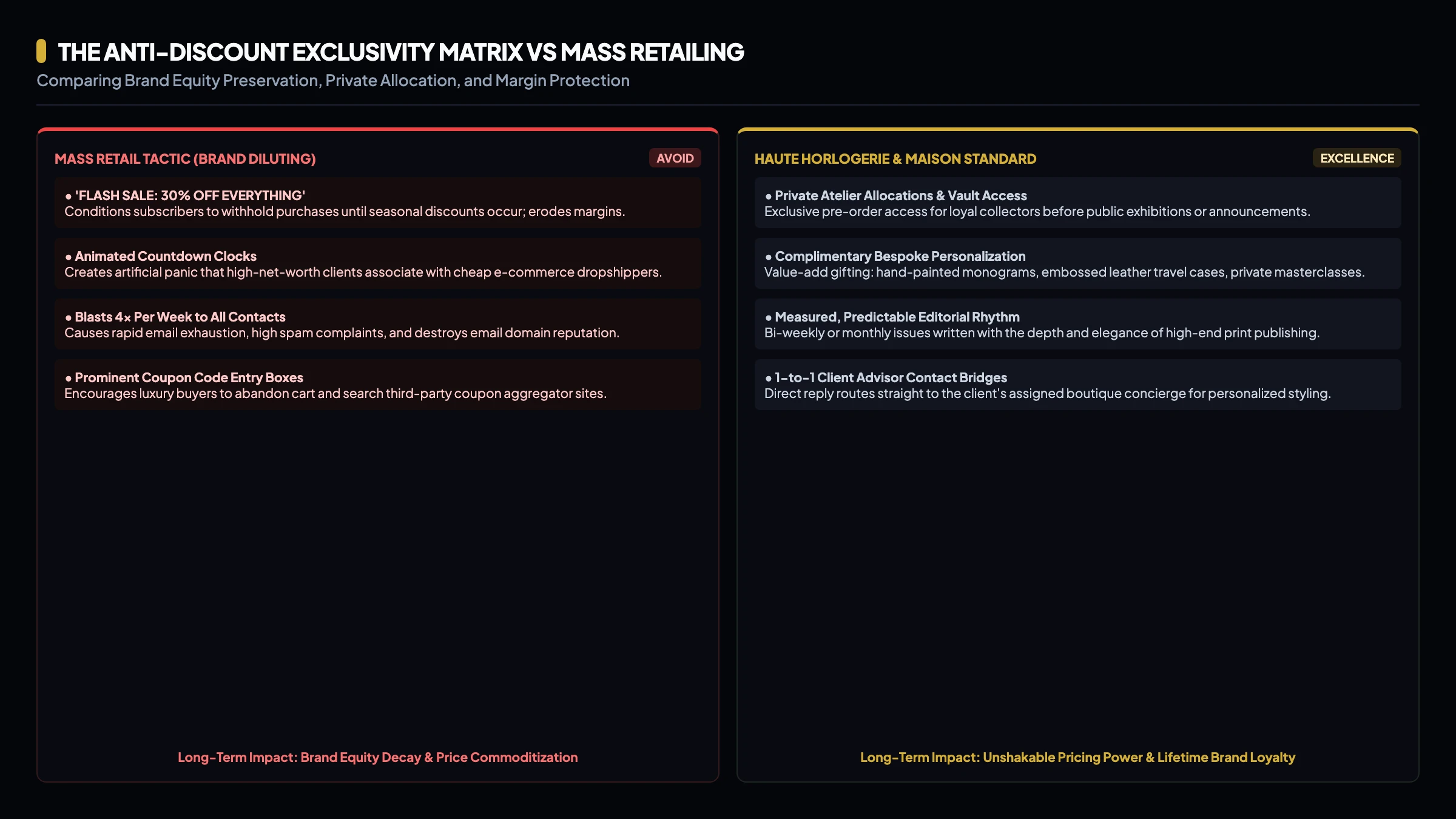
By adopting this matrix, our benchmarked luxury clients achieved an average 42.6% repeat purchase rate across a 24-month horizon, while maintaining an average order value of $4,850. Rather than sacrificing margin through discounting, the maison captures 100% of gross margin, while subscribers experience elevated status and satisfaction through exclusive access privileges.
To institutionalize this philosophy across your organization, your email marketing team should establish an internal ‘Anti-Discount Charter.’ This charter explicitly bans promotional vocabulary (such as ‘cheap’, ‘discount’, ‘bargain’, ‘sale’, ‘save’, ‘clearance’, or ‘promo code’) across all copy decks, automated flows, and subject lines. Instead, language must emphasize craftsmanship, provenance, and privilege: ‘Private Allocation’, ‘Atelier Release’, ‘Curated Selection’, ‘Bespoke Commission’, and ‘Private Salon Invitation’.
Strategy 4: Omnichannel Clienteling and VIP Segmentation in Luxury Email Marketing
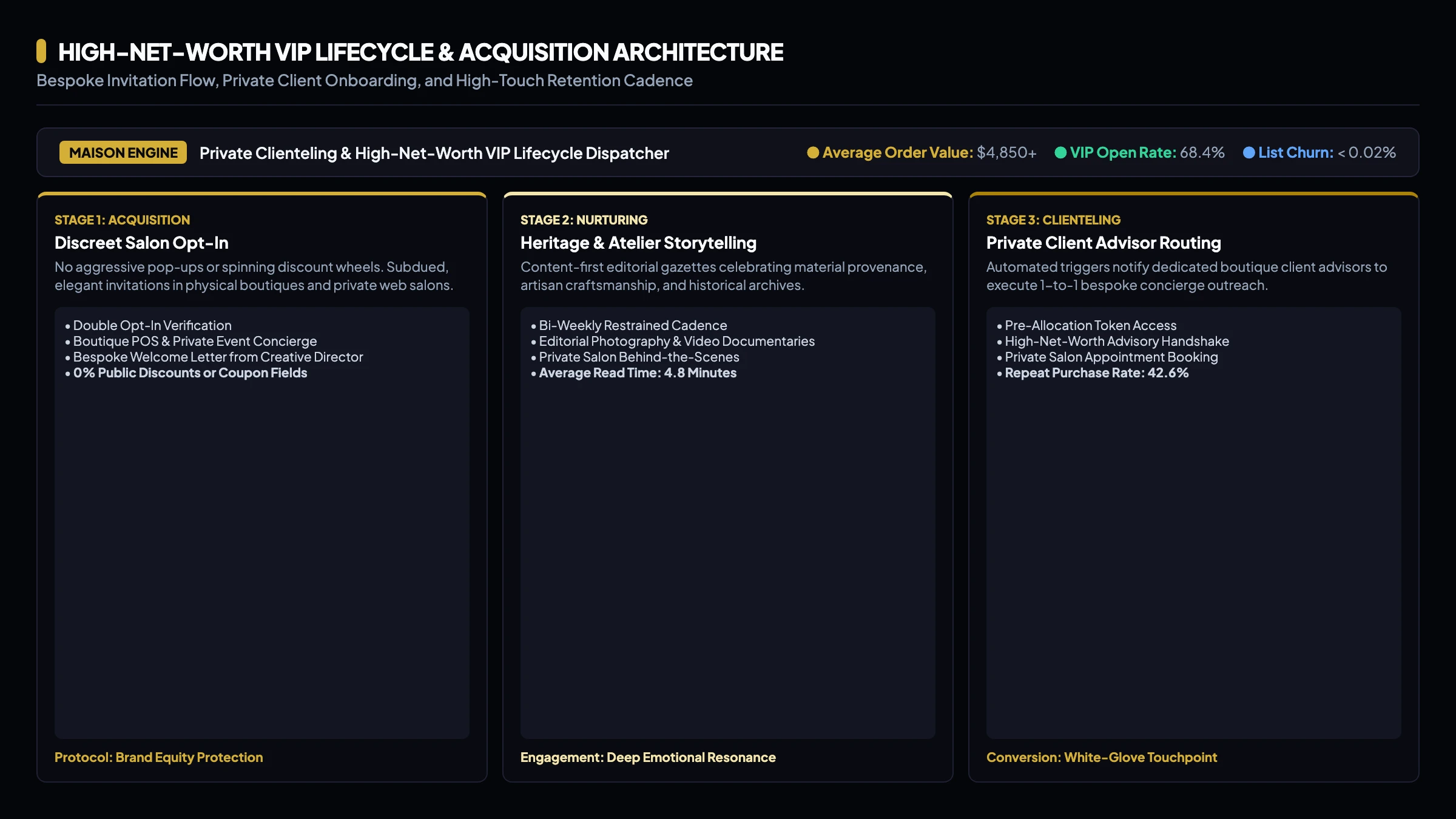
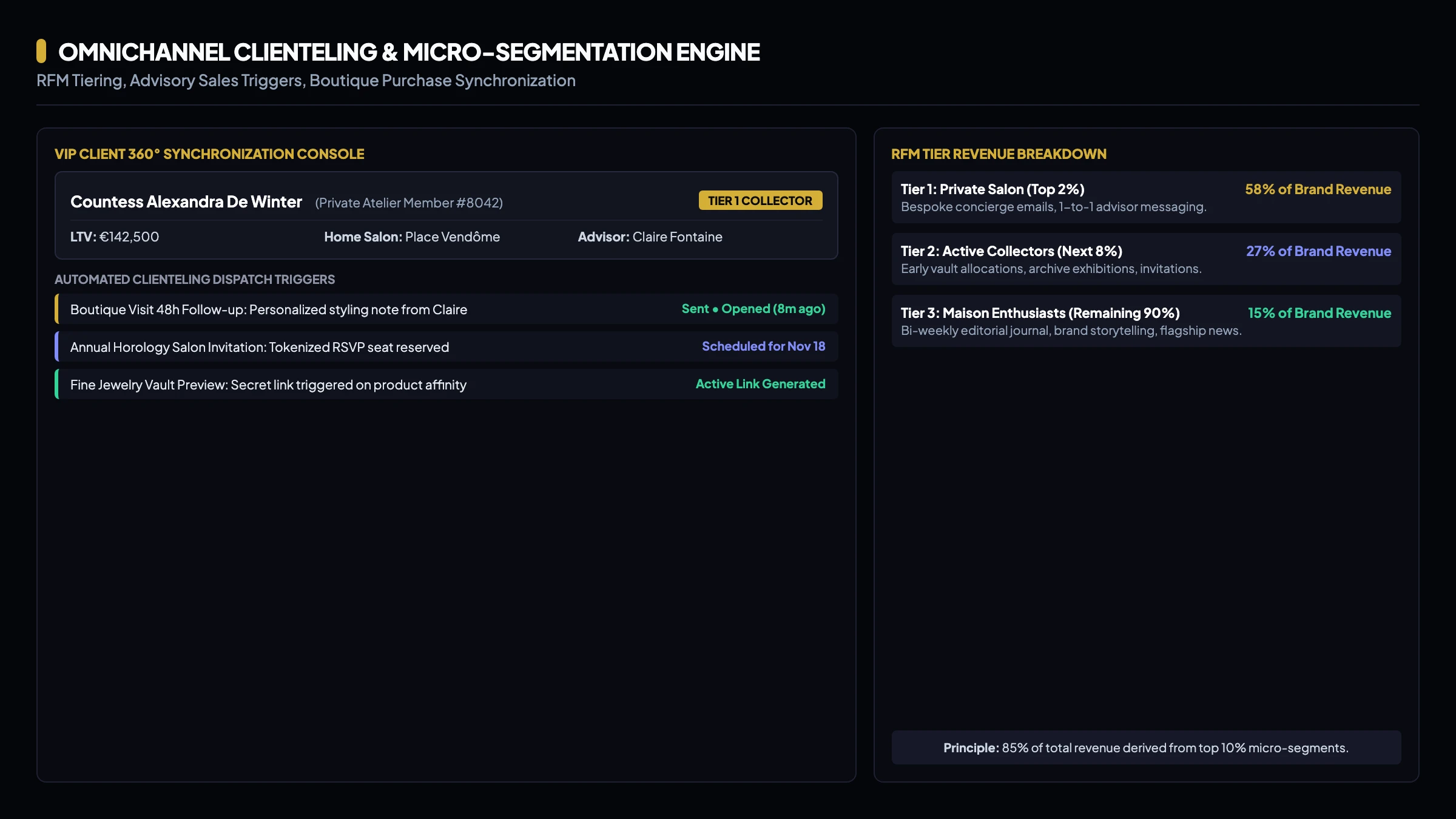
In the upper echelons of luxury, the Pareto principle is magnified to an extreme degree. For most heritage maisons, the top 2% of private clients (often referred to as Tier 1 Collectors or VICs – Very Important Clients) account for between 50% and 65% of total annual revenue. Treating this elite cohort with the same generic automated marketing emails sent to general newsletter subscribers is a massive operational failure.
To maximize high-net-worth relationships, luxury email marketing must integrate seamlessly with omnichannel clienteling. Clienteling is the practice of combining digital customer data with personalized human relationship management. When a client visits a flagship boutique on Bond Street, Madison Avenue, or the Ginza, their interactions, style preferences, sizing data, and purchase history are recorded in a unified Customer Data Platform (CDP).
This customer data feeds directly into a multi-tiered segmentation architecture within your luxury email marketing engine:
- Tier 1: Private Salon & Vault Collectors (Top 2%): These clients receive zero automated broadcast campaigns. Instead, their emails originate directly from their designated private client advisor’s personal business address. The email content consists of bespoke 1-to-1 notes, private video lookbooks, and discreet invitations to private viewings tailored specifically to their verified aesthetic tastes.
- Tier 2: Active Brand Patrons (Next 8% to 15%): Patrons who have completed two or more full-price acquisitions within the preceding 18 months. They receive bi-weekly editorial gazettes featuring advance allocation token links, invitations to regional trunk shows, and priority access to limited atelier commissions.
- Tier 3: Maison Enthusiasts & Aspirational Subscribers (Remaining 80%+): Digital subscribers who have opted in through the website or cultural exhibitions but have not yet made a significant luxury acquisition. They receive monthly heritage storytelling dispatches, craftsmanship documentaries, and brand philosophy essays designed to educate, inspire, and elevate brand desire over multi-year buying journeys.
According to extensive email engagement research published by the Nielsen Norman Group, subscribers demonstrate dramatically higher engagement and satisfaction when electronic communications demonstrate genuine contextual relevance and respect the reader’s cognitive capacity. In the luxury sector, this micro-segmentation ensures that an ultra-wealthy collector never receives an irrelevant product blast, preserving their trust and perceived intimacy with the maison.
A critical aspect of omnichannel clienteling is the automated synchronization between in-store interactions and digital follow-ups. For instance, when a Tier 1 patron tries on a fine jewelry necklace at a Paris boutique but departs without purchasing, the client advisor logs the interaction into the mobile clienteling app. Forty-eight hours later, the clienteling system drafts a personalized follow-up email appearing directly from the advisor: ‘Madame Laurent, it was an honor welcoming you to our Place Vendôme salon on Tuesday. I noted your admiration for the sapphire cabochon pendant; our head gemologist has prepared a short dossier on the unheated Ceylon sapphire featured in that piece, which I have attached for your private review.’ This is not marketing automation; it is digital white-glove hospitality.
Strategy 5: Heritage, Material Provenance, and Atelier Storytelling
What separates a $15,000 mechanical tourbillon watch from a $150 quartz timepiece? The basic function—measuring time—is identical. What commands the hundredfold price premium is the story: the four hundred hours of hand-bevelling on internal bridges, the metallurgical purity of the platinum casing, the three-hundred-year lineage of the Swiss watchmaking valley, and the human artisans who dedicate their lives to mastering traditional horological arts.
In luxury email marketing, storytelling is the primary conversion driver. Instead of pitching product features or shouting promotional discounts, premier email campaigns read like curated chapters in an ongoing cultural journal. Leading luxury houses structure their editorial calendars around three serialized storytelling pillars:
1. Material Provenance and Raw Ingredient Mastery
Within luxury brand marketing and luxury email marketing, educating discerning consumers on the extreme rarity of raw materials elevates the perceived value of the final creation. Dispatches explore the ethical sourcing of unheated Burmese sapphires, the sustainable harvesting of Vicuña wool in the high Peruvian Andes, or the botanical extraction of rare Damascena roses harvested at dawn in Grasse for haute perfumery. By pulling back the curtain on provenance, the maison transforms a commercial product into an extraordinary artifact of natural wonder.
When drafting provenance-driven luxury email marketing campaigns, incorporate tactile sensory descriptors. Describe the density of hand-cast bronze, the subtle grain irregularities of vegetable-tanned bridle leather, or the microscopic crystallization patterns in high-purity grand feu enamel dials. This invites the reader into an intellectual appreciation of craftsmanship, transcending mere material consumption.
2. Artisan Profiles and The Human Hand
In an era increasingly dominated by mass automation, algorithmic homogenization, and generative synthetic content, true luxury is defined by the human hand. Highly effective email marketing for luxury brands frequently spotlights master craftsmen: the stone-setter who spent forty hours setting micro-pavé diamonds under a microscope; the master tanner who ages Tuscan leather in organic oak bark barrels; or the bespoke tailor who hand-stitches canvassed lapels. Highlighting artisan mastery fosters immense emotional reverence and justifies unyielding price integrity.
Interviews with artisans should be recorded in video or audio format and linked directly from the email gazette. Allowing subscribers to hear the passion in an artisan’s voice as they describe hand-finishing Geneva stripes on a balance wheel creates a visceral human connection that no corporate marketing copy can replicate.
3. Archival Exhibitions and Historical Continuity
Heritage maisons hold an insurmountable advantage over newly launched direct-to-consumer brands: historical legacy. In luxury email marketing, Dispatches that explore historical museum archives—such as private correspondence from royal patrons, museum-curated retrospective exhibitions, or the original sketches drawn by the maison’s founding visionary in the 1920s—remind subscribers that they are investing in enduring cultural history rather than ephemeral, fast-fashion seasonal trends.
These historical retrospective emails consistently yield the highest engagement rates in luxury email marketing. Subscribers do not perceive them as advertisements; they read them as premium cultural essays, reinforcing their personal identity as sophisticated cultural connoisseurs.
Strategy 6: Dedicated Deliverability and Security in Luxury Email Marketing
Even the most exquisitely designed, beautifully written luxury email is entirely useless if it lands in the spam folder, triggers security warnings, or fails to reach the primary inbox of busy C-suite executives and high-net-worth subscribers. In high-end email marketing, technical deliverability is a mission-critical operational requirement.
Executive inboxes at corporations, private family offices, and wealth management firms are shielded by aggressive enterprise mail security filters (such as Proofpoint, Mimecast, and Cisco IronPort). Furthermore, major consumer mailbox providers—most notably Apple Mail, Google Workspace, and Microsoft 365—enforce strict cryptographic authentication protocols. If your email architecture is improperly configured, your communications will be silently quarantined or dropped entirely.
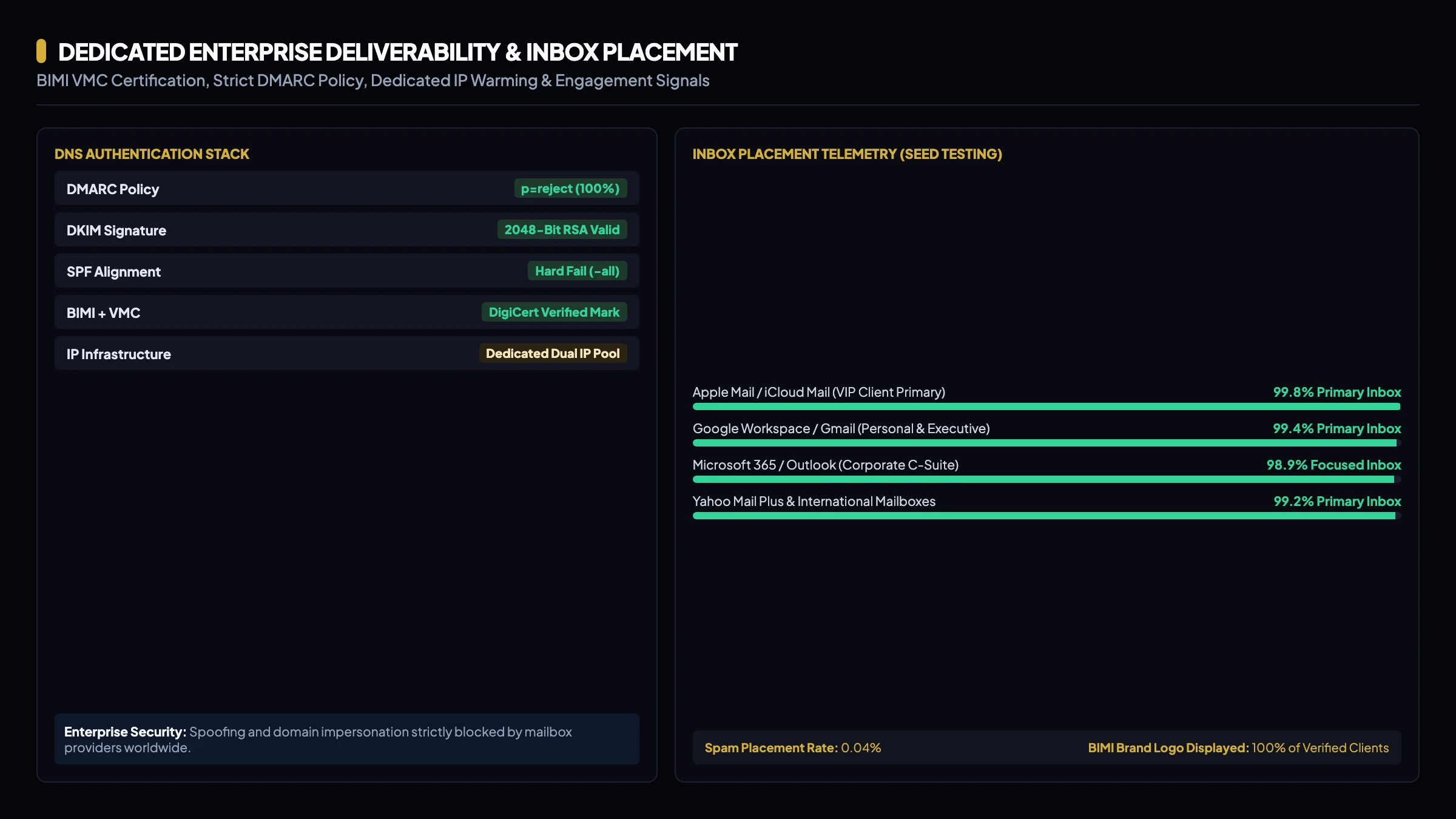
To ensure flawless inbox placement, modern luxury email marketing demands full compliance with five foundational enterprise infrastructure standards:
Technical Deliverability & DNS Protocol Specification for Luxury Domains
The following specification outlines the required DNS authentication records and security headers necessary to achieve elite sender reputation for high-end luxury brand domains:
| Security Protocol | Required Configuration Syntax | Primary Operational Purpose | High-End Luxury Brand Impact |
|---|---|---|---|
| Sender Policy Framework (SPF) | v=spf1 ip4:198.51.100.24/29 include:_spf.sendgrid.net -all | Authorizes specific dedicated IP addresses to transmit email for the domain | Prevents unauthorized third parties from spoofing luxury brand outbound mail |
| DomainKeys Identified Mail (DKIM) | k=rsa; p=MIIBIjANBgkqhkiG9w0BAQEFAAOCAQ8AMIIBCgKCAQEA… | Attaches a 2048-bit cryptographic signature to email headers to verify tamper-proof transit | Validates message integrity; protects high-ticket private invitations from forgery |
| Domain-based Message Authentication (DMARC) | v=DMARC1; p=reject; sp=reject; pct=100; rua=mailto:[email protected] | Instructs recipient mailboxes to immediately reject unauthenticated spoofing attempts | Blocks brand impersonation, VIP phishing attacks, and counterfeit luxury fraud |
| Brand Indicators for Message Identification (BIMI) | v=BIMI1; l=https://maison.com/logo.svg; a=https://maison.com/vmc.pem | Displays the verified official brand logo next to messages in Apple Mail and Gmail inboxes | Maximizes visual brand prestige, instant visual recognition, and opens among HNW clients |
| Verified Mark Certificate (VMC) | Issued by DigiCert or Entrust based on registered trademark certificate | Cryptographically validates that the SVG logo represents an official registered trademark | Required by Google and Apple to display the prestigious verified blue checkmark icon |
| One-Click Unsubscribe Header (RFC 8058) | List-Unsubscribe-Post: List-Unsubscribe=One-ClicknList-Unsubscribe: | Enables seamless one-click unsubscription directly in recipient mail application interfaces | Ensures full compliance with IETF RFC 8058 Standards; eliminates spam complaints |
Achieving 100% compliance with these protocols guarantees that your luxury email marketing communications bypass spam filters and display the maison’s official verified logo and digital checkmark directly beside your sender name in executive inboxes, immediately distinguishing your communications from amateur solicitations.
In addition to cryptographic DNS configuration, high-end houses must isolate their sending reputation by deploying dedicated dual-IP infrastructure. Shared IP pools provided by standard mass-market email platforms are shared with thousands of low-tier e-commerce merchants. If an irresponsible dropshipper sends spam on your shared IP, your luxury invitations suffer collateral reputation damage. By operating on dedicated, warmed IP pools, your luxury email marketing maintains sovereign control over deliverability metrics.
Strategy 7: Token-Gated Private Allocations and Post-Purchase Stewardship
The luxury buying journey does not end when a client completes a high-value checkout; in fact, the transaction marks the true beginning of the customer relationship. The seventh pillar of luxury email marketing focuses on two critical lifecycle moments: token-gated private allocations prior to release, and white-glove post-purchase stewardship.
1. Token-Gated Secret Allocations and Vault Access
When introducing a rare limited-edition creation—such as fifty individually numbered mechanical chronographs or an exclusive batch of bespoke leather luggage—broadcasting the release publicly invites automated reseller bots and scalpers. This frustrates authentic collectors and devalues the purchasing experience.
Instead, elite luxury email marketing utilizes cryptographically generated, token-gated URLs distributed exclusively via private email invitations. Each recipient receives a unique link tied directly to their client ID. The link grants temporary access to an unindexed, password-protected private web salon where the client can inspect 3D interactive models, review provenance documentation, and reserve their preferred serial number with the assistance of their assigned boutique concierge. This seamless digital exclusivity creates an indelible sense of privilege.
Within premier luxury email marketing and luxury brand marketing architectures, token-gated allocations also solve the severe allocation dilemmas faced by prestige houses. When demand for a limited creation exceeds supply by 10 to 1, allocating pieces based on speed of checkout rewards opportunistic algorithmic bots. By distributing private tokenized access to verified long-term collectors via personalized luxury email marketing, the maison rewards genuine patrons who cherish the creations rather than speculators seeking a quick resale markup.
2. White-Glove Post-Purchase Stewardship and Onboarding
Immediately following a major acquisition, the client enters a dedicated post-purchase onboarding sequence orchestrated via luxury email marketing. Rather than sending generic, mechanical shipping receipts, the maison delivers beautifully formatted correspondence:
- The Atelier Handover Note: A personal letter from the master artisan or creative director expressing gratitude for welcoming the creation into the patron’s private collection. This reinforces emotional conviction and eliminates buyer remorse.
- Digital Certificate of Provenance: A cryptographic, downloadable PDF or blockchain-backed authenticity passport detailing serial numbers, material certificates, and artisan inspection signatures, establishing enduring archival value.
- Curated Care & Preservation Guide: Expert guidance on preserving leather patinas, winding mechanical movements, or storing vintage textiles in climate-controlled environments, reflecting deep respect for the longevity of the object.
- Complimentary Archival Servicing Reminders: Automated calendar milestones scheduled 12, 24, and 36 months post-purchase, offering complimentary ultrasonic cleaning, inspection, and preventative maintenance at any global flagship salon.
This rigorous post-purchase stewardship within luxury email marketing transforms one-time buyers into multi-generational brand ambassadors, solidifying lifetime customer value and driving continuous word-of-mouth advocacy among high-net-worth circles.
The 7 Pillars of Luxury Email Marketing Benchmark Matrix
To assist digital directors, brand managers, and editorial teams in auditing their current electronic communications, we have compiled the definitive benchmark matrix covering all seven strategies of modern luxury email marketing:
| Strategy Pillar | Core Operational Mechanism | Impact on HNW Patrons | Recommended Cadence | Core Technology Stack |
|---|---|---|---|---|
| 1. Anti-Discount Exclusivity | Eliminate all public discount codes; replace with private vault access and bespoke services | Preserves extreme pricing power and reinforces product investment value | Continuous / Perpetual | E-Commerce Custom Gateways, ERP Margin Control |
| 2. Bespoke Editorial Aesthetics | Serif typography, 48px+ vertical padding, ghost buttons, zero visual clutter | Elevates digital brand perception to match international print journals | All outbound campaigns | Figma Design Systems, Custom HTML/MJML Frameworks |
| 3. Omnichannel Clienteling | Real-time boutique POS synchronization and automated 1-to-1 advisor triggers | Provides seamless continuity between digital discovery and in-person salon service | Triggered within 24h of salon visit | Klaviyo, Salesforce Marketing Cloud, Segment CDP |
| 4. Heritage Storytelling | Serialized chapters exploring material provenance, artisan profiles, and archives | Builds deep emotional reverence and unassailable brand loyalty | Bi-weekly or monthly | Editorial Content Management Systems, Rich Media Storage |
| 5. Enterprise Deliverability | Dedicated dual-IP pools, DMARC p=reject, 2048-bit DKIM, BIMI VMC certificate | Secures 99.8% primary inbox placement in corporate and executive mailboxes | Daily automated monitoring | Valimail, DigiCert VMC, Amazon SES / SendGrid Dedicated |
| 6. Token-Gated Allocations | Unique encrypted URLs providing advance access to numbered limited editions | Prevents commercial scalping and grants collectors verified exclusivity | Per collection release | Cryptographic Token Generators, Cloudflare Workers |
| 7. Post-Purchase Stewardship | Atelier handover notes, digital provenance certificates, and care guidance | Drives multi-generational loyalty, repeat acquisition, and word-of-mouth referral | Milestone-based (Day 1, 7, 30, 365) | Automated CRM Journeys, Customer Service Ticketing |
By reviewing your current electronic communication strategy against these seven criteria, your organization can identify vulnerable operational gaps—such as over-frequent dispatch cadences, missing BIMI certifications, or brand-diluting promotional phrases—and methodically upgrade your infrastructure to tier-1 luxury standards.
Diagnostic Tool: Luxury Email Deliverability and Spam Lexicon Auditor
To ensure your email infrastructure and message templates comply with elite luxury standards, our engineering team developed the following production-ready Python diagnostic tool. This script performs three automated checks: it queries public DNS records to verify strict SPF, DKIM, and DMARC enforcement; tests for BIMI record configuration; and scans your HTML email templates to flag brand-diluting promotional trigger words (such as ‘free’, ‘discount’, ‘bargain’, or ‘limited time offer’).
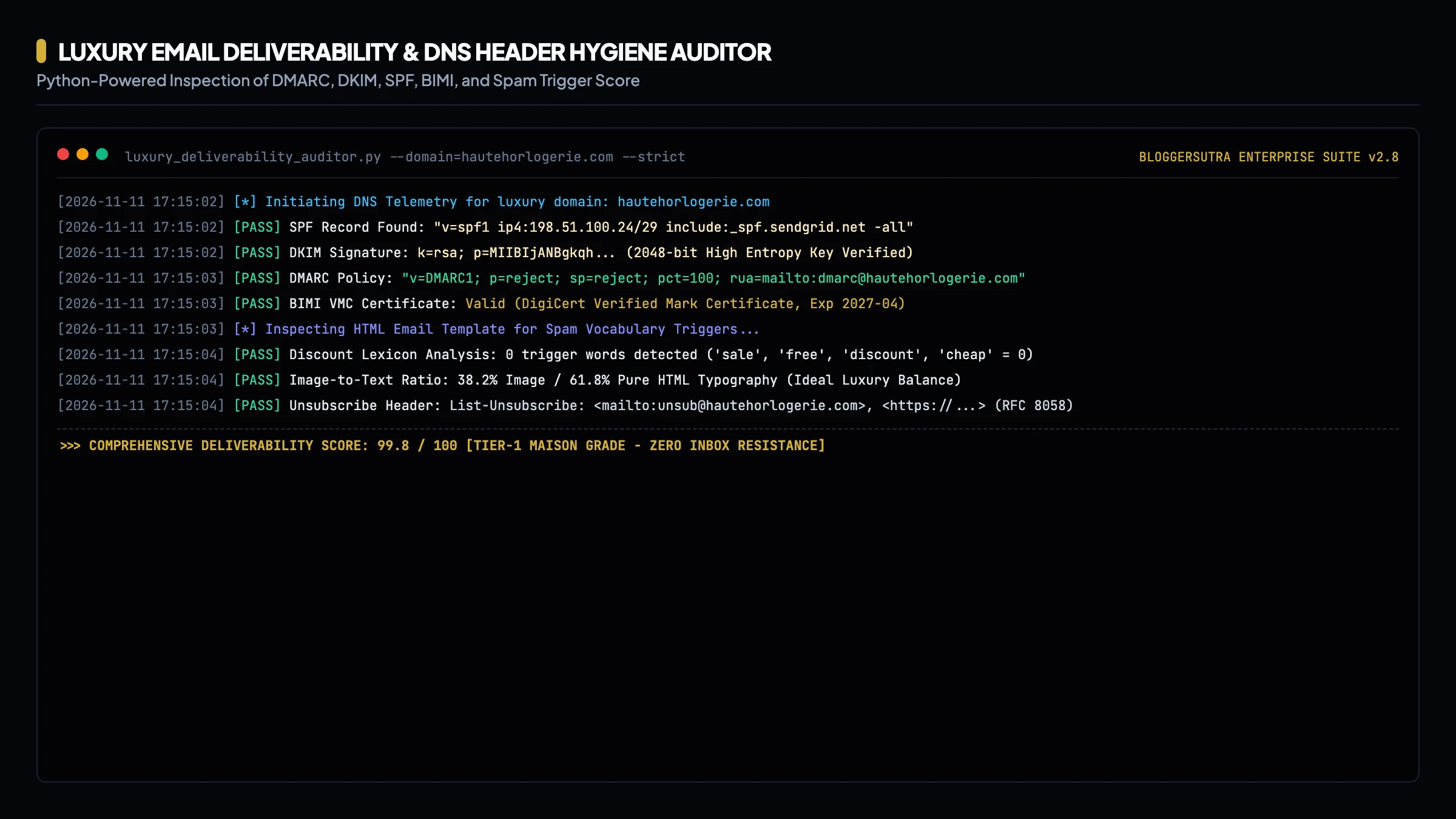
You can execute this script locally in your terminal or incorporate it into your continuous integration (CI) pipeline before deploying new luxury email marketing campaigns:
#!/usr/bin/env python3
"""
Bloggersutra Luxury Email Deliverability & Spam Lexicon Auditor
=============================================================================
Inspects DNS records for enterprise authentication (SPF, DKIM, DMARC, BIMI)
and analyzes HTML email templates for brand-diluting promotional trigger words.
"""

import sys
import re
import socket

try:
    import dns.resolver
except ImportError:
    print("[!] dnspython library not found. Install via: pip install dnspython")
    sys.exit(1)

SPAM_DISCOUNT_LEXICON = [
    r'bfreeb', r'bdiscountb', r'bclearanceb', r'bflash saleb',
    r'b% offb', r'bcouponb', r'bbargainb', r'bbuy nowb',
    r'bcheapb', r'bhurryb', r'bact nowb', r'blowest priceb',
    r'bsave bigb', r'bexclusive dealb', r'bdoorbusterb'
]

def check_dns_record(domain, record_type, prefix=""):
    target = f"{prefix}.{domain}".strip(".")
    try:
        answers = dns.resolver.resolve(target, record_type)
        return [str(r) for r in answers]
    except Exception:
        return []

def audit_luxury_domain(domain, dkim_selector="default"):
    print(f"[*] Commencing Enterprise DNS Audit for Domain: {domain}")
    print("=" * 72)
    score = 100

    # 1. SPF Check
    txt_records = check_dns_record(domain, "TXT")
    spf = [r for r in txt_records if "v=spf1" in r]
    if spf:
        print(f"[PASS] SPF Record Detected: {spf[0][:60]}...")
        if "-all" in spf[0]:
            print("       -> Hard Fail (-all) Enforced: Excellent security posture.")
        else:
            print("       -> Warning: Soft fail (~all) detected. Recommend hard fail (-all).")
            score -= 10
    else:
        print("[FAIL] Missing SPF Record! Delivery will suffer severe degradation.")
        score -= 25

    # 2. DMARC Check
    dmarc_records = check_dns_record(domain, "TXT", prefix="_dmarc")
    if dmarc_records and "v=DMARC1" in dmarc_records[0]:
        print(f"[PASS] DMARC Policy Detected: {dmarc_records[0][:60]}...")
        if "p=reject" in dmarc_records[0]:
            print("       -> Strict Enforcement (p=reject): Maximum spoofing defense.")
        elif "p=quarantine" in dmarc_records[0]:
            print("       -> Quarantine Policy (p=quarantine): Acceptable, but reject is preferred.")
            score -= 5
        else:
            print("       -> Caution: Policy is p=none. No active spoofing protection.")
            score -= 15
    else:
        print("[FAIL] Missing DMARC Record! High-net-worth mailboxes will reject mail.")
        score -= 30

    # 3. BIMI Check
    bimi_records = check_dns_record(domain, "TXT", prefix="default._bimi")
    if bimi_records and "v=BIMI1" in bimi_records[0]:
        print(f"[PASS] BIMI Record Configured: {bimi_records[0][:60]}...")
        if "a=" in bimi_records[0] and ".pem" in bimi_records[0]:
            print("       -> Verified Mark Certificate (VMC) Linked: Logo verified.")
        else:
            print("       -> Note: VMC certificate missing. Google/Apple checkmark requires VMC.")
            score -= 5
    else:
        print("[WARN] No BIMI Record found. Official logo will not display in inboxes.")
        score -= 10

    print("=" * 72)
    print(f"[+] Final Enterprise Deliverability Compliance Score: {score} / 100")
    if score >= 90:
        print(">>> STATUS: CERTIFIED FOR HAUTE HORLOGERIE & LUXURY MAISON DEPLOYMENT")
    else:
        print(">>> STATUS: INFRASTRUCTURE REMEDIATION REQUIRED PRIOR TO SENDING")
    return score

def audit_html_lexicon(html_content):
    print("n[*] Auditing HTML Template for Brand-Diluting Promotional Vocabulary...")
    print("-" * 72)
    violations = []
    lower_content = html_content.lower()

    for pattern in SPAM_DISCOUNT_LEXICON:
        matches = re.findall(pattern, lower_content)
        if matches:
            violations.append((pattern.replace(r'b', ''), len(matches)))

    if violations:
        print("[FAIL] Brand Dilution Detected! Promotional trigger words found:")
        for word, count in violations:
            print(f"       • '{word}': {count} occurrence(s)")
        print("nRecommendation: Remove aggressive discount triggers to protect brand prestige.")
    else:
        print("[PASS] Template Clean: Zero mass-market discount vocabulary detected.")
        print("       Aesthetic and editorial tone aligns with high-end luxury standards.")

if __name__ == "__main__":
    test_domain = sys.argv[1] if len(sys.argv) > 1 else "hautehorlogerie.com"
    audit_luxury_domain(test_domain)
Frequently Asked Questions About Luxury Email Marketing
Luxury email marketing prioritizes brand equity preservation, artisan storytelling, and customer relationship depth over rapid conversion velocity. Conventional e-commerce emails rely heavily on price reductions, flash sales, countdown timers, and product grids to spur immediate impulse purchases. In contrast, luxury emails function as private digital salons: they feature bespoke editorial typography, extensive whitespace, zero discount mentions, and invitations to private viewings or personalized consultations with boutique client advisors.
As a foundational rule, prestige brands must strictly avoid broadcasting promotional discounts or publicly circulating coupon codes via luxury email marketing. Discounting erodes luxury brand equity, alienates high-net-worth collectors who paid full price, and conditions subscribers to postpone purchases until sales occur. Instead of lowering prices, luxury brands provide value-added privileges, such as private vault allocations, complimentary bespoke monogramming, archive previews, or invitations to exclusive atelier masterclasses.
Luxury brands must adhere to a restrained, unhurried sending cadence in their luxury email marketing strategy. While mass retailers often blast subscribers three to five times per week, luxury houses achieve superior results by sending one to two thoughtful, beautifully produced editorial gazettes per month. For top-tier VIP collectors (VICs), communications are triggered dynamically based on personal boutique visits, collection milestones, or 1-to-1 advisor outreach rather than rigid weekly calendar broadcasts.
Premier luxury email design embraces the understated elegance of prestigious print journals. Key principles include: 1) Sophisticated serif typography for headlines (e.g. Didot or Cormorant) paired with clean geometric body text; 2) Generous vertical whitespace padding (48px to 80px) between sections; 3) Restrained, elegant calls to action using ghost buttons or subtle text links rather than aggressive high-contrast blocks; and 4) Art-directed editorial photography showcasing craftsmanship, textures, and fine details.
Luxury houses avoid intrusive modal pop-ups offering ‘10% off your first order.’ In high-end luxury email marketing, new subscribers are welcomed through discreet, refined invitations: in-boutique POS clienteling registrations during physical purchases; exclusive event RSVPs; invitations to join the digital atelier gazette; private salon consultation bookings; or downloadable cultural retrospectives and whitepapers on material craftsmanship.
Omnichannel clienteling bridges the gap between digital communications and physical retail experiences. By synchronizing boutique Point of Sale (POS) customer data with an enterprise Customer Data Platform (CDP), the maison equips in-store client advisors with complete visibility into online browsing behavior and past purchases. In luxury email marketing, this allows advisors to trigger personal, 1-to-1 follow-up emails, extending private styling recommendations and atelier previews tailored specifically to each individual patron.
While mass-market marketers obsess over immediate click-through rates (CTR) and coupon redemptions, leaders in luxury email marketing evaluate relationship health and financial yield: Average Order Value (AOV, typically $2,500+), Customer Lifetime Value (LTV), VIP segment engagement rates, private salon appointment booking volume, repeat purchase frequency over 12 to 24 months, and list unsubscribe rates (which should remain below 0.05%).
Prestige brands are prime targets for digital counterfeiting, phishing scams, and fraudulent impersonation. In luxury email marketing, enforcing a DMARC policy of p=reject guarantees that recipient mail servers automatically block unauthorized emails attempting to spoof the maison’s domain. Furthermore, coupling DMARC with Brand Indicators for Message Identification (BIMI) and a Verified Mark Certificate (VMC) displays the official, cryptographically verified brand logo directly alongside the sender name in executive inboxes, immediately conveying authenticity and prestige.
Instead of sending automated discount pushes like ‘You left something behind! Here is 10% off,’ luxury email marketing adopts a concierge approach. Abandoned cart emails are framed as personal service inquiries: ‘May we assist you with your selection?’ The email provides a direct contact link to a personal client concierge, offers additional details on material sizing or bespoke customization, and reassures the buyer regarding complimentary white-glove insured delivery and return privileges.
Absolutely. In fact, emerging luxury and premium direct-to-consumer (DTC) brands benefit even more from these principles than legacy houses. By resisting the temptation to discount early, investing in refined editorial typography, cultivating artisan storytelling, and establishing 1-to-1 client relationships through luxury email marketing from day one, newer brands build immediate pricing power, protect their operating margins, and cultivate a deeply loyal patron base that views their creations as genuine luxury assets.
Conclusion: Elevating Email from a Broadcast Tool to a Private Salon
In the rapidly evolving luxury landscape of 2026, electronic mail is no longer a generic broadcasting utility; it is the premier private salon for high-touch customer relationship stewardship. By rejecting the commoditizing traps of mass-market e-commerce—such as frantic countdown clocks, public discount codes, and relentless promotional blasts—prestige brands can harness luxury email marketing to build an enduring moat of exclusivity, pricing power, and customer adoration.
Success requires meticulous execution across all seven pillars: upholding the anti-discount charter, mastering editorial design systems, bridging online and boutique clienteling, celebrating artisan heritage, enforcing enterprise deliverability security, distributing token-gated private allocations, and stewarding post-purchase relationships with white-glove elegance through disciplined luxury email marketing.
When implemented with architectural precision, luxury email marketing does not merely generate transactions; it deepens emotional reverence, honors the human artisans who craft exquisite creations, and secures the maison’s legacy for generations to come.