





Quick answer
- How do you launch a blog successfully in 2026? To master how to launch a blog with high day-one velocity and long-term search authority, execute a rigorous 6-phase operational framework: (1) finalize a high-performance technical stack (following our masterclass on how to choose web hosting) with NVMe hosting, PHP 8.2+, TLS 1.3 SSL, and Core Web Vitals under 1.2s LCP, (2) publish a foundational ‘Cornerstone Silo’ of 5 to 8 deeply researched pillar articles (minimum 2,500 words each) before opening public access, (3) seed a pre-launch VIP waitlist of 300 to 500 email subscribers using a minimalist coming-soon landing page and high-value lead magnet, (4) execute an exhaustive technical pre-flight audit validating XML sitemaps, robots.txt, schema markup, and Google Search Console integration, (5) execute a 48-hour multi-channel launch blitz combining VIP email broadcasts, value-first community seeding on LinkedIn, X, and Reddit, and direct outreach to cited experts, and (6) maintain post-launch compounding momentum with a consistent 2-to-3 post weekly cadence, systematic internal linking, and query harvesting..tp-post-content code, .tp-post-content pre, .toc-link{word-break:break-word!important;overflow-wrap:break-word!important;}
- How many articles should you publish before launching a blog? Never launch a blog with zero or only one article. To establish baseline topical authority and signal semantic depth to search engine crawlers, you must have 5 to 8 interlinked pillar articles live on launch day. This structure keeps visitors on your domain, reduces bounce rates, and gives Googlebot an interconnected topical cluster to index immediately.
- How do you get traffic to a brand new blog on day one? Relying solely on organic search for day-one traffic will fail, as Google’s indexation and algorithmic evaluation take days to weeks. The secret to day-one traffic when learning how to launch a blog is pre-launch audience seeding: build a 300-500 subscriber VIP email list prior to launch, engage in niche community discussions, and notify experts and tools cited in your launch articles for instant amplification.
- What is the biggest mistake founders make when launching a blog? The most fatal error is executing a ‘silent launch’—publishing articles in isolation and waiting passively for search engines to discover them (‘the build it and they will come fallacy’). Without an audience gravity well, technical pre-flight verification, or social distribution, new blogs suffer prolonged traffic flatlines that demoralize creators.
- How long should the pre-launch phase last? The optimal pre-launch window is 30 to 45 days. This timeframe allows sufficient room to configure hosting, draft the cornerstone content silo, establish legal pages, seed the initial email waitlist, and conduct thorough QA without losing creative momentum or burning out before launch.
In the hyper-competitive digital media landscape of 2026, understanding how to launch a blog is the decisive difference between establishing a high-traffic, authoritative publishing brand and abandoning an empty WordPress installation after six months of silence. Thousands of aspiring creators learn how to choose a domain name and register web addresses every single day, yet fewer than 8% ever surpass 1,000 monthly unique visitors. The primary cause of this staggering mortality rate is not poor writing or bad luck; it is the catastrophic failure to execute a disciplined, phased launch strategy.
For over a decade, amateur blogging tutorials repeated the same outdated, naive advice: ‘just install WordPress, write a hello world post, publish your thoughts, and traffic will magically appear.’ In modern search environments governed by Google’s Helpful Content System, Core Algorithm Updates, and NavBoost interaction telemetry, that passive approach is digital suicide. Search crawlers expect immediate structural topical authority, lightning-fast Core Web Vitals, verified author E-E-A-T credentials, and genuine human interaction signals. Mastering how to launch a blog in 2026 requires operating like a venture-backed digital media publisher.
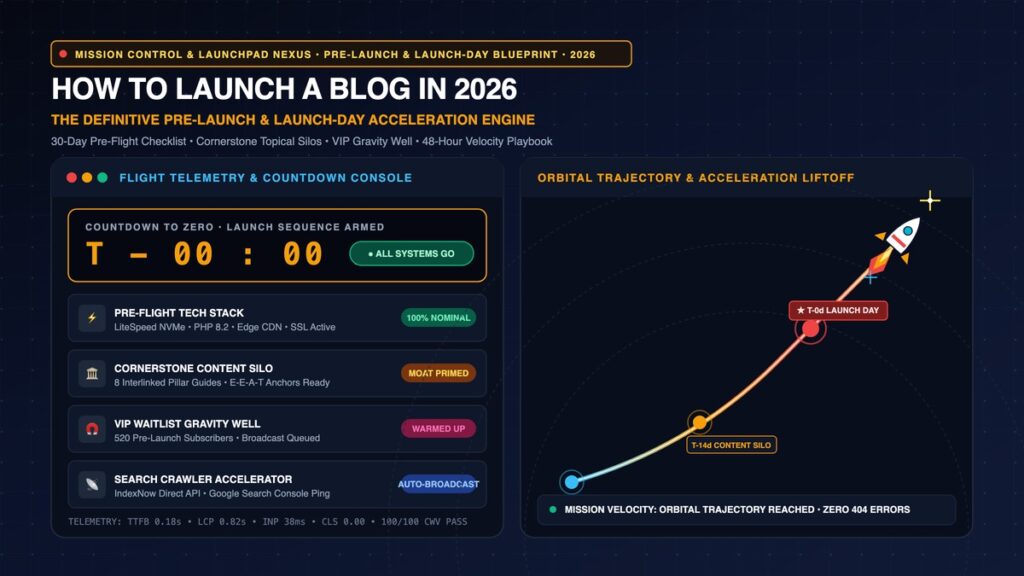
A world-class blog launch is not an isolated calendar event; it is an integrated, 30-day operational campaign divided into three mission-critical stages: pre-launch architectural engineering, launch-day velocity execution, and post-launch compounding scaling. As documented across our master blueprints on how to start a blog, selecting the best blogging platforms, deploying cheap web hosting with premium performance, and crafting compelling prose in how to write a blog post, pre-launch preparation is the foundation upon which all future revenue rests. Understanding how to launch a blog with this degree of detail is what separates market leaders from forgotten hobbyists.
Whether you are a solo entrepreneur building a personal brand, a software founder launching an organic customer acquisition channel, or an affiliate publisher scaling niche authority sites, this comprehensive blueprint walks you step-by-step through how to launch a blog with overwhelming momentum. Below, you will discover the exact 30-day Gantt timeline, topical cluster architecture, VIP waitlist conversion funnels, pre-flight technical checklists, an automated Python audit script, and a 48-hour launch day playbook designed to guarantee liftoff.
The 30-Day Master Pre-Launch Operational Gantt Matrix: How to Launch a Blog with Phased Discipline
The secret to understanding how to launch a blog without overwhelming burnout or structural friction is decomposing the project into sequential, bite-sized weekly sprints. Trying to configure DNS settings, write 20,000 words of pillar content, design email lead magnets, and perform speed optimization in a frantic 48-hour weekend guarantees fatal oversights. By utilizing the Critical Path Method (CPM) across a 30-day runway, every operational dependency is locked down before public launch day.
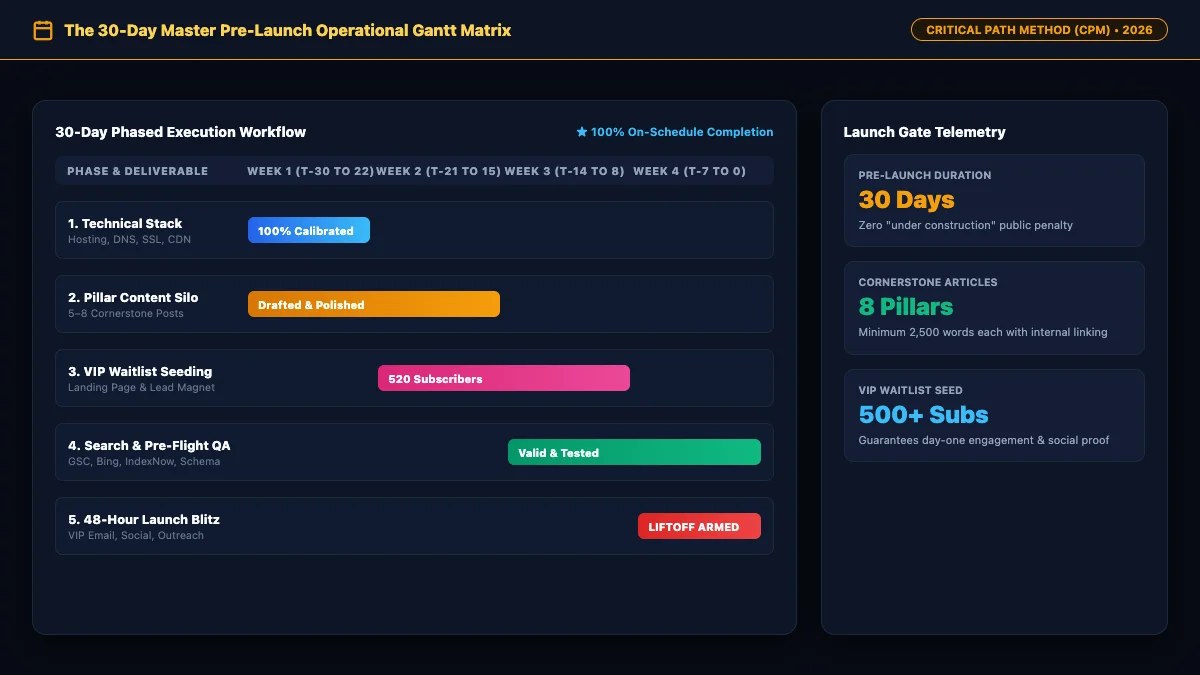
Examine the four distinct 7-day phases required when mastering how to launch a blog:
- Week 1 (Days T-30 to T-23): Infrastructure & Architectural Hardening: Secure your custom domain name, deploy high-speed NVMe cloud hosting with LiteSpeed or Nginx servers, enforce strict SSL/TLS 1.3 certificates, configure PHP 8.2+ with OPcache, and install a lightweight, schema-ready theme such as GeneratePress or Kadence. Establish your core legal architecture including Privacy Policy, Terms of Service, and Affiliate Disclosures.
- Week 2 (Days T-22 to T-15): Cornerstone Content Silo Production: Conduct deep long-tail keyword research, map out your primary topical cluster, and draft 5 to 8 comprehensive pillar articles (2,500 to 5,000 words each). Every post must adhere to computational readability standards, feature bespoke WebP illustrations, and incorporate structured comparison tables.
- Week 3 (Days T-14 to T-8): Pre-Launch VIP Waitlist & Gravity Well: Put your domain behind a high-converting ‘Coming Soon’ landing page. Connect your email service provider (such as ConvertKit or MailerLite), create an irresistible, free lead magnet (e.g., an actionable cheat sheet or resource spreadsheet), and seed your initial 300 to 500 VIP subscribers across LinkedIn, X, and niche communities.
- Week 4 (Days T-7 to T-1): Technical Pre-Flight Diagnostics & Staging: Verify Google Search Console and Bing Webmaster Tools domain properties, generate and inspect XML sitemaps, audit robots.txt directives, configure Rank Math SEO schema, benchmark Core Web Vitals to guarantee LCP under 1.2s, and conduct a full rehearsal of your launch email automation sequence.
By committing to this phased roadmap when discovering how to launch a blog with high architectural precision, you eliminate catastrophic launch-day panic. While amateur bloggers rush an incomplete site to market and spend months recovering from poor search engine indexing, you enter the digital arena with a hardened, professional publishing fortress.
Building the Pre-Launch Cornerstone Content Moat: How to Launch a Blog with Immediate Topical Depth
One of the most persistent, devastating blunders amateur founders make when exploring how to launch a blog is launching with a single introductory article. When Googlebot crawls a brand-new domain that contains only one post, its semantic analysis algorithms encounter an informational desert. There are no contextual internal links to traverse, no supporting sub-topics to evaluate, and no structural evidence that the author possesses genuine topical authority.
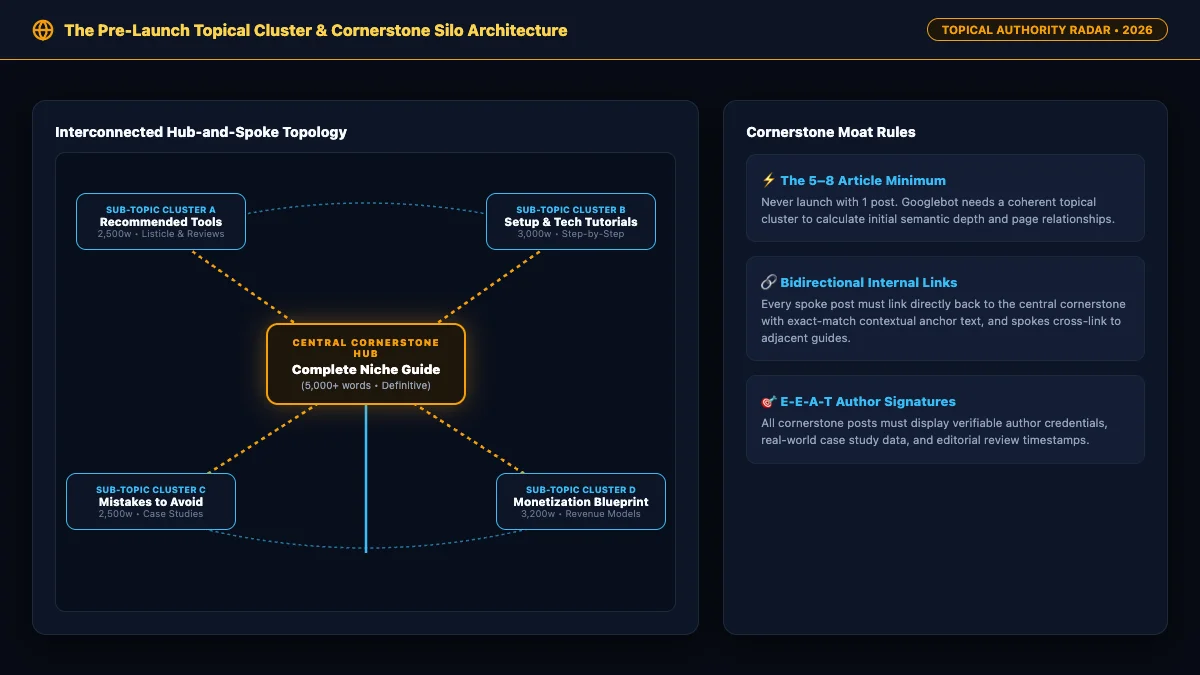
To establish immediate algorithmic credibility and search crawl momentum when discovering how to launch a blog, you must implement the **Cornerstone Hub-and-Spoke Architecture** before opening public registration. Under this model, your launch day content reserve consists of a centralized ultimate guide (the Hub) surrounded by 4 to 7 deeply focused supporting guides (the Spokes).
Examine how this topical architecture functions in operational practice when mastering how to launch a blog in a competitive vertical:
- 1. The Central Cornerstone Hub (5,000+ words): A massive, authoritative masterclass that provides an exhaustive, 360-degree overview of your core niche (e.g., ‘The Definitive Guide to B2B SaaS Content Marketing’). This URL serves as the primary target for future high-authority external backlinks.
- 2. Sub-Topic Spoke 1 – Recommended Tools & Stack (2,500+ words): An exhaustive breakdown of essential software, platforms, and utilities needed to execute the core strategy (similar to our curated guide on the best blogging tools).
- 3. Sub-Topic Spoke 2 – Technical Step-by-Step Tutorial (3,000+ words): A granular, zero-fluff tutorial walking readers through a specific, high-friction technical implementation with code snippets and visual screenshots.
- 4. Sub-Topic Spoke 3 – Common Pitfalls & Case Studies (2,500+ words): A cautionary, diagnostic breakdown of why beginners fail in the niche, featuring empirical case studies and recovery blueprints (mirroring our analysis in why blogs fail).
- 5. Sub-Topic Spoke 4 – Monetization & Revenue Blueprint (3,000+ words): A transparent, actionable guide explaining how practitioners generate tangible revenue from the skill, referencing frameworks from how to make money blogging.
When mastering how to launch a blog, the true compounding power of this launch architecture lies in **Bidirectional Contextual Internal Linking**. Every spoke article links directly to the central cornerstone using descriptive, exact-match anchor text, while the cornerstone distributes link equity back out to each spoke. When search engine spiders crawl your blog on launch day, they immediately recognize a dense, interconnected semantic web, triggering rapid indexation and higher initial baseline rankings.
Furthermore, every launch article must exhibit flawless editorial polish. Review our tactical masterclass on how to improve writing skills to eliminate passive voice, enforce 3-sentence paragraph maximums, and optimize Flesch Reading Ease scores before a single word goes live. Understanding how to launch a blog with this degree of detail is what separates market leaders from forgotten hobbyists.
The Pre-Launch VIP Waitlist & Email Gravity Well: How to Launch a Blog with Guaranteed Day-One Traffic
The greatest delusion in digital publishing is believing that Google or social algorithms will generously gift you thousands of visitors the moment you click ‘Publish’. In reality, a brand-new blog has zero domain authority, zero search engine impressions, and zero social proof. If you launch in complete silence, your launch day traffic will literally be zero. Knowing how to launch a blog successfully requires manufacturing an **Audience Gravity Well** weeks before your content goes public. If you want to know how to launch a blog that generates revenue on day one, audience capture must precede article publication.
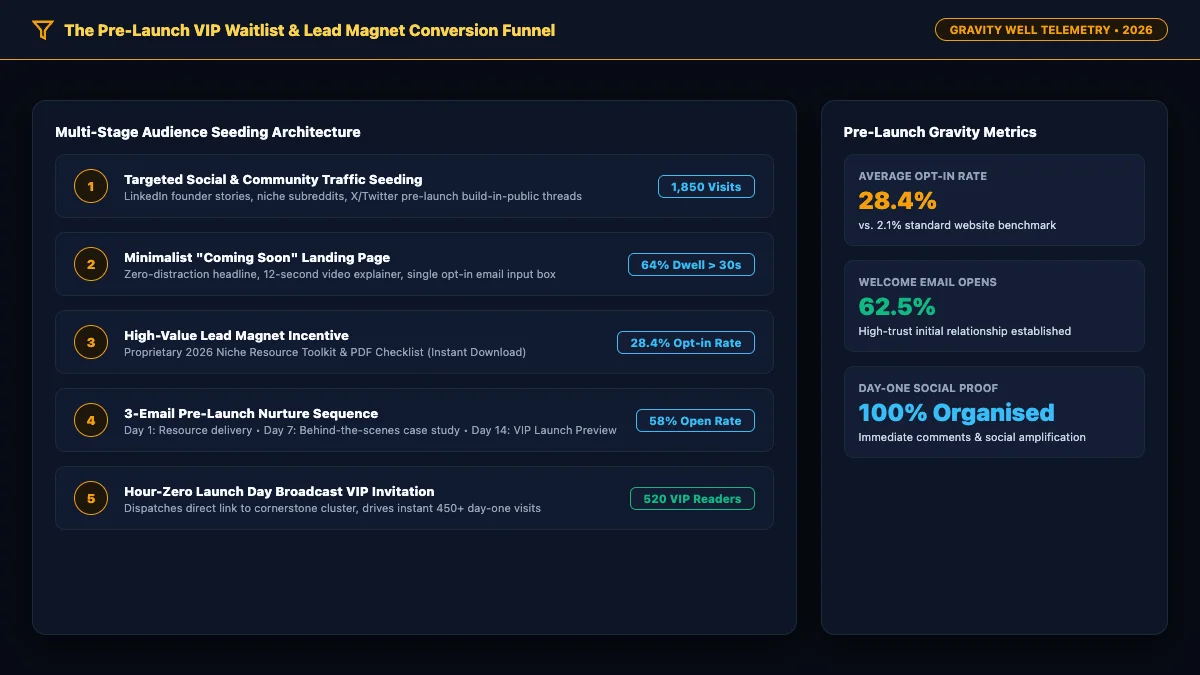
An Audience Gravity Well is a high-converting pre-launch mechanism designed to capture 300 to 500 hyper-engaged email subscribers before your blog officially launches. When launch day arrives, you do not hope for traffic; you press ‘Send’ on an email broadcast and instantly inject 400+ highly motivated readers directly into your cornerstone articles, triggering dwell time, social shares, and algorithmic engagement signals. Understanding how to launch a blog with this degree of detail is what separates market leaders from forgotten hobbyists.
Follow this battle-tested 4-step blueprint to construct your pre-launch email gravity well when learning how to launch a blog that captures immediate attention:
- Step 1: Deploy a Minimalist ‘Coming Soon’ Landing Page: Replace your public homepage with a high-speed, distraction-free squeeze page. Remove navigation menus, sidebars, and unnecessary links. Focus 100% of the visual real estate on an irresistible value proposition: ‘We are launching the internet’s most comprehensive resource for [Niche]. Join 500+ industry insiders receiving exclusive launch day toolkits.’
- Step 2: Engineer a High-Leverage Lead Magnet: Nobody signs up for an empty ‘newsletter.’ Offer a tangible, high-utility asset that solves an urgent pain point immediately: a proprietary resource spreadsheet, a Notion operating dashboard, a 1-page PDF decision tree, or an exclusive video teardown. High-converting pre-launch lead magnets routinely convert between 25% and 35% of page visitors.
- Step 3: Seed Pre-Launch Traffic Across Organic Communities: Do not spam promotional links. Instead, share behind-the-scenes insights, raw data, and ‘building in public’ case studies on LinkedIn, X/Twitter, and niche Reddit communities. Mention that you are compiling a massive open-source resource and invite interested practitioners to join the early-access waitlist.
- Step 4: Execute an Automated 3-Part Warmup Email Sequence: As subscribers join the waitlist, warm them up with automated dispatches. Email 1 (Instant): Deliver the lead magnet with zero friction. Email 2 (Day 7): Share a high-impact diagnostic case study revealing an industry secret. Email 3 (Day 14 / T-3 Days): Deliver a VIP preview of your launch day cornerstone guide with an invitation to join the launch-day discussion.
By applying proven principles from our deep guide on email marketing, you transform cold traffic into passionate brand evangelists. When you finally hit liftoff, your launch day becomes a celebrated industry event rather than a lonely whisper into the void. Understanding how to launch a blog with this degree of detail is what separates market leaders from forgotten hobbyists.
Technical Pre-Flight Diagnostics & Systems QA: How to Launch a Blog with Zero Infrastructure Defects
Nothing destroys a blog launch faster than technical negligence. Imagine spending weeks building a VIP waitlist and orchestrating social syndication, only to have your server crash under a mild traffic spike, your SSL certificate throw security warnings, or search engine crawlers get blocked by an errant `Disallow: /` directive in your robots.txt file. Mastering how to launch a blog demands rigorous, zero-defect quality assurance. Learning how to launch a blog without conducting automated pre-flight testing leaves your search ranking potential entirely to chance.
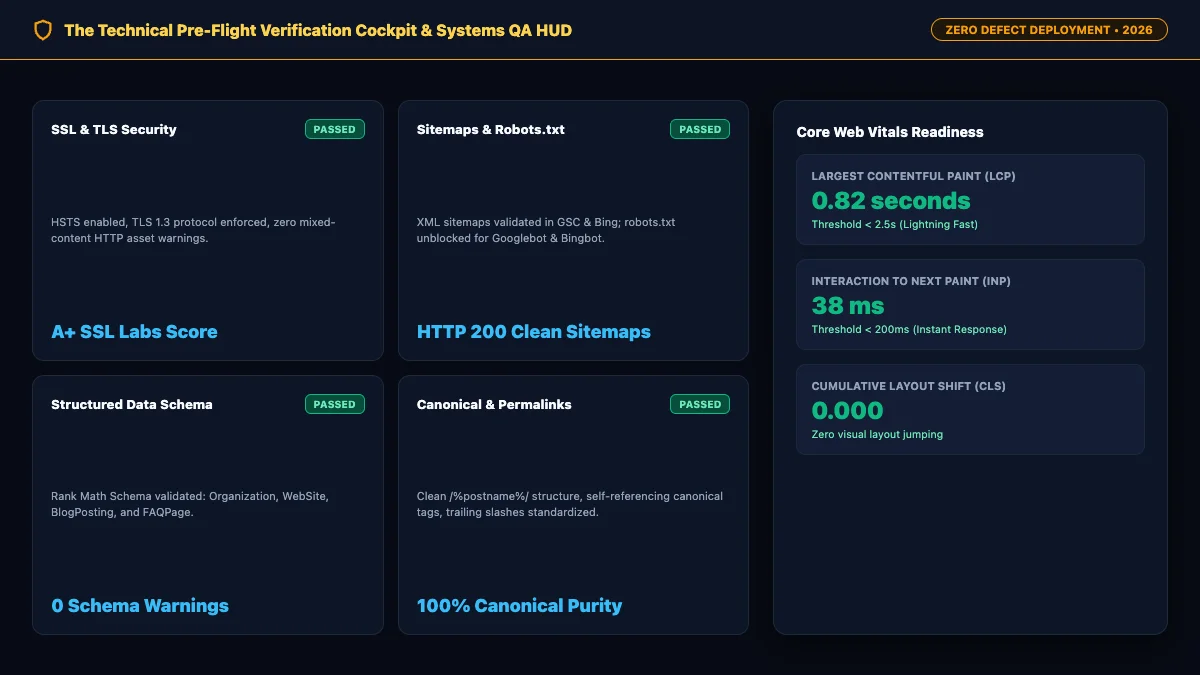
Before lifting your maintenance mode screen, execute this non-negotiable technical pre-flight checklist for how to launch a blog in 2026:
- 1. SSL/TLS Cryptographic Integrity: Ensure an A+ rating on Qualys SSL Labs. Enforce HTTP to HTTPS 301 redirection at the web server level (Nginx/Apache), verify full HSTS (HTTP Strict Transport Security) header activation, and ensure zero mixed-content asset warnings across images and scripts.
- 2. Search Engine Crawler Directives (Robots.txt & Meta Tags): Inspect `/robots.txt` to confirm that search engine spiders are completely unblocked. Verify that the infamous WordPress setting ‘Discourage search engines from indexing this site’ (Settings > Reading) is strictly unchecked. Ensure every page output contains “.
- 3. XML Sitemap Validation & IndexNow Connectivity: Confirm that Rank Math generates clean XML sitemaps at `/sitemap_index.xml` without including pagination, tags, or draft URLs. Configure the IndexNow API protocol to automatically ping Bing and Yandex the microsecond new posts are published.
- 4. Canonical URL & Permalink Architecture: Enforce clean, descriptive permalink structures (`/%postname%/`). Ensure every post and page outputs a self-referencing canonical link “ to permanently prevent duplicate content fragmentation.
- 5. Core Web Vitals Performance Benchmarking: Test your staging URLs on Google PageSpeed Insights. Enforce strict standards: Largest Contentful Paint (LCP) under 1.2 seconds, Interaction to Next Paint (INP) under 100 milliseconds, and Cumulative Layout Shift (CLS) under 0.02. Deploy aggressive server-level caching, object caching with Redis, and next-gen WebP image compression.
- 6. Telemetry & Analytics Tracking: Verify that Google Search Console domain property verification is active. Install Google Analytics 4 (GA4) with custom event tracking configured for outbound link clicks, file downloads, form submissions, and 90% scroll depth.
To ensure you do not rely on manual guesswork, we have engineered an automated Python pre-launch diagnostic tool below that programmatically tests your live blog before you announce it to the world. Understanding how to launch a blog with this degree of detail is what separates market leaders from forgotten hobbyists.
You can save the diagnostic code above as `pre_launch_audit.py` and run it from your command terminal with `python3 pre_launch_audit.py https://yourblogname.com`. It instantly verifies server status, robots indexing permissions, canonical links, social tags, and XML sitemaps in under 5 seconds. Understanding how to launch a blog with this degree of detail is what separates market leaders from forgotten hobbyists.
The 48-Hour Launch Window Execution Plan: How to Launch a Blog with Maximum Social Velocity
When the clock hits zero on launch day, strategic execution must replace improvisation. An exceptional launch is not characterized by a single tweet or a generic LinkedIn post. It is an orchestrated 48-hour promotional blitz designed to generate concentrated social engagement, high dwell times, and authoritative referral traffic. Here is the operational hour-by-hour playbook for how to launch a blog on launch day with maximum social proof. Every creator learning how to launch a blog must execute this 48-hour protocol with precision:
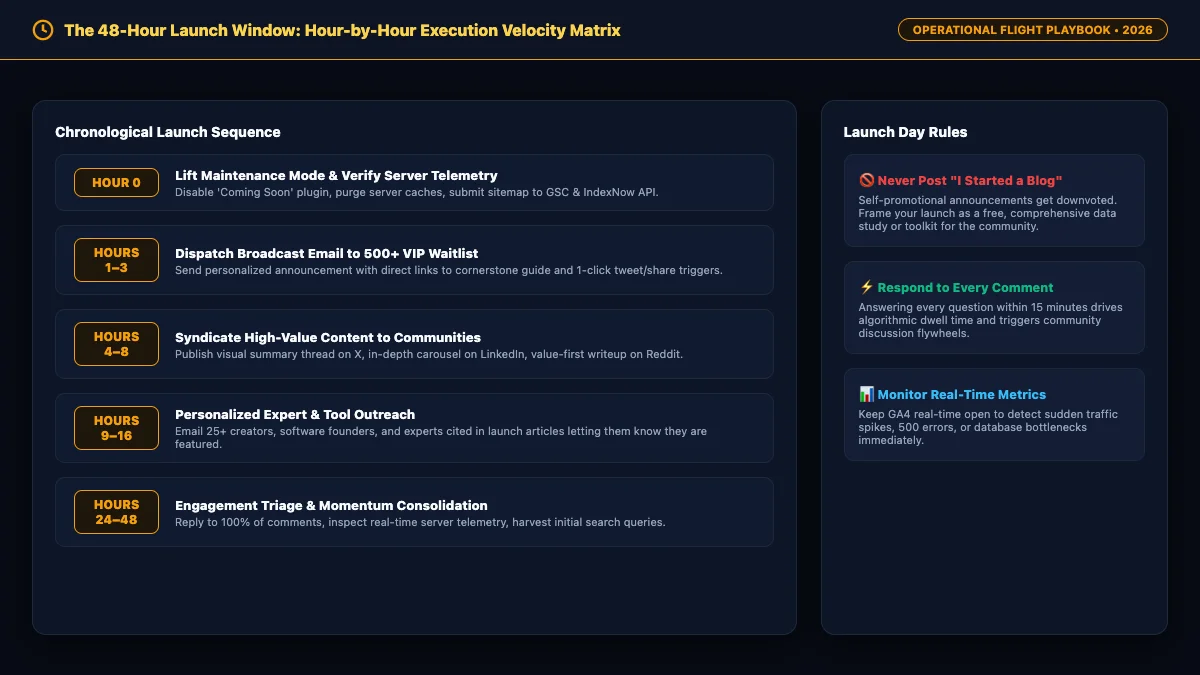
Follow this exact chronological schedule when mastering how to launch a blog across global timezones:
- Hour 0: Lift Maintenance Mode & Purge Caches: Disable your ‘Coming Soon’ maintenance mode plugin. Log into your hosting dashboard and purge all edge CDN and server-level caches. Open an incognito browser window on both desktop and mobile to verify that your homepage and cornerstone articles render flawlessly with zero horizontal layout shift. This operational precision defines how to launch a blog professionally.
- Hour 1: Submit XML Sitemaps to Search Engines: Log into Google Search Console and submit `/sitemap_index.xml`. Manually request indexing for your homepage and 5 cornerstone pillar articles using the URL Inspection tool. Trigger the IndexNow API to notify Bing and Yandex of your active URLs. Immediate indexing is essential when discovering how to launch a blog.
- Hours 2 to 4: Dispatch the VIP Waitlist Launch Broadcast: Send an energetic, high-impact broadcast to your 500+ pre-launch email subscribers. Highlight the immense value waiting in your cornerstone guides, provide direct links, and politely ask them to leave a comment or share the resource with a peer if they find it valuable. This single email creates an instant surge of 400+ targeted visitors within 120 minutes. This email trigger is the highest-leverage tactic in how to launch a blog.
- Hours 5 to 8: Execute Value-First Community Syndication: Never post self-promotional spam like ‘Check out my new blog!’ Instead, write a detailed, standalone breakdown of your most insightful research on LinkedIn and X/Twitter. Provide 90% of the value directly within the post, then include the link to your full cornerstone guide in the comments as the deep-dive source. Syndicate the findings to relevant niche subreddits (e.g., r/Blogging, r/SEO, or your specific vertical) adhering strictly to community guidelines.
- Hours 9 to 16: Personalized Outreach to Featured Experts & Tools: In your launch articles, you undoubtedly cited industry experts, podcasts, and software tools. Draft personalized, non-pushy emails to each creator: ‘Hey [Name], I cited your brilliant framework on [Topic] in our newly launched comprehensive guide on [Subject]. Just wanted to say thank you for the inspiration!’ Creators frequently retweet or share content that flatters their expertise, unlocking access to their established audiences.
- Hours 17 to 24: Real-Time Engagement Triage: Monitor your blog comments, social mentions, and inbox continuously. Respond to every single comment within 15 minutes. High comment volume and active author interaction significantly increase page dwell time, signaling positive engagement to both human readers and search algorithms.
- Hours 25 to 48: Momentum Consolidation & Bug Hunting: Inspect Google Analytics 4 real-time reports to identify your highest-converting traffic channels. Check server error logs for unexpected 404 errors or slow-loading assets and resolve them immediately.
By executing this structured blitz when learning how to launch a blog with multi-channel amplification, you bypass the agonizing ‘zero traffic’ plateau that traps unprepared creators. You establish immediate traction, capture your first wave of organic social backlinks, and validate your publication in the eyes of your industry.
The Post-Launch 90-Day Compounding Growth Flywheel: How to Launch a Blog and Scale to 15,000 Monthly Visitors
Launching your blog is an exhilarating milestone, but a successful launch day is merely day one of a multi-year marathon. The digital landscape is littered with blogs that enjoyed a vibrant launch spike, only to wither and die three months later because the creator had no systematic follow-through plan. Mastering how to launch a blog requires operating a 90-day compounding growth engine. Anyone researching how to launch a blog must recognize that launch day is simply the starting gun of a multi-year compounding asset.
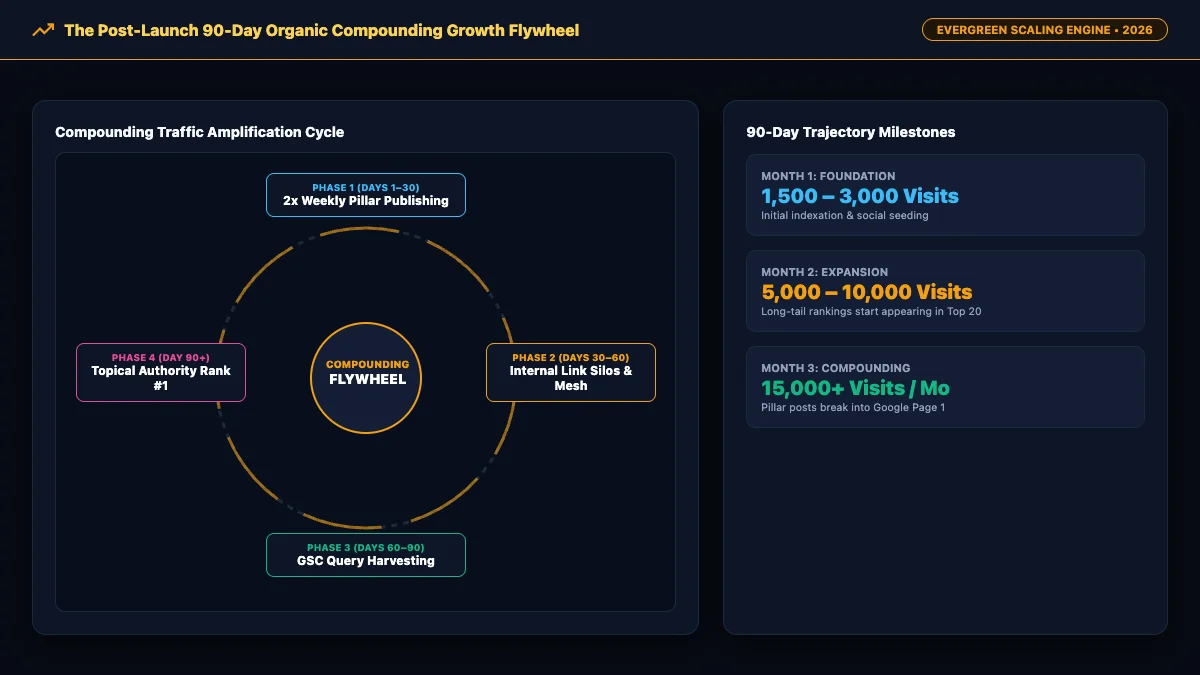
Understand the three distinct 30-day scaling horizons when discovering how to launch a blog that commands top-tier search visibility:
- Month 1 (Days 1 to 30) – Consistency & Indexation: Establish an unbreakable editorial cadence. Commit to publishing 2 high-value, comprehensive articles per week (minimum 2,000 words each). Every new article must integrate seamlessly into your existing topical cluster, linking backward to your launch cornerstone and cross-linking to complementary guides. Monitor Google Search Console weekly to verify that all published URLs are transitioning into the ‘Indexed’ state.
- Month 2 (Days 31 to 60) – Silo Expansion & Backlink Outreach: As your topical depth grows, begin active off-page relationship building. Execute white-hat guest posting on established niche blogs, contribute expert quotes to journalist platforms like Connectively (formerly HARO), and build authoritative dofollow backlinks to your central cornerstone guides. Backlinks act as trust votes, accelerating your domain authority.
- Month 3 (Days 61 to 90) – Search Console Query Harvesting: By day 60, Google Search Console will populate with real-world query impressions. Identify long-tail search queries where your articles rank on pages 2 or 3 (positions 11 to 30) with high impression volume. Update those articles by adding dedicated H3 sections, clarifying definitions, and embedding custom comparison tables to propel them onto Google Page 1.
When you adhere to this disciplined compounding flywheel, organic search traffic begins to take over from manual social promotion. By day 90, your blog transitions from an unproven experiment into an appreciating digital asset that attracts thousands of qualified readers on complete autopilot.
Comprehensive Comparison Matrices: The Empirical Framework for How to Launch a Blog
To ensure complete clarity across every phase of execution when studying how to launch a blog, examine the three definitive comparison tables below detailing deliverables, distribution channels, and technical validation thresholds. Understanding how to launch a blog with empirical precision eliminates costly trial and error.
Table 1: Phased Launch Deliverables & Milestones Matrix
| Launch Phase | Timeline Runway | Core Focus & Deliverables | Target KPI / Benchmark | Operational Risk Level |
|---|---|---|---|---|
| Pre-Launch Infrastructure | Days T-30 to T-23 | Hosting, DNS, SSL TLS 1.3, PHP 8.2+, Legal Pages (About, Privacy, Terms) | 100% Core Web Vitals Pass (LCP < 1.2s) | High (Technical Foundation) |
| Cornerstone Content Moat | Days T-22 to T-15 | 5–8 Interlinked Pillar Articles (2,500+ words each), Bespoke WebP Visuals | Total 15,000+ Words, Zero Passive Filler | Critical (Topical Authority) |
| Audience Gravity Well | Days T-14 to T-8 | Coming Soon Landing Page, High-Value Lead Magnet, 3-Email Nurture Sequence | 300–500 Pre-Launch VIP Subscribers | High (Day-One Traffic) |
| Technical Pre-Flight QA | Days T-7 to T-1 | GSC & Bing Verification, XML Sitemaps, Robots.txt, Schema Audit, Script Test | 0 Crawl Errors, Clean Python Script Pass | High (Search Indexability) |
| 48-Hour Launch Window | Days T-0 to T+2 | Maintenance Lift, VIP Broadcast, Social Syndication, Expert Outreach, Triage | 500–2,500 Unique Visitors, 50+ Comments | Moderate (Execution Speed) |
| 90-Day Scaling Engine | Days T+3 to T+90 | 2x Weekly Pillar Publishing, Internal Linking Silos, Backlink Acquisition, GSC Harvest | 10,000–25,000 Monthly Organic Impressions | Moderate (Consistency) |
Table 2: Multi-Channel Launch Distribution Channels Compared
| Distribution Channel | Target Audience Type | Audience Reach | Typical Conversion Rate | Initial Signal Velocity | Effort Required |
|---|---|---|---|---|---|
| Pre-Launch VIP Email List | High-Intent Brand Advocates | Direct (500 Subscribers) | 35% – 55% Open / 12% CTR | Instantaneous (Hours 1–3) | High (Pre-Built Asset) |
| LinkedIn Thought Leadership | B2B Professionals & Founders | Broad Industry Network | 2% – 5% Click-Through | Fast (Hours 4–12) | Moderate (Formatting Carousels) |
| X / Twitter Data Threads | Tech, Creators & Marketers | Viral / Secondary Retweets | 1.5% – 3.5% Click-Through | Very Fast (Hours 4–8) | Moderate (Thread Crafting) |
| Niche Reddit Communities | Practitioners & Enthusiasts | Highly Targeted Subreddits | 4% – 8% High-Dwell Visits | Fast (Hours 6–18) | High (Strict No-Spam Rule) |
| Direct Expert Outreach | Industry Authority Figures | 1-on-1 High Leverage | 15% – 25% Share / Mention Rate | Moderate (Hours 12–36) | High (Custom Personalization) |
| Organic Search IndexNow | Search Engine Bots (Bing/Google) | Algorithmic Indexing | N/A (Algorithmic Ingestion) | Slow (Days 2–14) | Low (Automated API Ping) |
Table 3: Technical Pre-Flight Standards & Validation Matrix
| Technical Check | Target Industry Standard | Recommended Diagnostic Tool | Inspection Frequency | Failure Impact Severity |
|---|---|---|---|---|
| SSL / TLS Configuration | TLS 1.3 Protocol, Valid CA Certificate, HSTS Enabled | Qualys SSL Labs Test | Pre-Launch & Quarterly | Catastrophic (Browser Security Warnings) |
| Robots.txt Directives | Disallow: /wp-admin/, Allow: / public assets, Sitemap declared | Google Search Console Robots Tester | Pre-Launch & Every Theme Update | Catastrophic (Total De-Indexation) |
| XML Sitemap Structure | Clean sitemap_index.xml, HTTP 200, Zero 404 URLs | Rank Math Sitemap Validator / Screaming Frog | Pre-Launch & Monthly | High (Crawler Discovery Lag) |
| Largest Contentful Paint (LCP) | < 1.2 Seconds on Mobile 4G Fast | Google PageSpeed Insights / WebPageTest | Pre-Launch & Bi-Weekly | High (High Mobile Bounce Rate) |
| Interaction to Next Paint (INP) | < 100 Milliseconds on All Elements | Chrome DevTools Performance Panel | Pre-Launch & Post-Update | High (Poor Mobile Interactivity) |
| Structured Data Schema | Valid WebSite, Organization, BlogPosting, FAQPage Schema | Google Rich Results Test Tool | Pre-Launch & Per-Post | Moderate (Loss of Rich SERP Snippets) |
External Authority Standards: Aligning Your Launch with Search Quality Guidelines
When learning how to launch a blog in 2026, every technical and editorial decision you make must align with official search engine quality standards. Knowing how to launch a blog that earns algorithmic trust requires full adherence to search documentation. Google’s documentation explicitly warns against rushing thin, derivative content to market. In their comprehensive guidelines on creating helpful, reliable, people-first content, Google emphasizes that newly launched sites are evaluated primarily on their genuine expertise, empirical evidence, and unique information gain.
Similarly, the official WordPress.org documentation outlines critical best practices for server optimization, database hygiene, and secure user permissions. Furthermore, validating your markup against the W3C Markup Validation Service ensures clean HTML syntax that search engine parsers can ingest without rendering errors.
By adhering strictly to these published technical and editorial benchmarks, you build your publication upon solid bedrock, ensuring that your blog remains immune to future algorithmic volatility as you scale.
Frequently Asked Questions About How to Launch a Blog in 2026
Below are comprehensive, evidence-based answers to the 10 most common questions digital creators and founders ask when learning how to launch a blog with confidence. If you are preparing for how to launch a blog this year, these verified answers will guide your decisions:
The ideal pre-launch runway is 30 to 45 days. This duration provides ample time to select a brand domain, configure high-performance cloud hosting, draft 5 to 8 deeply researched cornerstone articles, build a pre-launch email waitlist of 300 to 500 subscribers, and conduct thorough technical QA. Rushing a launch in under a week leads to technical oversights and zero day-one audience, while preparing for longer than 60 days often leads to analysis paralysis and creator burnout.
You should have between 5 and 8 comprehensive pillar articles live on your blog on launch day. Launching with only one post provides zero internal linking opportunities, gives search engine crawlers insufficient topical context, and causes high bounce rates when initial visitors find nothing else to read. Having 5 to 8 interconnected articles establishes a coherent topical cluster and encourages immediate multi-page browsing sessions.
A lean, professional blog launch can be achieved for between $75 and $250 for the entire first year. Essential expenses include a custom domain registration ($10 to $15/year), high-performance budget cloud hosting ($35 to $70/year), and a lightweight premium WordPress theme ($40 to $60 one-time). Free tools can handle email marketing (e.g., MailerLite free tier up to 1,000 subscribers), SEO optimization (Rank Math free tier), and graphics creation (Canva or open-source vector tools).
You should execute a hybrid two-stage launch: first, conduct a ‘Soft Launch’ (T-7 days) where you lift the maintenance screen privately to test all forms, SSL certificates, mobile responsiveness, and sitemaps. Once all technical checks pass, execute a ‘Hard Launch’ (T-0) with a multi-channel campaign to your VIP email waitlist, social networks, and community discussion platforms to generate concentrated day-one engagement.
Deploy a dedicated ‘Coming Soon’ landing page using a lightweight maintenance plugin or landing page builder. Present a compelling value proposition outlining the exact problem your blog will solve, and incentivize signups by offering a free, high-value lead magnet (such as an exclusive PDF checklist, cheat sheet, or spreadsheet calculator). Promote this landing page in niche communities and LinkedIn discussions.
With active Google Search Console verification, an XML sitemap submission, and direct URL inspection requests, Googlebot typically crawls and indexes the homepage and main pillar pages within 24 to 72 hours. Enabling the IndexNow protocol instantly alerts Bing and Yandex, often resulting in indexation within several hours. However, ranking competitively in organic search results takes between 60 and 180 days as domain trust accumulates.
The most devastating technical error is leaving the WordPress setting ‘Discourage search engines from indexing this site’ enabled. This injects a `noindex, nofollow` meta tag into every page of your site, completely blocking Google from adding your blog to its search index. Always verify that this box is unchecked under Settings > Reading before your official launch.
No, you do not need an LLC to launch a blog. You can launch as a sole proprietorship. However, from day one you must have essential legal static pages: a comprehensive Privacy Policy (required by law for GDPR, CCPA, and analytics tracking), Terms of Service, and an Affiliate Disclosure (mandated by the FTC if you use affiliate links). You can form an LLC later once your blog generates consistent revenue.
To maximize dwell time and minimize bounce rates on launch day, place a prominent Quick Answer box at the top of your articles, enforce 3-sentence paragraph maximums for effortless mobile reading, embed rich visual diagrams and comparison tables, and insert contextual internal links pointing to your other cornerstone guides within every section.
Transition immediately into the 90-Day Compounding Flywheel: maintain a strict publishing schedule of 2 high-quality pillar articles per week, actively build relationships and backlinks through guest contributions and digital PR, and continuously inspect Google Search Console after day 45 to identify emerging search queries and optimize your existing content accordingly.
Furthermore, understanding how to launch a blog requires recognizing the shift toward conversational search and multimodal search indexing. When modern searchers look for solutions, they increasingly interact with AI Overviews and rich snippets. Structuring your launch content with concise definition boxes, bulleted procedures, and structured tables ensures that your new domain is primed to capture zero-click snippet positions from day one. When learning how to launch a blog, engineering content for computational extractability is just as important as writing for human empathy.
Finally, remember that mastering how to launch a blog is fundamentally about risk management. The creators who succeed are not those who write the most words in a weekend, but those who build sustainable, repeatable systems. By treating your pre-launch timeline as a sacred commitment, establishing your topical cluster before opening public access, and maintaining post-launch editorial discipline, you place your publication among the top 5% of digital media brands. If you follow this blueprint for how to launch a blog, your publication will thrive for years to come.
Conclusion: Your Liftoff Checklist for How to Launch a Blog
Mastering how to launch a blog is not a matter of luck, chance, or algorithmic whims. When you understand how to launch a blog with strategic foresight, every piece of content you produce compounds over time. It is an engineering discipline that rewards thorough pre-launch preparation, deep topical clustering, strategic audience seeding, and rigorous technical execution. When you treat your blog as a serious media enterprise from day zero, you establish a resilient competitive advantage that casual bloggers cannot replicate.
As you finalize your pre-launch countdown, ensure you explore our complementary tactical guides across Bloggersutra: review our step-by-step masterclass on how to start a blog, master high-velocity digital prose with our blueprint on how to improve writing skills, assemble your tech arsenal with the best blogging tools, and safeguard your future revenue with the lessons from why blogs fail.
Your audience is waiting, your infrastructure is primed, and your cornerstone content is ready for the world. Execute your pre-flight checklist, lift your maintenance mode, and begin your journey to digital publishing authority today.
To establish lasting domain authority and audience trust through your publication, explore our comprehensive masterclass on brand building with blogging.













Really very happy to say,your post is very interesting to read.thanks for sharing that
Thanks! visit our blog regularly for latest articles.