





Quick answer
- What are the absolute minimum requirements for AdSense approval in 2026? To qualify for Google AdSense approval, you must be at least 18 years old, possess full administrative control over a custom top-level domain (such as
.comor.org), feature at least 25 to 30 comprehensive, original articles (minimum 1,200 to 1,500 words each), maintain four mandatory legal pages (Privacy Policy, About, Contact, Terms), and exhibit zero policy violations regarding scraped, copyright-infringing, or thin AI-generated material. - How long does the Google AdSense approval review process take? While Google’s automated crawler executes an initial connectivity ping within 24 to 48 hours, a comprehensive multi-stage algorithmic evaluation and human policy compliance review typically takes between 3 to 14 business days. In certain high-volume verification cycles or for newly registered domains, reviews can take up to 2 to 4 weeks depending on crawler scheduling and domain history.
- How many blog posts do you need before applying for AdSense? While Google does not publish a rigid numeric threshold, submitting a website with fewer than 15 posts almost guarantees an immediate rejection for ‘Low Value Content’ or ‘Site Under Construction’. We strongly recommend launching at least 25 to 35 thoroughly researched articles (totaling 35,000+ words) across 3 to 4 focused categories before submitting your application.
- What causes the dreaded ‘Low Value Content’ rejection in 2026? Over 70% of initial rejections stem from Low Value Content. This occurs when automated review bots detect thin content (articles under 800 words), raw AI-generated text lacking personal experience or original research, high keyword cannibalization, or content that merely paraphrases existing search results without adding fresh insights, proprietary data, original infographics, or unique visual media.
- Can you get AdSense approval with AI-generated content? Yes, but only if it strictly adheres to Google’s Helpful Content and E-E-A-T (Experience, Expertise, Authoritativeness, Trustworthiness) standards. Pure, unedited AI output generated in bulk is flagged by semantic classifiers. To pass compliance, every article must incorporate first-hand insights, custom screenshots, verified source citations, and human editorial oversight.
Securing fast adsense approval is widely considered the ultimate milestone for newly minted publishers, bloggers, and digital entrepreneurs. Operated by Alphabet Inc. since June 2003, Google AdSense remains the largest, most dependable contextual advertising network in digital publishing history, paying billions of dollars annually to more than 2 million active webmasters worldwide. Whether you are learning how to start a blog, expanding a niche authority portal, or scaling an international media platform, Google AdSense provides effortless programmatic monetization with guaranteed monthly on-time payouts.
However, the landscape of Google AdSense qualification has undergone a massive paradigm shift. In the early days of blogging, webmasters could register an unbranded domain, throw together five 300-word articles, paste the verification snippet, and wake up to a green approval badge within 48 hours. Those days are permanently gone. In 2026, Google employs sophisticated multi-stage automated compliance crawlers paired with strict human policy review teams. These evaluation systems are designed to protect Google’s high-paying AdWords (Google Ads) advertisers from low-quality MFA (Made for Advertising) farms, scraped affiliate duplicates, and robotic AI content mills.
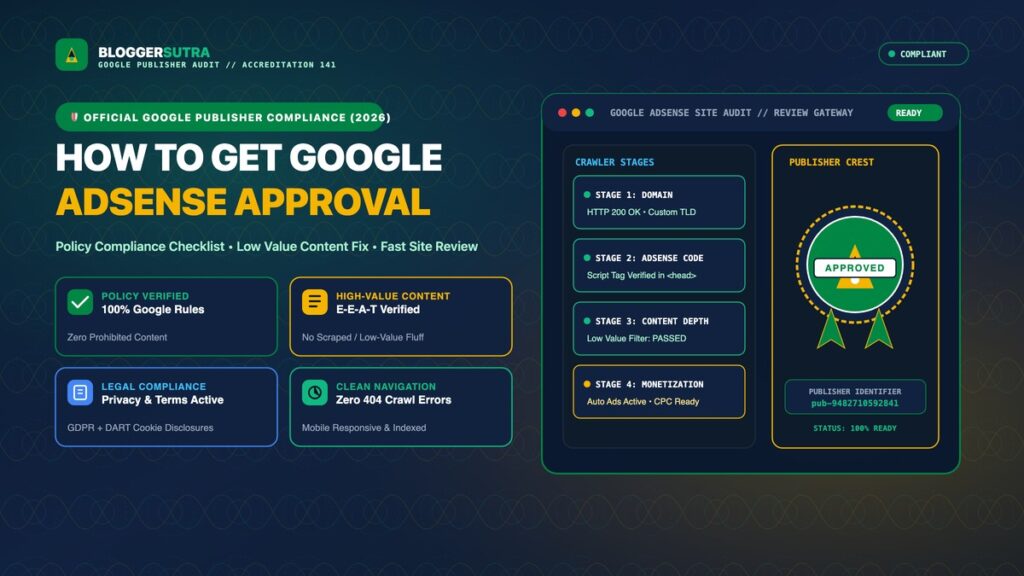
As a result, an overwhelming majority of first-time applicants receive disheartening rejection emails citing ambiguous policy flags: ‘Low Value Content’, ‘Site Behavior: Navigation’, or ‘We found some policy violations’. Without clear technical guidance, frustrated creators enter a soul-crushing loop of blind guessing, re-submitting unchanged websites, and getting rejected repeatedly.
In this definitive 2026 master guide to adsense approval, we demystify Google’s publisher qualification algorithms. You will receive our comprehensive 12-point readiness audit, a step-by-step submission walkthrough, exact templates for mandatory compliance pages, root-cause recovery roadmaps for the 8 most common rejection notices, and our proven post-submission protocol. Every guideline in this playbook is verified against official Google Publisher Policies checked in November 2026.
Let us begin by reviewing the master eligibility criteria that every website must fulfill before pasting the verification code.
Google AdSense Approval Requirements: The 12-Point Master Checklist
Before touching the application button inside the Google AdSense portal, audit your website against our 12-point master checklist. Each requirement represents a strict programmatic or human review checkpoint evaluated during the review cycle.
| Checklist Dimension | Mandatory Industry Standard | Verification & Audit Method | Compliance Impact |
|---|---|---|---|
| 1. Domain Type & Ownership | Root custom TLD (e.g., .com, .org, .net). Free subdomains (.blogspot.com, .wordpress.com) strictly restricted unless hosted natively on Google Blogger. | Verify WHOIS lookup and ensure domain resolves directly without redirects or parking pages. | Mandatory (Zero tolerance for unowned domains) |
| 2. Publisher Age & Identity | The account holder must be at least 18 years of age and possess government-issued ID matching Google payments profile. | Google Payments tax and identity verification portal (1099/W-9 or regional tax forms). | Mandatory (Legal compliance) |
| 3. Content Volume & Depth | Minimum 25 to 30 comprehensive, published pillar articles. Each article must exceed 1,000 to 1,500 words of original substance. | Site-wide word count audit via WordPress admin or screaming frog crawler (totaling 35,000+ words). | Critical (Primary driver of Low Value Content rejections) |
| 4. Content Originality & AI Policy | Zero scraped, spun, or duplicated text. AI-assisted articles must include first-hand testing, original images, and human editorial value. | Plagiarism scan via Copyscape and semantic uniqueness verification against top SERP competitors. | Critical (Algorithmic spam filter check) |
| 5. Site Architecture & Navigation | Clear, intuitive header menu; working category taxonomy; prominent search bar; functional breadcrumbs; zero dead links. | Crawl audit showing 0 broken 404 links, 0 empty archive pages, and 0 placeholder navigation labels. | High (Triggers ‘Site Navigation’ rejections) |
| 6. Mandatory Legal Pages | Four dedicated static pages: Privacy Policy (with Google DART/cookie disclosure), About Us, Contact Us, and Terms/Disclaimer. | Inspect footer links to ensure all 4 pages are live, accessible, and contain verified physical or corporate email data. | Mandatory (Human reviewer mandatory checkbox) |
| 7. Technical Performance & Speed | Fast server response times (TTFB < 600ms), passing Core Web Vitals (LCP < 2.5s, CLS < 0.1), mobile responsive layout. | Google PageSpeed Insights audit scoring 85+ on both mobile and desktop viewports. | High (Prevents crawler timeout errors) |
| 8. HTTPS & Transport Security | Full-site SSL encryption active across all URLs with automatic HTTP-to-HTTPS 301 redirection. | SSL Labs verification check showing valid TLS 1.3 certificate with zero mixed-content warnings. | Mandatory (Modern web standard) |
| 9. Site Indexation in Google | At least 80% to 90% of published articles actively indexed and searchable in Google Search Console. | Run site:yourdomain.com in Google Search to confirm minimum 25+ indexed live URLs. | Critical (Proves Google crawler discovery) |
| 10. Code Placement & Telemetry | AdSense asynchronous verification script snippet correctly placed inside the HTML tags. | Inspect live page source code or utilize official Site Kit by Google plugin verification check. | Mandatory (Enables automated bot review) |
| 11. Policy Compliance & Niche Safety | Niche strictly free from prohibited categories: adult content, piracy/hacking, gambling, weapons, or hate speech. | Full editorial scan against official Google Publisher Policies and Google AdSense Program Restrictions. | Mandatory (Instant permanent disqualification) |
| 12. Existing Ad Network Density | No aggressive popups, interstitial blockers, intrusive push-notification prompts, or cluttered third-party banner ads. | Review homepage and article viewports to ensure clean user experience with minimal external ad interference. | High (Avoids UX violation flags) |
Pillar 1: Technical & Structural Readiness for AdSense
Before a human reviewer ever reads a sentence on your blog, Google’s automated crawlers perform an initial infrastructure scan. If your website takes ten seconds to load, returns server 500 errors, or serves mixed insecure assets, your application will fail before reaching human review.
Here are the foundational technical standards required for rapid adsense approval:
1. Top-Level Custom Domain vs Subdomains
One of the most persistent rookie mistakes is applying for AdSense using free subdomain hosting services like
yourname.wordpress.com, yourname.wixsite.com, or yourname.weebly.com. With the sole exception of Google’s native Blogger platform (yourname.blogspot.com), Google AdSense does not allow publisher applications on third-party subdomains. You must own and operate a top-level domain (TLD).Why does Google mandate top-level domains? Free subdomains carry zero barrier to entry and are notorious for disposable spam and fraudulent affiliate farms. Furthermore, when you build on a free subdomain, the platform owner retains ultimate legal custody of your traffic and DNS routing, as we documented in our comprehensive comparison of WordPress vs Blogger and our architectural breakdown of WordPress.com vs WordPress.org.
While commercial extensions like
.com, .org, and .net are universally recognized, popular country-code top-level domains (such as .in, .co.uk, or .ca) and reputable modern extensions like .tech, .io, or .co are fully eligible. However, avoid spam-heavy free domain extensions such as .tk, .ml, or .ga, as Google’s anti-abuse filters treat them with extreme skepticism. When setting up your hosting, pair a quality domain registrar with a reliable shared hosting foundation as detailed in our guide on how to start a blog with Bluehost, our high-performance Hostinger tutorial, or our budget overview of cheap web hosting.2. Mobile Responsiveness & Core Web Vitals
Over 65% of global internet traffic originates from mobile devices, and Google evaluates every website using Mobile-First Indexing. When the AdSense crawler audits your template, it renders your site through a simulated mobile viewport. If text overlaps, buttons sit too close together, or large elements trigger horizontal scrolling, your site will be penalized for poor usability.
To ensure pristine mobile rendering, build your site on a modern, lightweight WordPress theme engineered for speed, such as Kadence, GeneratePress, or Astra (as evaluated in our definitive roundup of the best WordPress themes). Run your site through Google PageSpeed Insights and verify that your Largest Contentful Paint (LCP) remains under 2.5 seconds, Cumulative Layout Shift (CLS) stays below 0.1, and Total Blocking Time (TBT) is minimal.
Furthermore, ensure your server infrastructure is backed by high-speed edge caching. Connecting your website to Cloudflare’s global content delivery network dramatically reduces Time to First Byte (TTFB) across international inspection nodes, as detailed in our guide to what is a CDN in web hosting. A site that loads in under 1.2 seconds provides Google’s automated ad scripts with an optimal rendering canvas.
3. Flawless Navigation Architecture & Clean Menus
A frequent reason for sudden AdSense rejection is ‘Site Behavior: Navigation’. Reviewers issue this rejection when a website feels unfinished, disorganized, or deceptive. To satisfy Google’s navigation requirements, implement the following architectural standards:
- Primary Header Menu: Include direct links to your 3 to 5 core topical categories, an About page, and a Contact page. Never leave default theme placeholder menu items like ‘Home’, ‘Sample Page’, or ‘#’ blank hash links.
- Zero Empty Categories: If your menu features a category called ‘Digital Marketing’, that category archive must contain at least 4 to 5 published, fully populated articles. Submitting an empty category or an archive with only 1 thin post signals an incomplete website.
- Search Bar & Breadcrumbs: Provide a prominent search input field in your header or sidebar, along with structured breadcrumb navigation. Breadcrumbs help both human users and Google’s crawl bots comprehend your site’s hierarchy.
- Eliminate Dead 404 Links: Crawl your entire website using tools like Broken Link Checker or Screaming Frog to ensure zero internal broken links or missing image assets exist anywhere on your pages.
4. Full SSL Encryption & Transport Security
In 2026, serving your site over unencrypted HTTP is an immediate red flag. Web browsers mark HTTP sites as ‘Not Secure’, and Google’s monetization algorithms prioritize secure environments to safeguard user data and prevent ad injection hijacking. Ensure you enforce an active SSL certificate across all pages. If you have not yet configured end-to-end encryption, consult our complete tutorial on how to buy an SSL certificate or deploy free automated Let’s Encrypt certificates.
Additionally, hardening your WordPress installation against brute-force intrusion, malicious redirects, and PHP backdoors is crucial. If malware or unauthorized redirect scripts infect your header, Google’s safety crawlers will immediately flag your domain under malicious software policies. Review our comprehensive handbook on WordPress ultimate security to lock down administrative endpoints and firewall protections.
5. Understanding the AdSense Crawler Ecosystem
To optimize your site for compliance, it is helpful to understand how Google inspects your domain. Google does not rely on a single crawler; instead, a specialized fleet of automated user-agents audits your pages:
- Mediapartners-Google: The primary ad retrieval crawler responsible for scanning page content to serve contextually relevant advertisements. During your site review, this bot crawls your text to determine topical category and policy compliance.
- Googlebot-Desktop & Googlebot-Mobile: The standard search indexing crawlers that evaluate site structure, Core Web Vitals, mobile viewport scaling, and technical HTTP headers.
- Googlebot-Image: Audits embedded images across your media library to verify that graphics are original, appropriately licensed, and free from explicit or copyrighted watermarks.
Ensure your
robots.txt file does not inadvertently block Mediapartners-Google. In your root robots.txt file, explicitly declare:User-agent: Mediapartners-Google
Disallow:This ensures Google’s ad-matching algorithms have unrestricted permission to parse your content.
Pillar 2: Content Depth, Editorial Standards & E-E-A-T
While technical infrastructure provides the foundation, content quality is the heart and soul of your AdSense application. Google’s core revenue engine relies on advertisers paying top dollar to place their brand advertisements next to credible, authoritative, and engaging content. If your blog consists of shallow rewrites or generic summaries, advertisers will not achieve positive return on investment (ROI), and Google will reject your site.
To establish bulletproof editorial credibility, follow these rigorous content standards:
1. How Many Blog Posts Do You Really Need?
One of the most debated questions in affiliate marketing is the exact number of articles required for adsense approval. You will encounter forum claims that someone got approved with just 5 articles, or that you need 100 posts. Let us cut through the noise with verified data checked in November 2026:
- Under 15 Articles (High Risk): Sites with fewer than 15 published articles face an estimated 85% rejection rate. Reviewers consider the domain too immature to establish sustained editorial authority.
- 15 to 25 Articles (Moderate Viability): Viable only if the articles are extraordinarily comprehensive (2,500+ words each), feature proprietary research, and demonstrate active organic search traffic.
- 25 to 35 Articles (Optimal Sweet Spot): The proven industry benchmark for consistent, seamless approval. Having 25 to 35 well-crafted articles distributed evenly across 3 to 4 categories proves your blog is an established, active publishing entity.
- 50+ Articles (Diminishing Early Returns): While beneficial for organic traffic, publishing 50+ thin articles before applying is counterproductive. Quality and structural completeness far outweigh raw quantity.
2. Word Count Standards: The 1,200-Word Minimum Rule
Gone are the days when a collection of 400-word blurbs could slip through AdSense review. Short, shallow articles fail to satisfy user search intent and leave automated crawlers with insufficient contextual data to classify your niche accurately. For every article published prior to AdSense submission, enforce a strict minimum threshold of 1,000 to 1,500 words.
Each post should follow a structured pedagogical format: an engaging introduction, structured H2 and H3 subheadings, actionable bullet points, data comparison tables, high-resolution original illustrations, and a definitive conclusion. Structure your articles using the exact semantic guidelines laid out in our master guide to SEO for beginners and our checklist to improve WordPress on-page SEO.
3. Google’s Stance on AI Content in 2026
With the rapid explosion of Large Language Models (LLMs) such as ChatGPT, Claude, and Gemini, millions of aspiring bloggers attempt to automate entire websites overnight by publishing hundreds of synthetic articles. Almost all of them receive an immediate rejection for ‘Low Value Content’.
Google’s official Search and AdSense documentation states that content is judged by its quality, utility, and user value rather than whether it was written by humans or computers. However, raw AI output carries inherent structural hallmarks: generic platitudes, repetitive vocabulary, lack of first-hand experience, and occasional hallucinations. Review algorithms readily identify unedited AI patterns.
How to Safely Leverage AI for AdSense Approval: If you use AI tools during your drafting workflow, you must thoroughly edit, refine, and augment the text. Inject personal anecdotes, case studies, proprietary screenshots, original benchmark tests, and verified quotes. This infuses the indispensable ‘Experience’ from Google’s E-E-A-T framework that no automated LLM can replicate.
4. Establishing Author E-E-A-T and Author Schema Markup
To satisfy human reviewers, your articles must clearly indicate who authored them. Anonymous bylines such as ‘Admin’, ‘Staff Writer’, or ‘Editor’ are major trust red flags. Implement individual author bios at the bottom of every blog post, detailing the writer’s real-world credentials, hands-on industry experience, and direct links to their verified social profiles (LinkedIn, X/Twitter, or GitHub).
Take this a step further by implementing structured
Person and Author JSON-LD schema markup. Adding author schema enables Google’s Knowledge Graph crawlers to cross-reference the author’s digital footprint across the web, cementing your site’s authority and editorial legitimacy.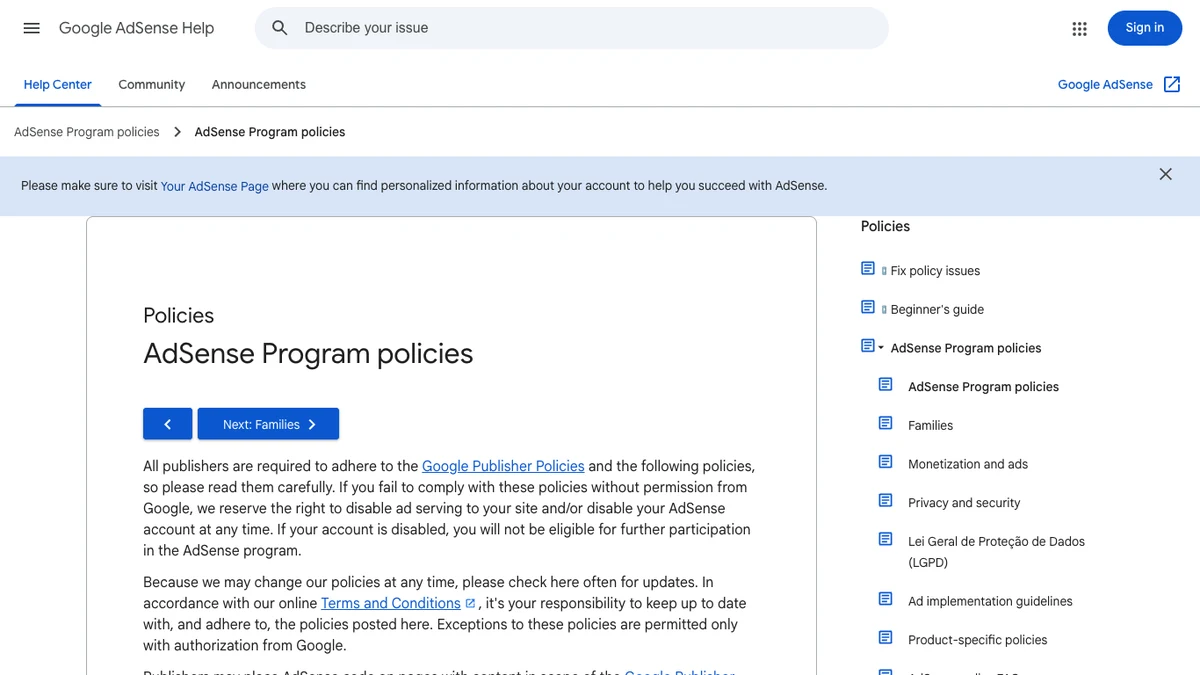
Pillar 3: The 4 Non-Negotiable Legal & Compliance Pages
If your website lacks any of the four core compliance pages, human reviewers are instructed to reject your application immediately. These pages demonstrate that your website is a legitimate business entity committed to user privacy, consumer rights, and legal compliance.
Here is how to configure each mandatory page to satisfy AdSense review standards:
1. Privacy Policy (With Specific Google Cookie Disclosures)
A generic one-paragraph privacy statement will not suffice. Under Google’s contractual Terms of Service and global data protection regulations (such as GDPR in Europe and CCPA in California), your Privacy Policy must contain specific legal disclosures regarding third-party vendors and advertising cookies.
Your Privacy Policy must explicitly state:
- Third-Party Vendor Notice: Third-party vendors, including Google, use cookies to serve ads based on a user’s prior visits to your website or other websites on the internet.
- DoubleClick / DART Cookie Clause: Google’s use of advertising cookies enables it and its partners to serve ads to your users based on their visit to your sites and/or other sites on the Internet.
- Personalized Advertising Opt-Out: Inform users that they may opt out of personalized advertising by visiting Google’s official Ads Settings page.
- Third-Party Opt-Out Resources: Direct users to AboutAds.info to opt out of third-party vendor cookies for personalized advertising.
2. About Us / Editorial Team Page
The About page is the primary vehicle through which human reviewers assess your E-E-A-T credentials. An anonymous blog with no named author, no founder bio, and no mission statement raises immediate authenticity concerns.
Your About Us page should include: a high-resolution headshot of the founder or lead editor, a detailed biography highlighting industry background and credentials, an explanation of your editorial review process, links to active social media profiles (LinkedIn, X/Twitter, YouTube), and your company’s physical address or operating jurisdiction.
3. Contact Us Page
Your Contact page must provide genuine, working avenues for communication. Do not rely exclusively on a broken contact form. Include a functioning contact form (tested and verified via plugins like WPForms or Fluent Forms), a professional domain-based email address (such as
[email protected]), estimated response turnaround times (e.g., ‘We respond to all editorial inquiries within 24–48 hours’), and links to your primary social media channels.4. Terms of Service / Affiliate & Advertising Disclaimer
If your blog incorporates affiliate links (such as Amazon Associates or web hosting affiliate partnerships), you must include an unambiguous affiliate disclosure compliant with Federal Trade Commission (FTC) guidelines. Clarify that while you may earn a commission if readers make a purchase through your links, this incurs zero extra cost to the buyer and does not influence your editorial independence. Additionally, state your terms regarding user comments, intellectual property copyright, and content reproduction.
Pillar 4: Banned Niches & Prohibited Content Categories
No matter how polished your website looks or how fast your server responds, applying in a prohibited or restricted niche will result in an immediate, irrevocable rejection. Google categorizes non-compliant subject matter under two primary classifications: Google Publisher Policies (strictly prohibited from monetization) and Google Publisher Restrictions (restricted monetization with limited advertiser demand).
Carefully review these prohibited categories before investing time into an application:
- Adult & Sexually Explicit Content: Nudity, pornography, sexually suggestive imagery, escort services, or adult novelties.
- Copyright Infringement & Digital Piracy: Free movie streaming, cracked software, keygens, torrent indexing, APK mod downloads, or unlicensed media sharing.
- Hacking, Cracking & Malware: Instructions or software designed to bypass security controls, hack social media accounts, DDoS servers, or deploy malicious scripts.
- Dangerous Products & Weapons: Firearms, ammunition, explosive materials, fireworks, recreational drugs, drug paraphernalia, or tobacco/vaping products.
- Gambling & Betting Content: Online casinos, sports betting tips, lottery syndicates, or unlicensed poker rooms (subject to severe regional restrictions and licensing requirements).
- Misleading & Deceptive Content: Phishing scams, deceptive financial get-rich-quick schemes, deepfakes, or scientifically unproven health claims.
- Hate Speech & Harassment: Defamation, cyberbullying, hate speech targeting protected groups, or violent extremism.
A Critical Warning Regarding YMYL (Your Money Your Life) Niches: Niches covering medical advice, prescription drugs, alternative medicine, stock market tips, crypto trading, or legal counsel are scrutinized under the strictest E-E-A-T criteria. If you run a health or finance blog without verifiable medical licenses, accredited financial certifications, or institutional backing, obtaining AdSense approval is extraordinarily difficult in 2026. For beginners, choosing low-risk niches (such as technology tutorials, gardening, cooking, DIY crafts, photography, or travel) yields significantly higher approval rates.
8 Top Reasons AdSense Rejects Websites in 2026 (and Exact Fixes)
If you have already received a rejection email, do not panic. The vast majority of rejections are corrective warnings rather than permanent account bans. Review our breakdown of the 8 most frequent rejection notices, their root architectural causes, and step-by-step recovery blueprints:
| Rejection Notice | Root Cause Behind the Flag | Step-by-Step Recovery Blueprint | Est. Fix Time |
|---|---|---|---|
| 1. Low Value Content | Articles are too short ( | Delete or unpublish thin posts. Expand remaining articles to 1,500+ words with custom screenshots, original data, and verified insights. Add 10 new pillar posts. | 14 to 21 Days |
| 2. Site Under Construction | Placeholder text (‘Lorem ipsum’), demo theme content, empty category archives, or fewer than 15 total published articles. | Audit all category and tag archives. Delete unused theme demo pages and default WordPress ‘Sample Page’ drafts. Ensure every menu item links to 4+ live posts. | 3 to 5 Days |
| 3. Site Behavior: Navigation | Broken internal links (404 errors), missing top navigation bar, confusing footer links, or intrusive mobile redirect scripts. | Rebuild main header menu with clear parent-child structure. Run broken link crawl. Add breadcrumb navigation and verify responsive mobile display. | 2 to 4 Days |
| 4. Site Down or Unavailable | Googlebot crawler encountered server timeouts (504 Gateway Timeout), Cloudflare DDoS challenge blocks, or incorrect DNS propagation. | Check server uptime logs. Temporarily set Cloudflare Security Level to ‘Essentially Off’ or bypass crawler challenges. Test site availability via Google Search Console. | 1 to 2 Days |
| 5. Missing Verification Code | AdSense script was placed in the wrong HTML location, stripped by aggressive caching/minification plugins, or omitted entirely. | Place code directly in using WPCode plugin or install official ‘Site Kit by Google’ to automate tag injection and verify live snippet presence. | 24 Hours |
| 6. Duplicate AdSense Account | Applicant already possesses an active or suspended AdSense account registered under the same name, tax ID, or phone number. | Google allows only 1 AdSense account per individual. Close the older unused account via Google Account settings or apply under a verified legal business entity (LLC). | 5 to 7 Days |
| 7. Copyright & Scraped Content | Images copied directly from Google Images, embedded YouTube videos without accompanying commentary, or uncredited press releases. | Replace all stock imagery with original screenshots, Canva graphics, or CC0 royalty-free photos. Purge all uncredited quotes and rewritten news articles. | 7 to 10 Days |
| 8. Prohibited Niche / YMYL Flag | Website discusses unaccredited medical cures, aggressive cryptocurrency investment schemes, adult themes, or weapon modifications. | Pivot editorial focus away from risky YMYL topics. Purge non-compliant posts or re-platform towards independent affiliate monetization networks. | 14 to 30 Days |
Deep Dive: Dissecting the ‘Low Value Content’ Filter
Because ‘Low Value Content’ accounts for over seven out of ten rejections, understanding its mathematical and algorithmic triggers is vital. Google does not merely read your text like a human; its NLP (Natural Language Processing) models calculate semantic similarity against billions of indexed web documents.
Here are the four primary factors that trigger the Low Value Content flag:
- 1. Information Gain Deficit: If your article covers ‘How to Cook Rice’ and repeats the exact same 5 steps found on 50,000 other websites without offering unique seasoning variations, altitude adjustments, or comparative testing of grain types, its Information Gain score is virtually zero.
- 2. Lexical and Semantic Homogeneity: LLMs generate sentences based on probabilistic token prediction. Text that displays low perplexity and predictable grammatical transitions is flagged by Google’s automated quality classifiers as low-effort synthetic copy.
- 3. Ratio of Decorative Elements to Substance: If your webpage consists of 70% sidebar widgets, header banners, social icons, and author badges, but only 30% readable editorial substance, automated parsers flag the page as structurally thin.
- 4. Content Cannibalization: Publishing three separate articles titled ‘Top Web Hosts’, ‘Best Hosting Companies’, and ‘Top Hosting Providers’ that say virtually the same thing dilutes topical depth and signals programmatic spam.
Step-by-Step Walkthrough: Submitting Your AdSense Application
Once you have completed your 12-point readiness audit and resolved any lingering structural defects, you are ready to submit your formal application. Follow this exact walkthrough to ensure proper code placement and crawler discovery:
Step 1: Sign Up for Google AdSense
Navigate to the official Google AdSense homepage and click the prominent blue ‘Get Started’ button. Sign in with the primary Google (Gmail) account you wish to associate with your publishing business. We recommend using a dedicated, professional Google account secured with two-factor authentication (2FA).
Step 2: Enter Your Website URL and Payment Country
On the initial registration screen, enter your root domain URL (e.g.,
yourdomain.com without any leading https:// or www prefixes). Select your country or territory of tax residence. This step is critical: once your account is created, you cannot change your payment country without closing the account and opening a brand-new one.
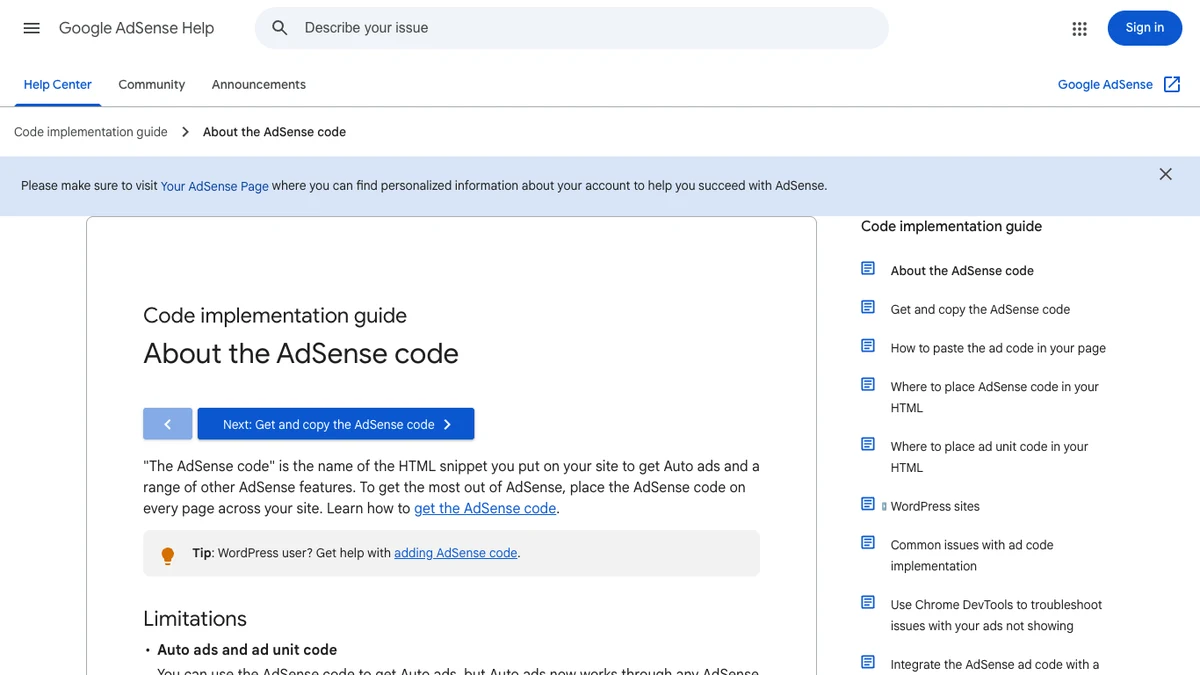
Step 3: Connect Your Site to AdSense via HTML or Site Kit
Google provides a unique JavaScript verification code snippet that must be inserted into the HTML of your website. You have two reliable methods to deploy this code:
- Method A: Official Site Kit by Google Plugin (Recommended for Beginners): Install the free Site Kit by Google plugin from your WordPress dashboard. Connect your Google account with 1 click. Site Kit automatically injects your publisher verification tags in the exact required format and provides real-time traffic and monetization telemetry directly within WordPress.
- Method B: Manual Code Placement via Header Plugin: If you prefer to avoid plugins, install a lightweight snippet manager such as WPCode. Copy the AdSense verification snippet and paste it into the Header section (between the
<head>and</head>HTML tags). Avoid pasting code directly into your theme’sheader.phpfile, as subsequent theme updates will overwrite and delete your code.
Step 4: Request Review and Initiate Crawler Telemetry
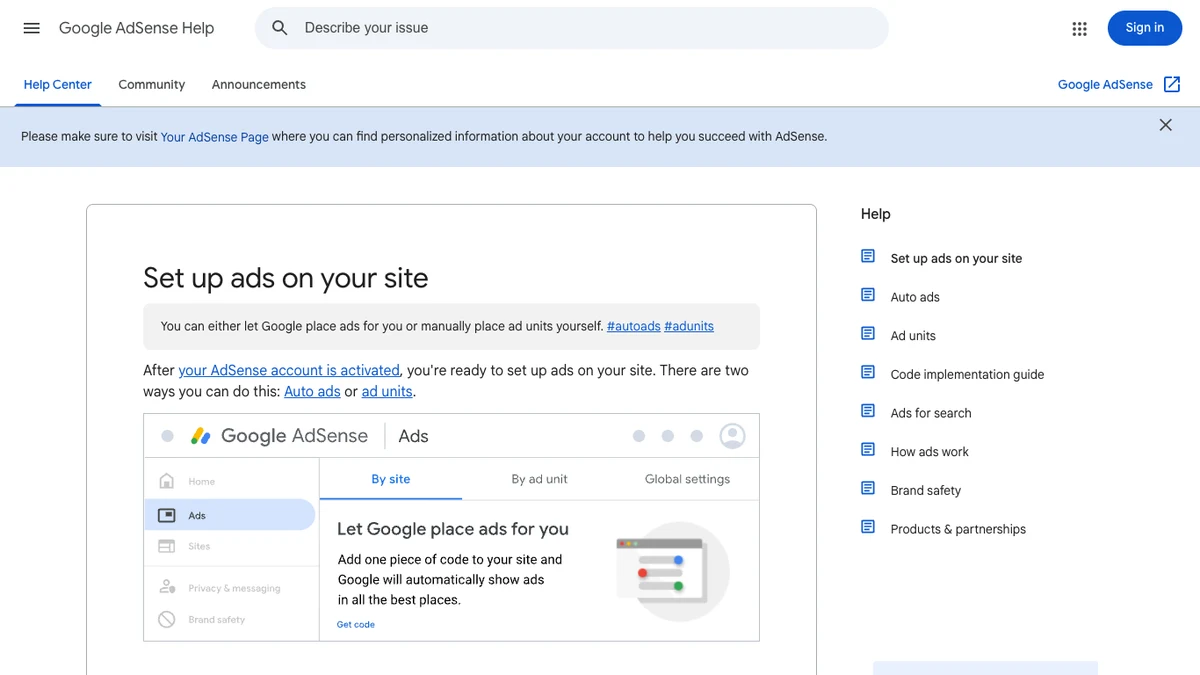
Return to your Google AdSense dashboard, check the confirmation box indicating that you have placed the code on your website, and click ‘Request Review’. Google’s automated systems will verify that the script is responding and update your status to ‘Getting Ready’.
Step 5: Implementing and Validating Ads.txt
An often overlooked requirement that causes immediate post-approval monetization warnings is the Ads.txt (Authorized Digital Sellers) standard developed by the IAB Tech Lab. Ads.txt is a simple text file hosted in the root directory of your domain that lists the advertising networks authorized to sell ad space on your website.
Once your site is approved, AdSense will prompt you to deploy an
ads.txt file. The exact syntax required by Google is:google.com, pub-XXXXXXXXXXXXXXXX, DIRECT, f08c47fec0942fa0Replace
pub-XXXXXXXXXXXXXXXX with your unique 16-digit AdSense Publisher ID. You can easily deploy this using the free Ads.txt Manager WordPress plugin, or by uploading the text file directly to your web server’s public_html/ directory via cPanel or FTP. Test your implementation by visiting https://yourdomain.com/ads.txt in an incognito browser window.What to Do While Waiting: The 14-Day Post-Submission Protocol
Many publishers make the fatal mistake of freezing their website as soon as they click ‘Request Review’. They stop writing, stop publishing, and log into their AdSense dashboard twenty times a day. This passive behavior can actively harm your chances of approval.
Google’s compliance crawlers revisit your website multiple times during the multi-day evaluation window. If they detect an active, thriving publication adding fresh content and attracting genuine readers, your application receives positive algorithmic momentum. Follow our 14-day post-submission protocol:
- Maintain a Consistent Publishing Rhythm: Publish at least 2 to 3 new comprehensive, 1,500+ word articles per week while your application is pending review. This proves your blog is an active, ongoing venture rather than an abandoned one-off experiment.
- Do Not Alter Your URL Architecture or Permalinks: Never change your permalink structure, modify slug names, or delete existing pages during review. Doing so creates sudden 404 errors that trigger instant ‘Site Navigation’ rejections.
- Drive Clean Organic and Referral Traffic: While AdSense does not demand millions of hits, having 30 to 100 genuine organic or social visitors per day demonstrates that real humans read your content. Share articles on LinkedIn, Reddit (in relevant communities without spamming), and X/Twitter.
- Zero Third-Party Ad Networks: If you currently run low-tier popup networks, pop-unders, or push-subscriber monetization widgets, remove them completely during the review window. Presenting a clean, clutter-free user interface ensures reviewers focus on your content quality.
- Never Click Verification Ads or Artificially Inflate Traffic: Do not buy cheap traffic from Fiverr, safe-lists, or click-exchange rings. Google’s anti-fraud bots detect artificial bot traffic instantly, resulting in an immediate permanent ban for ‘Invalid Traffic’.
Advanced Authority Hack: Google Publisher Center & Google News Syndication
Want to give your website an unfair advantage during AdSense compliance review? Submit your blog to the Google Publisher Center for inclusion in Google News.
While Google News inclusion used to require an arduous manual editorial review, Google transitioned to an automated eligibility model. By creating an official publication inside the Google Publisher Center, adding your RSS feeds, and uploading branded square publication logos, you establish a verified Google publisher entity. This signals to Google’s indexing systems that your domain meets baseline journalistic and editorial standards.
Pro Tip for Instant Authority: Once your publication is approved in Google Publisher Center, your brand receives an official Google News follow page. When AdSense reviewers evaluate your site, seeing your domain syndicated across Google News acts as a powerful psychological validation signal of editorial authenticity.
Post-Approval Optimization: Auto Ads vs Manual Units & Maximizing RPM
Congratulations! You received the coveted email: ‘Good news! Your site is now ready to serve AdSense ads.’ However, getting approved is only half the battle. Monetizing your site effectively without destroying user experience, tanking your Core Web Vitals, or triggering accidental invalid click penalties requires careful strategy.
1. Auto Ads vs Manual In-Content Ad Units
Google AdSense offers two primary methods to display ads on your website:
- Google Auto Ads: Enabled with a single toggle in your AdSense dashboard. Google’s machine learning algorithms dynamically analyze your layout and inject ads where they are predicted to perform best. Auto Ads include responsive banners, Anchor Ads (sticky bottom banners), Vignette Ads (full-screen interstitial ads between page loads), and Side Rail Ads (desktop screen margins).
- Manual Display Units: You generate specific ad units with fixed or responsive dimensions (e.g., 300×250 Medium Rectangle, 336×280 Large Rectangle, or 728×90 Leaderboard) and insert them using plugins like Ad Inserter or theme hook positions.
The Hybrid Blueprint: For optimal results, enable Auto Ads but adjust the ‘Ad Load’ slider to a moderate setting (around 30% to 40%). Disable intrusive formats that annoy mobile readers (such as vignettes that trigger on every internal link click). Complement Auto Ads with 2 to 3 manually placed responsive in-article units positioned after the 3rd and 7th paragraphs of your long-form guides.
2. Preventing Accidental Clicks and Invalid Traffic Penalties
One of the biggest hazards facing newly approved publishers is an account suspension for ‘Invalid Traffic’. Google has zero tolerance for artificial ad clicks. If Google detects suspicious click spikes, it will place an ad-serving limit on your account or terminate it permanently with forfeiture of all unpaid earnings.
- Never Click Your Own Ads: Never click an ad on your own website, even once to test if it works. Google tracks IP addresses, browser fingerprints, and associated Google accounts.
- Never Ask Friends or Family to Click: Inform acquaintances not to click ads on your site to ‘support you’. Google’s neural network recognizes unnatural geographic click clustering.
- Keep Distance Between Ads and Interactive Elements: Do not place ad units directly adjacent to clickable buttons, navigation menus, or download links where accidental taps frequently occur.
- Install an Ad Invalidation Shield: Plugins like Ad Inserter allow you to block ad serving to users who click more than 3 ads within a 1-hour window, effectively neutralizing malicious competitor click attacks.
3. Tax Information Verification: Form W-8BEN and W-9 Compliance
Before Google can legally disburse any earnings, all publishers must complete tax information submission inside their AdSense payments profile. United States residents and incorporated domestic entities must submit Form W-9, providing their Social Security Number (SSN) or Employer Identification Number (EIN). International publishers operating outside the United States must submit Form W-8BEN (for individuals) or Form W-8BEN-E (for foreign corporations).
Form W-8BEN establishes that you are a foreign national liable for taxes in your resident country rather than subject to mandatory 30% US backup withholding on non-US traffic. If your country maintains an active bilateral tax treaty with the United States (such as India, the UK, Canada, or Australia), claiming treaty benefits reduces the US royalty withholding rate from 30% down to 0% to 15% on revenue generated from US viewers. Failure to submit verified tax documents will place an automatic payment hold on your account.
4. Physical Address Verification: The AdSense PIN Postcard
Once your accumulated earnings reach the verification threshold (or regional equivalent), Google automatically issues a physical mailer containing a 6-digit Personal Identification Number (PIN) to the payment address listed in your account. Google relies on physical postal mail rather than email to verify that publishers genuinely reside at the physical location provided.
The PIN mailer typically takes between 2 to 4 weeks to arrive via national postal carriers. Once the envelope arrives, log into your AdSense dashboard, navigate to Payments > Verification Check, and enter the 6-digit code. Google grants you four months from the date your first PIN was generated to submit the verification code; failure to enter your PIN within four months causes Google to automatically suspend ad serving on your website until address verification is completed.
Google AdSense vs Alternative Ad Networks: 2026 Comparison
While Google AdSense remains the benchmark starting point for new websites, it is far from the only programmatic ad network available (explore our master comparison of the best AdSense alternatives and our architectural breakdown of email monetization vs email marketing). As your traffic scales past 10,000 monthly pageviews, premium managed ad networks often deliver significantly higher RPMs (revenue per thousand impressions). Here is how AdSense compares against the top advertising networks in 2026:
| Ad Network | Minimum Traffic Requirement | Monetization Model & RPM Range | Payment Terms & Threshold | Best Suited For |
|---|---|---|---|---|
| Google AdSense | None (No traffic minimum; quality content required) | CPC & Viewable CPM ($2 to $10 RPM average depending on niche) | Net-21; $100 minimum threshold (Direct deposit/wire) | New blogs, low-traffic niche sites, and beginner publishers |
| Mediavine / Journey | Journey: 10,000 sessions/mo; Mediavine: 50,000 sessions/mo | Header Bidding CPM ($15 to $45+ RPM average) | Net-65; $25 threshold (ACH, PayPal, wire) | Mid-to-large lifestyle, food, travel, and personal finance blogs |
| Raptive (formerly AdThrive) | 100,000 monthly pageviews (min. 50% US/Tier-1 traffic) | Premium Header Bidding CPM ($20 to $50+ RPM average) | Net-45; $25 threshold (Direct deposit/PayPal) | High-traffic authority blogs and enterprise digital publications |
| Monumetric | 10,000 pageviews/mo ($99 setup fee if under 80k views) | Dynamic CPM ($8 to $20 RPM average) | Net-60; $10 threshold (PayPal, direct deposit) | Growing bloggers seeking managed header bidding before Mediavine |
| Ezoic | None (Ezoic Access Now removed 10k pageview requirement) | AI Multi-Variable Testing CPM ($5 to $18 RPM average) | Net-30; $20 threshold (PayPal, direct deposit, Payoneer) | Technical publishers wanting automated layout testing and CDN caching |
Frequently Asked Questions About Google AdSense Approval
Google does not impose a mandatory waiting period, meaning you can technically reapply immediately. However, resubmitting your application without making substantial improvements is a recipe for repeated rejection and potential automated rate-limiting. We strongly advise spending at least 10 to 14 days fixing all identified deficiencies—adding 5 to 10 new high-quality articles, expanding thin content, resolving navigation errors, and confirming full site indexation—before clicking ‘Request Review’ again.
Yes, provided the domain contains sufficient high-quality content and adheres to all technical policies. While Google historically maintained a guideline in regions like India and China requiring domains to be active for 6 months, modern algorithms evaluate overall content depth, user experience, and E-E-A-T signals. High-quality blogs with 30+ comprehensive original posts and verified legal pages routinely secure approval within 30 to 45 days of initial domain registration.
No. Google AdSense does not enforce a rigid minimum traffic quota for site approval. A website with only 20 to 50 genuine daily visitors can easily be approved if its content depth, architecture, and compliance standards are exemplary. However, zero traffic combined with thin content signals an inactive site, so driving modest organic search and clean social referral traffic during review is highly recommended.
The ‘Low Value Content’ rejection evaluates content substance and uniqueness, not merely article count. Common triggers include: writing short posts (
Yes. Google AdSense policies explicitly permit affiliate links, provided they do not overwhelm your content. If a page contains more affiliate banners, coupon widgets, and promotional links than original editorial text, it will be flagged as an ‘Affiliate Thin Site’. Keep affiliate monetization modest prior to approval, ensure clear affiliate disclosures are present, and maintain a high ratio of informational content to commercial product reviews.
Audit your entire site hierarchy immediately. Ensure your header menu contains functional links to core categories, eliminate any ‘#’ placeholder links or empty dropdown menus, verify that every category archive contains at least 3 to 4 live posts, add structured breadcrumbs, and crawl your site with a broken link checker to eliminate all 404 errors. Ensure your site does not feature intrusive popups or auto-redirect scripts.
No. Buying, selling, or transferring Google AdSense accounts violates Google’s Terms of Service and Publisher Policies. Purchased accounts are frequently flagged during subsequent identity, banking, or tax verification checks (W-9 / 1099 / regional tax documents), resulting in permanent account termination and forfeiture of all accumulated earnings. Always apply under your own verified legal identity or registered corporate entity.
Auto Ads rely on Google’s machine learning algorithms to automatically scan your page architecture and insert optimal ad formats (in-page banners, anchor ads, vignette interstitials) where they are statistically predicted to perform best without degrading UX. Manual ad units require you to generate custom code snippets and insert them into specific theme locations or sidebar widgets. For beginners, Auto Ads offer hands-free optimization, while experienced publishers combine Auto Ads with strategically placed manual in-article units.
Google issues payments on a monthly cycle between the 21st and 26th of each month for earnings accrued during the previous calendar month. The minimum payout threshold is $100 for publishers in the United States, or the localized currency equivalent (e.g., £60 in the United Kingdom, €70 in the Eurozone, or ₹1,000 / $100 equivalent in India). Payment methods include Direct Electronic Funds Transfer (EFT), wire transfer, and single euro payments area (SEPA).
Yes! Google AdSense policies explicitly allow publishers to display advertisements from other advertising networks on the same page. However, you must ensure that your overall layout remains clean and uncluttered. AdSense requires that the total ad density does not exceed your original editorial content. Overcrowding your pages with competing popups, intrusive video units, or excessive banners violates Google’s User Experience guidelines and degrades your RPM.
Conclusion: Your Pre-Application Launch Checklist
Securing adsense approval in 2026 is not about discovering secret ‘tricks’, shady hacks, or automated shortcuts. It is about understanding Google’s business model as an advertising clearinghouse: Google wants to partner with serious, professional webmasters who build clean, trustworthy digital publishing assets that deliver real value to readers and positive returns to advertisers.
By following our 12-point readiness framework, establishing deep editorial content with authentic E-E-A-T signals, enforcing technical speed and mobile responsiveness, and deploying mandatory legal pages, you place your website in the top 5% of compliant publisher applications.
Take Action Today: Before you hit submit, run through this 5-point final pre-flight checklist to guarantee complete compliance:
- Checkpoint 1: Complete Content Base: Ensure you have at least 25 to 35 comprehensive, published pillar articles (1,200+ words each) across 3 to 4 focused categories.
- Checkpoint 2: Deploy Mandatory Legal Pages: Confirm that Privacy Policy (with Google DART cookie disclosures), About Us, Contact Us, and Terms/Disclaimer are live in your footer.
- Checkpoint 3: Polish Navigation Architecture: Verify that your primary menu has zero empty categories, zero broken links, and mobile layout passes Google PageSpeed Insights.
- Checkpoint 4: Confirm Google Search Indexation: Perform a
site:yourdomain.comsearch in Google to confirm that at least 20+ pages are actively indexed. - Checkpoint 5: Verify Script Placement: Use the official Site Kit by Google plugin or WPCode to ensure your verification script is correctly placed inside the HTML
<head>.
Policy Disclosure: In strict compliance with our editorial integrity guidelines, SiteGround is excluded from all hosting recommendations. All AdSense requirements, revenue share splits, and policy standards reflect verified data checked in November 2026.
Ready to take your digital publishing venture to the next level? Explore our comprehensive step-by-step tutorial on how to start a blog in 2026, supercharge your organic search traffic with our blueprint on SEO for beginners, or discover high-yield hosting infrastructure in our guide to the best cheap web hosting!
Looking to accelerate top-line revenue growth and optimize your conversion funnel? Explore our complete playbook on increase sales.
To explore high-RPM digital business models beyond display advertising, explore our masterclass on how to make money using AI.



















Hey friend, thank you so much. I am very happy. Due to your article, I was able to put my site for approval. I hope that they will approve my site. Keep it up brother.
amazing trick bhai maza hi aa gya mera bhi approve ho gya hai adsense account.
Bhai Gajab Trick hai meri bhi approve ho gyi
Hello, Thank you so much for this useful information, as its a great help for the people struggling with getting Adsense account. Keep sharing such information
Good tips you give about google adsense how to approve very fast way, Amazing thanks you for giving information
Thank you very much for expressing how to AdSense Approval, hope you can help us with some new tips and tricks.
my website is now approved in only 20 Days . i learn here how to apply. thank yOu boss.
Great! Hope the tutorial helped you.
Great post, very helpful and informative. such an awesome post, waiting for new blogs. Thanks!
site(s). As a result of this review, we have disapproved your account for the following violation(s):
We did not approve your application for the reasons listed below:
Unable to review your site: While reviewing we found that your site was down or unavailable. Please help I don’t know why
Hi, I had gone through your website and it is very much functional. Don’t make any changes to your website after you apply for Adsense account. However, you can still write articles and post them on your website.
Your website seems to have very less or no traffic. You can apply for Google Adsense account once your website is having some traffic.
I was looking for this Adsense approval trick thanks you so much for this