Quick answer
- What are the most effective blog name ideas and naming formulas in 2026? The most successful blog name ideas leverage six proven architectural formulas: Compound Words (pairing two vivid nouns like TechCrunch or Foodbeast), Portmanteaus/Blends (merging concepts like Pinterest or Groupon), Evocative Metaphors (igniting emotional imagery like Wirecutter or Pitchfork), Descriptive Keyword Combos (stating the exact niche like Copy<a href="/blogger-to-<a href="/best-contact-form-plugins-how to create a review website on WordPress/”>best WordPress contact form plugins on WordPress/”>migrating from Blogger to WordPress), Invented/Abstract Neologisms (creating fresh coined words like Spotify or Etsy), and Founder Names (anchoring personal authority like NeilPatel)..tp-post-content code, .tp-post-content pre, .toc-link{word-break:break-word!important;overflow-wrap:break-word!important;}
- How do you evaluate if catchy blog names pass the ‘Radio Test’? The Radio Test requires that when you speak your blog name aloud across a noisy audio channel without spelling it, listeners immediately know how to type it into their browser on the first attempt without guessing. Top blog name ideas avoid hyphens, intentional misspellings, ambiguous homophones (e.g., ‘to’, ‘too’, ‘two’, or ‘four’ vs ‘for’), and adjacent duplicate consonants.
- Should you prioritize a .com extension when brainstorming blog name ideas? Yes. Over 73% of spontaneous web traffic instinctively appends
.comto any domain name they recall. While modern alternatives like.co,.io, and.blogare widely accepted in developer and creative niches, securing the matching.comdomain remains the paramount benchmark for establishing immediate consumer credibility, preventing traffic leakage, and maximizing domain resale valuation. - How do you protect your creative blog names against trademark infringement? Before registering your domain, you must conduct a rigorous clearance search across official registries: search the USPTO Trademark Electronic Search System (TESS) in the United States, check WIPO globally, and verify common-law usage on Google and social media networks. Securing a domain does not grant trademark rights, and launching on an infringing name risks costly cease-and-desist orders.
- What is the best workflow when looking for blog name ideas in 2026? Combine AI-assisted creative brainstorming with disciplined manual phonetic filtering. Start by mapping your niche lexicon (nouns, active verbs, vivid adjectives), pass targeted prompt matrices into language models to generate hundreds of candidate variations, filter candidates against the Radio Test, audit USPTO trademarks and social handles via Namechk, and register the winning
.comimmediately through an ICANN-accredited registrar like Namecheap or Cloudflare.
Selecting the right name for your new publishing venture or digital business is one of the most critical foundational milestones in your entrepreneurial journey. Your name serves as your digital storefront, your intellectual property brand identity, and the very first impression potential readers, sponsors, and search engine algorithms form about your authority. When aspiring creators seek out compelling blog name ideas in 2026, they quickly discover that the digital landscape is vastly crowded. With hundreds of millions of registered domain names worldwide, discovering an available, punchy, memorable, and legally unencumbered moniker requires both creative ingenuity and structured engineering discipline.
Many beginners make the disastrous mistake of rushing through the naming phase. They settle for cumbersome, hyphenated domain strings, awkward intentional misspellings (such as replacing ‘s’ with ‘z’), or generic, keyword-stuffed phrases that feel sterile and completely unbrandable. Others choose a name that is so narrow it restricts their future business growth—such as naming a blog after a specific camera model, only to find themselves completely trapped when that technology becomes obsolete two years later. Exploring high-caliber blog name ideas requires balancing niche relevance with limitless expansion potential.
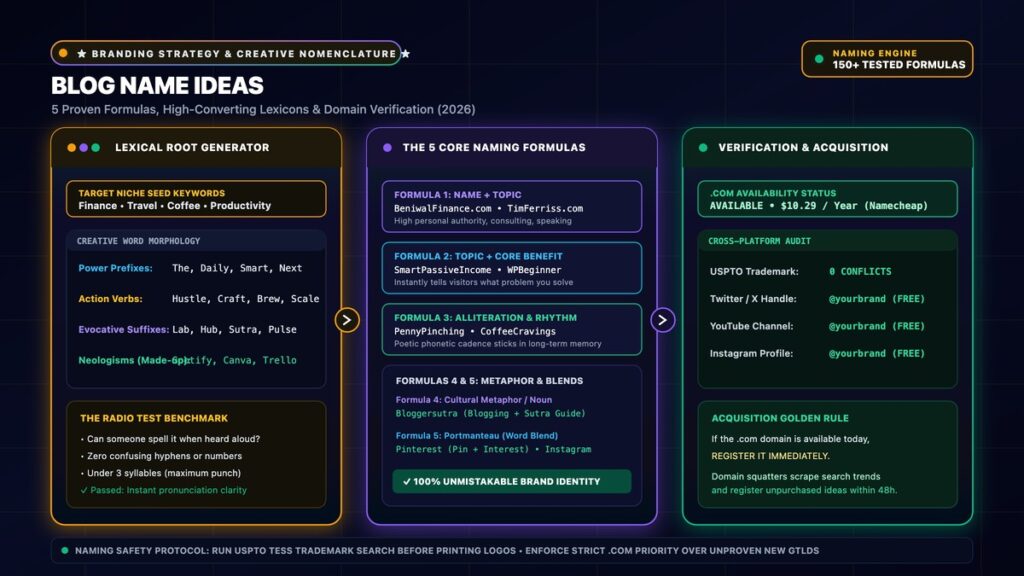
To build an enduring digital asset that commands audience trust, you need a repeatable naming framework. Whether you are seeking catchy blog names for a food blog, lifestyle publication, technical developer hub, personal finance journal, or e-commerce storefront, this masterclass provides a complete, 360-degree blueprint. We explore the cognitive psychology behind brand recall, dissect the six core naming formulas, provide curated lexicons across major niches, compare AI prompt workflows against manual phonetic brainstorming across three technical comparison tables, and deliver an automated Python name generator and evaluator script.
Before you connect your brand to hosting in our guide on domain vs hosting, dive into WordPress plugin vs widget and WordPress settings, or discover how to choose a WordPress theme, let us unpack the definitive methodology for uncovering world-class blog name ideas.
The Cognitive Psychology of Memorable Blog Names
Why do certain brand names instantly lodge themselves into our long-term memory while others evaporate within seconds? Cognitive psychologists and behavioral linguists have studied brand recall for decades. When generating blog name ideas, understanding human cognitive processing helps you craft names that trigger immediate familiarity and subconscious trust.
Three fundamental psychological phenomena govern how the human brain processes, stores, and retrieves digital brand names:
1. Processing Fluency (The Ease of Pronunciation): Cognitive fluency refers to how effortlessly our brains process incoming information. Studies in consumer psychology consistently demonstrate that words that are easy to pronounce, phonetically rhythmic, and structurally predictable are perceived as significantly more trustworthy, familiar, and appealing than complex, jagged words. In the context of blog name ideas, names with balanced vowel-to-consonant ratios and soft plosives (such as b, p, d, t, k) activate positive emotional resonance in the auditory cortex.
2. The Picture Superiority Effect & Mental Imagery: The human brain is biologically wired to store visual imagery far more efficiently than abstract lexical strings. When evaluating blog name ideas, names that immediately conjure a vivid mental picture—such as The Wirecutter (tools, precision, metal craft) or NerdWallet (intelligence, calculators, secure money)—enjoy double the unprompted recall rates of abstract, semantic phrases. Infusing tangible sensory nouns into catchy blog names gives readers a concrete mental anchor.
3. Syllabic Rhythm and Cadence (The Rule of 2 to 3 Syllables): Analyze the most recognized web publications and digital brands in the world: Google (2 syllables), Reddit (2 syllables), Twitter (2 syllables), Medium (3 syllables), TechCrunch (2 syllables), YouTube (2 syllables). When brainstorming blog name ideas, names that exceed four syllables create cognitive friction and auditory exhaustion. Aiming for a concise 2-to-3 syllable cadence optimizes both verbal sharing and visual scanning in search engine result pages.
The 6 Architectural Blog Naming Formulas
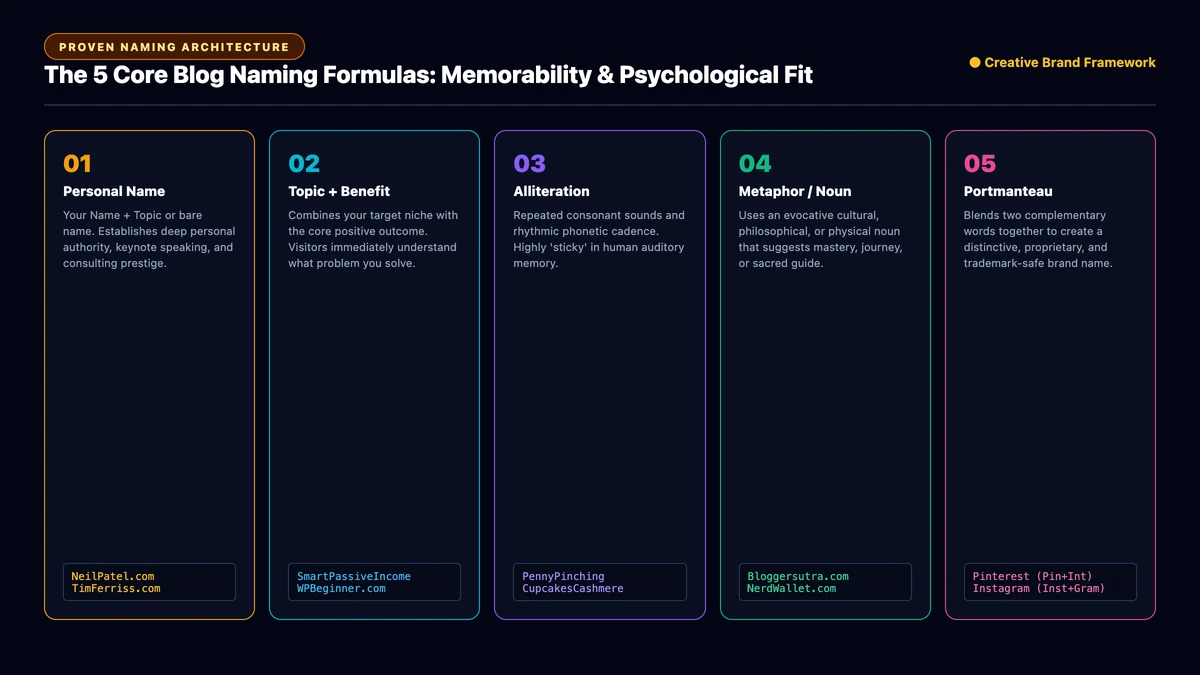
Rather than staring at a blank piece of paper waiting for creative inspiration to strike, elite branding agencies rely on structural naming formulas. When developing blog name ideas, these six architectural frameworks provide an endless pipeline of viable concepts:
• Formula 1: The Compound Word (Noun + Noun / Adjective + Noun): Pairing two distinct, concrete words to forge a unified brand meaning. Examples: TechCrunch, Foodbeast, NerdWallet, PocketLint, DigitalOcean. This is the single most reliable framework for discovering available
• Formula 2: The Blend or Portmanteau (Mashing Word Segments): Fusing segments of two distinct words together into an organic hybrid. Examples: Pinterest (Pin + Interest), Groupon (Group + Coupon), Instagram (Instant + Telegram), Bloggersutra (Blogger + Sutra/Guide). Portmanteaus make for exceptionally unique creative blog names that are frequently unencumbered by prior trademark registrations.
• Formula 3: The Evocative Metaphor (Symbolic & Indirect Imagery): Selecting a word or concept that embodies the spirit, feeling, or philosophy of your publication without explicitly describing the mechanical niche. Examples: The Wirecutter (gadget reviews), Pitchfork (independent music critique), Smashing Magazine (cutting-edge web design), Refinery29 (curated lifestyle). Evocative blog name ideas offer supreme brand longevity because they never box you into a narrow topical corner.
• Formula 4: The Descriptive Functional (Niche + Audience / Action): Clearly and concisely stating exactly what your publication delivers to the audience. Examples: Copyblogger, ProBlogger, Social Media Examiner, Search Engine Journal. While descriptive names require creative effort to secure clean domains, they provide instant SEO context and zero visitor confusion.
• Formula 5: The Abstract Neologism (Coined / Invented Words): Constructing a completely novel linguistic invention by combining pleasant phonetic roots. Examples: Spotify, Zillow, Etsy, Hulu, Uber. Neologisms provide maximum trademark defensibility and effortless domain acquisition, though they require substantial promotional marketing to educate consumers on what the publication represents.
• Formula 6: The Personal Founder Authority (Name + Modifier): Anchoring the publication in your individual name or professional persona. Examples: Neil Patel, Tim Ferriss, Marie Forleo, Backlinko (Brian Dean). Ideal for consulting, coaching, thought leadership, and solo advisory blogs where personal trust is the core monetization engine.
.com domains while maintaining immediate semantic clarity. Compound blog name ideas allow you to anchor one word in your niche while using the second word to establish your unique tone.• Formula 2: The Blend or Portmanteau (Mashing Word Segments): Fusing segments of two distinct words together into an organic hybrid. Examples: Pinterest (Pin + Interest), Groupon (Group + Coupon), Instagram (Instant + Telegram), Bloggersutra (Blogger + Sutra/Guide). Portmanteaus make for exceptionally unique creative blog names that are frequently unencumbered by prior trademark registrations.
• Formula 3: The Evocative Metaphor (Symbolic & Indirect Imagery): Selecting a word or concept that embodies the spirit, feeling, or philosophy of your publication without explicitly describing the mechanical niche. Examples: The Wirecutter (gadget reviews), Pitchfork (independent music critique), Smashing Magazine (cutting-edge web design), Refinery29 (curated lifestyle). Evocative blog name ideas offer supreme brand longevity because they never box you into a narrow topical corner.
• Formula 4: The Descriptive Functional (Niche + Audience / Action): Clearly and concisely stating exactly what your publication delivers to the audience. Examples: Copyblogger, ProBlogger, Social Media Examiner, Search Engine Journal. While descriptive names require creative effort to secure clean domains, they provide instant SEO context and zero visitor confusion.
• Formula 5: The Abstract Neologism (Coined / Invented Words): Constructing a completely novel linguistic invention by combining pleasant phonetic roots. Examples: Spotify, Zillow, Etsy, Hulu, Uber. Neologisms provide maximum trademark defensibility and effortless domain acquisition, though they require substantial promotional marketing to educate consumers on what the publication represents.
• Formula 6: The Personal Founder Authority (Name + Modifier): Anchoring the publication in your individual name or professional persona. Examples: Neil Patel, Tim Ferriss, Marie Forleo, Backlinko (Brian Dean). Ideal for consulting, coaching, thought leadership, and solo advisory blogs where personal trust is the core monetization engine.
Blog Naming Formula & Brand Archetype Comparison Matrix
Examine the architectural matrix below comparing the six primary naming archetypes across brand defensibility, memorability, and domain viability:
| Naming Formula | Structural Mechanics | Iconic Real-World Examples | Brand Defensibility | Domain Availability (.com) | Best Suited For |
|---|---|---|---|---|---|
| Compound Word | Noun + Noun / Adj + Noun | TechCrunch, NerdWallet, Food52 | High (Unique pairing) | Moderate (Requires iteration) | Tech, Finance, Lifestyle, Gear |
| Portmanteau / Blend | Fusing morphemes of 2 words | Pinterest, Groupon, Instagram | Very High (Distinct neologism) | High (Novel linguistic word) | Social platforms, Creative hubs |
| Evocative Metaphor | Symbolic noun evoking tone | Wirecutter, Pitchfork, Quartz | Maximum (Conceptual asset) | Moderate to Low (Dictionary nouns) | High-end journalism, Niche critique |
| Descriptive / Functional | Exact niche + action/role | Copyblogger, ProBlogger, SEJ | Moderate (Risk of descriptiveness) | Low (High domain competition) | Educational portals, Industry guides |
| Abstract Neologism | Coined invented syllables | Spotify, Etsy, Zillow, Canva | Maximum (Pure distinctiveness) | Very High (Endless combinations) | SaaS blogs, Modern digital hubs |
| Founder / Persona | Personal name + qualifier | NeilPatel, TimFerriss, Avinash | High (Inherent personal identity) | High (Assuming unique name) | Consultants, Creators, Executives |
Curated Blog Name Ideas Across 5 Major Niches
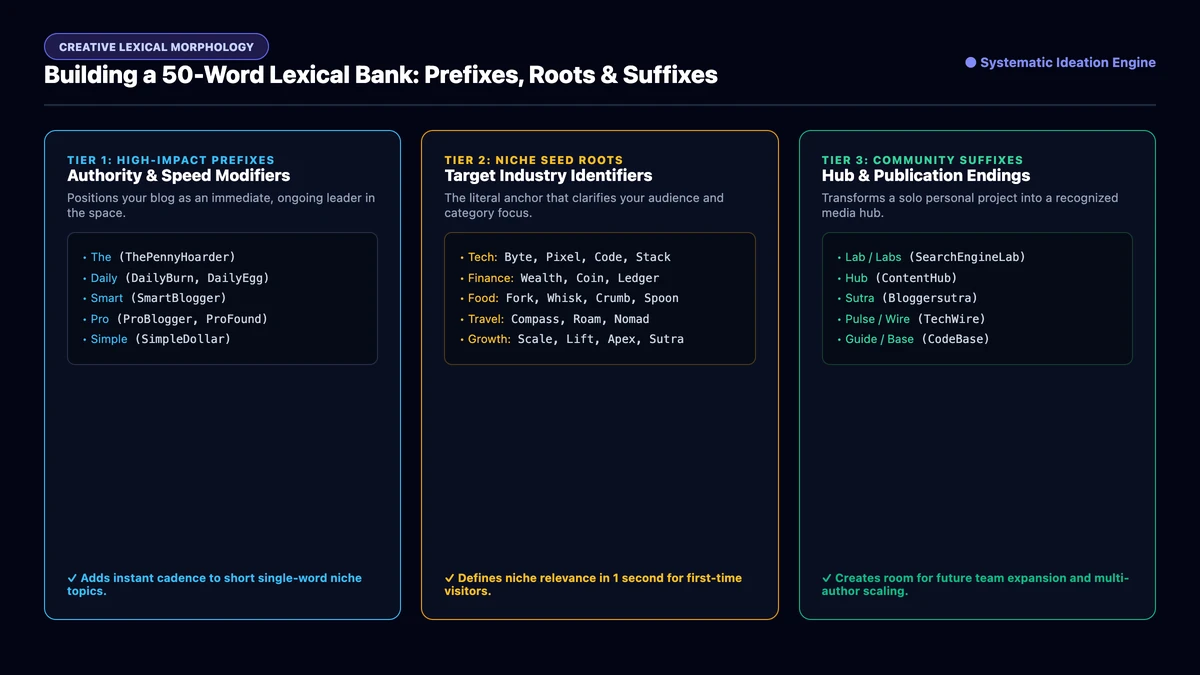
To stimulate your creative ideation process, we have curated over 100 structured, brandable blog name ideas across five of the most popular, high-yielding publishing verticals in 2026. Each concept utilizes the psychological hooks and architectural formulas outlined above:
1. Technology, AI & Web Development Blog Name Ideas
In the technology and developer sphere, authority stems from precision, engineering clarity, and forward momentum. Winning blog name ideas in this space combine computational nouns with dynamic modifiers:
- CodeFoundry / SyntaxFoundry: Evokes industrial reliability, precision programming, and artisanal software architecture.
- ByteForge / LogicForge: Suggests active creation, hands-on coding, and deep technical engineering.
- AlgorithmicDigest: Communicates academic rigor, machine learning insights, and curated data analysis.
- DevVector / CloudVector: Represents deliberate technical direction, trajectory, and modern DevOps mastery.
- CircuitPulse / SiliconPulse: Conveys real-time hardware news, semiconductor analysis, and bleeding-edge computing.
- TerminalCrafter: Tailored for terminal-centric developers, CLI tool enthusiasts, and Linux administrators.
- NextStackJournal: Focuses on full-stack web frameworks, serverless infrastructure, and modern JavaScript runtimes.
- DataDriftReview: Specialized for data scientists and ML engineers monitoring model performance in production.
2. Personal Finance, Wealth & Investing Blog Name Ideas
In personal finance, trust, prudence, and growth are paramount. Catchy blog names in wealth management must balance stability with inspiring upward trajectory:
- CompoundingCraft: Emphasizes the mathematical miracle of compound interest, long-term wealth, and financial discipline.
- YieldCompass: Portrays navigational clarity through the complex landscape of high-yield savings, dividends, and real estate.
- FrugalSovereign: Appeals to the Financial Independence, Retire Early (FIRE) demographic seeking autonomy through lean living.
- LedgerNomad: Combines remote digital nomad work with meticulous tax optimization and portable wealth building.
- CapitalBlueprint: Projects architectural precision, portfolio allocation models, and strategic investing frameworks.
- WealthCadence: Inspires steady, rhythmic financial progress over erratic market speculation.
- PennyMatrix: A modern, analytical lens on micro-savings, budgeting software, and cash-back optimization.
3. Health, Wellness, Fitness & Nutrition Blog Name Ideas
Health and wellness publications require vitality, scientific credibility, and holistic vitality. Explore these dynamic blog name ideas:
- VitalityGrid: Merges holistic physiological wellness with structured, daily actionable health tracking.
- MetabolicFocus: Connects biohacking, intermittent fasting, and metabolic health for high-performance longevity.
- IronPinnacle: Appeals to strength training purists, powerlifters, and barbell athletics.
- NourishMatrix: Balances evidence-based nutritional biochemistry with delicious, wholesome meal preparation.
- KineticPulse: Inspires movement, mobility rehabilitation, cardio endurance, and athletic vitality.
- PrimalBreathe: Evokes nervous system regulation, somatic breathwork, meditation, and stress alleviation.
4. Travel, Adventure & Digital Nomad Blog Name Ideas
Travel blogs thrive on wanderlust, sensory exploration, and cultural immersion. These creative blog names spark geographic curiosity:
- NomadMeridian: Conjures images of global navigation, meridian lines, remote work, and borderless adventure.
- CompassAndCarry: Combines navigational discovery with minimalist one-bag travel philosophy.
- WanderLatitude: Expresses unrestrained geographical exploration across uncharted climates and cultures.
- RoamAtlas: Classic, authoritative, and evocative of detailed cartography and deep cultural road trips.
- VagabondProtocol: Tailored for budget-conscious backpackers, travel hackers, and solo international explorers.
- WaypointDrift: Reflects spontaneous travel, slow exploration, and discovering off-the-beaten-path destinations.
5. Food, Culinary Arts & Specialty Cooking Blog Name Ideas
Culinary publications demand sensory richness, aroma, warmth, and kitchen mastery. Consider these appetizing blog name ideas:
- SavorFoundry: Celebrates the craft of recipe development, fermentation science, and gourmet techniques.
- SimmerAndSpice: Alliterative, comforting, and instantly communicates home-cooked comfort and culinary depth.
- CastIronCanvas: Honors traditional skillet cooking, artisanal baking, and rustic kitchen aesthetics.
- UmamiChronicles: Focuses on savory flavor compounds, Japanese culinary traditions, and fermentation.
- The Baker’s Proof: Tailored for sourdough enthusiasts, pastry artisans, and precision baking science.
- HarvestPalette: Emphasizes farm-to-table seasonal eating, organic gardening, and plant-forward dining.
AI Blog Name Generators vs Manual Brainstorming: The Hybrid Protocol
In 2026, the emergence of advanced Large Language Models has fundamentally transformed how digital creators generate blog name ideas. Traditional automated name spinners (like older tools that simply attached random suffixes like ‘hub’ or ‘central’) have been superseded by nuanced AI conversational prompting. However, relying purely on raw AI output or strictly on manual brainstorming both carry distinct hazards.
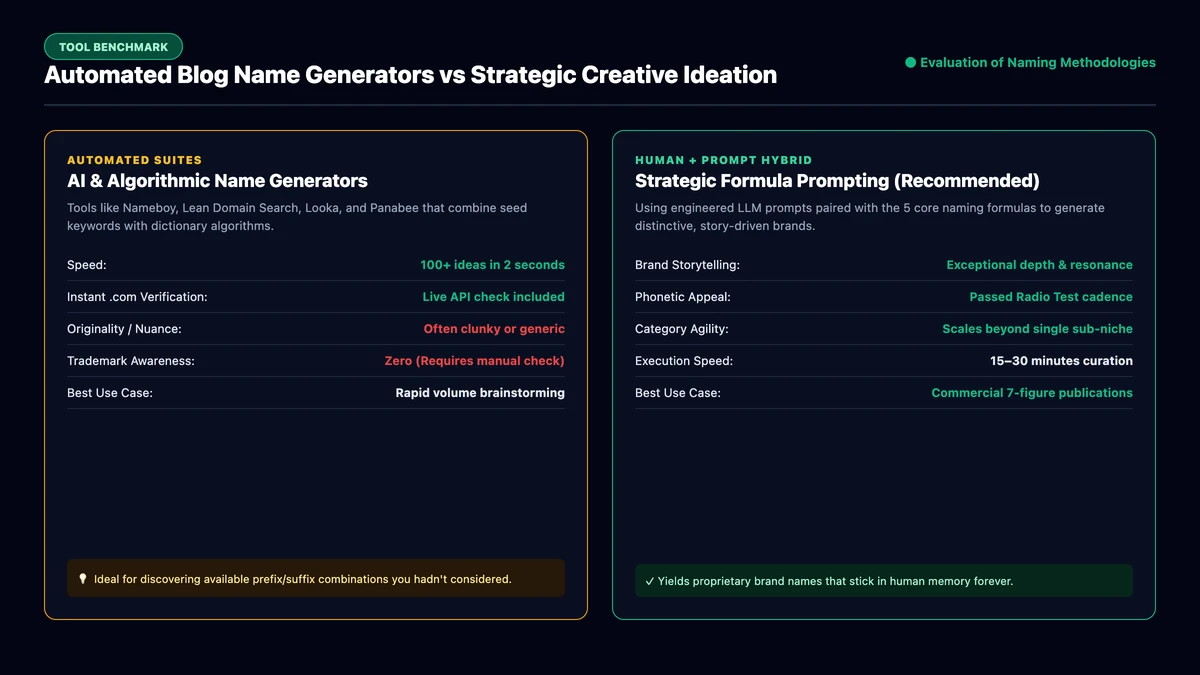
The true secret to uncovering extraordinary blog name ideas lies in an iterative Hybrid Human-AI Protocol:
• The Pitfalls of Pure AI Generation: Generic prompts (e.g., ‘give me 20 tech blog names’) inevitably yield tired, clichéd results stuffed with overused buzzwords like ‘TechHub’, ‘CyberWorld’, ‘DigitalSphere’, or ‘SmartBytes’. Furthermore, AI models have no real-time awareness of existing registered trademarks or active domain portfolios, often hallucinating names that have been trademarked for decades.
• The Pitfalls of Pure Manual Brainstorming: Human creators suffer from semantic fatigue and subconscious cognitive bias. After writing down 30 ideas, human ideation slows dramatically, repeatedly circling around the same narrow vocabulary clusters.
• The Winning Hybrid Protocol: First, manually build a domain-specific lexicon of 40 words (nouns, action verbs, textures, metaphors). Second, feed this lexicon into an AI model using structured role-prompting (e.g., ‘Act as a Madison Avenue brand naming partner. Using this custom lexicon, generate 50 compound names following the rule of 2 syllables, soft plosives, and zero hyphens’). Third, apply human editorial taste, phonetic verification, and trademark screening to the output.
AI Naming Tools & Methodology Benchmark Matrix
Compare the capabilities, strengths, and limitations of modern naming methodologies in the technical benchmark below:
| Naming Tool / Workflow | Primary Mechanism | Strengths for Blog Name Ideas | Primary Limitation | Ideal User Persona |
|---|---|---|---|---|
| Claude / ChatGPT Prompt Matrix | LLM Semantic Conditioning | Vast lexical nuance, customized phonetic rules, rapid iteration | No native domain or trademark verification | Professional bloggers, digital agencies |
| Looka / BrandBucket | Visual brand & logo coupling | Pairs names with typography, color palettes, and brand identity | Heavy commercial bias toward premium domains | Design-centric entrepreneurs, startups |
| Nameboy / DomainWheel | Algorithmic keyword combiner | Direct integration with registrar APIs for instant availability | Produces repetitive, mechanical compound strings | Complete beginners seeking fast .com matches |
| Manual Lexicon Mind-Mapping | Linguistic association & thesaurus | Produces deeply authentic, unique personal metaphors | High cognitive effort, slow output, semantic fatigue | Boutique authors, literary essayists |
| Python Automated Generator | Scripted syllabic combinations | Customizable phonetic filtering, instant bulk evaluation | Requires Python runtime environment execution | Technical bloggers, software engineers |
The 5-Point Brandability & Memorability Checklist
Before you fall in love with any candidate among your blog name ideas, you must put it through a rigorous qualitative gauntlet. A name might look stunning written down on paper, but if it fails when spoken, typed, or displayed in tiny mobile typography, it will handicap your growth permanently.
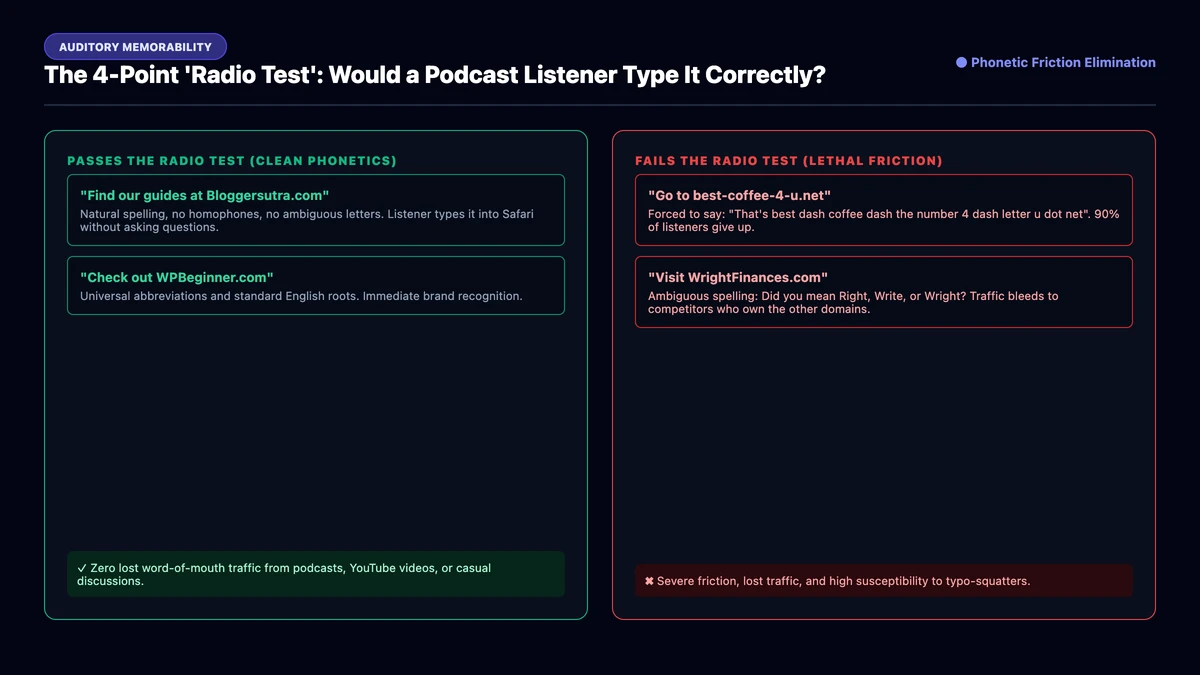
Evaluate your top candidate against these five non-negotiable brandability criteria:
1. The Golden Radio Test (Phonetic Clarity): Imagine you are a guest on a popular podcast or national radio show. The host turns to you and asks, ‘Where can our listeners find your work?’ You say your domain name once. Do listeners immediately know how to spell it into their mobile browser, or do you have to explain: ‘It’s tech-crunch with a hyphen, and byte is spelled with an ‘i’, not a ‘y”? If you have to spell out your domain name, it has completely failed the Radio Test. Eliminate ambiguous spellings immediately.
2. Zero Consecutive Duplicate Letters: When combining two words into a compound domain name (e.g., WordPressSettings or BookKeep), pay close attention to the seam between the words. If the first word ends with the exact same letter that begins the second word (such as
PressSecret with double ‘s’), users will constantly mistype it as a single letter, resulting in high bounce rates, 404 errors, and potential phishing exposure to typosquatters.3. Avoid Numbers and Hyphens at All Costs: Using hyphens (e.g.,
best-coffee-guide.com) or numbers (e.g., travel4life.com) is an immediate visual red flag for consumers. Hyphenated domains carry a lingering association with low-quality affiliate spam from the early 2000s. Furthermore, mobile keyboards require toggling between character screens to type hyphens and digits, introducing friction into direct navigation.4. The Expansion Cushion (Avoiding the Topical Trap): Ensure your name leaves room for horizontal growth. If you start a blog named ‘The Paleo Slow Cooker’, you will find it nearly impossible to expand into keto diet reviews, outdoor grilling techniques, or kitchen knives without alienating your audience or rebranding. Choose a name that provides thematic cohesion while allowing you to broaden your editorial scope over a 5-to-10 year horizon.
5. Clean Visual Wordmark Harmony: Write your domain name in all-lowercase letters without any spaces (e.g.,
bloggersutra.com). Inspect it carefully for accidental hidden words, offensive double entendres, or visual ambiguities. Infamous domain naming catastrophes (such as Experts Exchange or Therapist In A Box) occurred because creators failed to inspect the all-lowercase, concatenated string before purchase.Legal Clearance: USPTO Trademarks and Social Handle Audit
One of the most catastrophic errors an online creator can make is falling in love with blog name ideas, investing months into content production and SEO link building, only to receive a formal Cease-and-Desist letter from corporate trademark attorneys. Securing an available domain name from an ICANN-accredited registrar does NOT grant you legal rights to use that name as a commercial trademark.
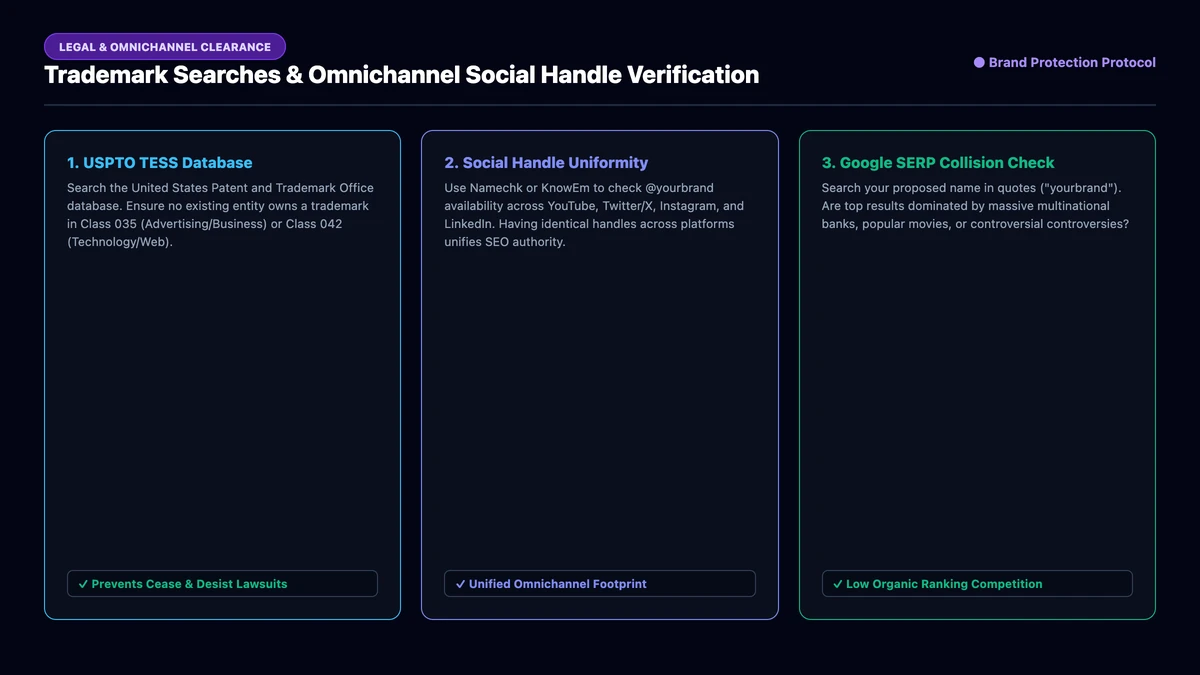
Follow this mandatory four-step clearance workflow before spending a single dollar on domain registration:
1. Search the USPTO Trademark Database: If your audience includes the United States, visit the United States Patent and Trademark Office (USPTO) and search the Trademark Electronic Search System (TESS). Conduct both ‘Exact Mark’ and ‘Word Mark’ searches across International Class 009 (downloadable software/digital media), Class 035 (advertising and online business), Class 041 (educational and entertainment services), and Class 042 (software and web hosting services). If a confusingly similar mark exists in a related class, abandon the name immediately.
2. Audit the Global WIPO Madrid System: If you plan to build an international publication, query the World Intellectual Property Organization (WIPO) Global Brand Database. This ensures your brand does not conflict with registered commercial entities across the European Union, United Kingdom, Canada, or Asia.
3. Conduct a Common Law Conflict Search: In many jurisdictions (including the United States and United Kingdom), trademark rights are established through actual commercial use in commerce, even if the mark was never formally registered. Perform rigorous Google searches for your prospective name enclosed in quotation marks, review state business registries, and check LinkedIn corporate directory listings.
4. Audit Cross-Platform Social Handle Availability: A truly brandable name must maintain unified namespace consistency across major social networks. Utilize free aggregator tools like Namechk or KnowEm to verify that matching handles (e.g.,
@yourblogname) are completely available on YouTube, X (Twitter), Instagram, TikTok, LinkedIn, and GitHub. If your primary handle is occupied by an active, competing influencer, your audience will suffer ongoing identity confusion.Top-Level Domains (TLDs): .com Dominance vs Modern Alternatives
When evaluating blog name ideas, the choice of your domain extension (the Top-Level Domain or TLD) carries immense weight. Over the past decade, ICANN has introduced hundreds of new generic TLDs (gTLDs), including
.tech, .blog, .guru, and .ninja. While these specialized extensions offer abundant availability, how do they truly measure up against the almighty .com?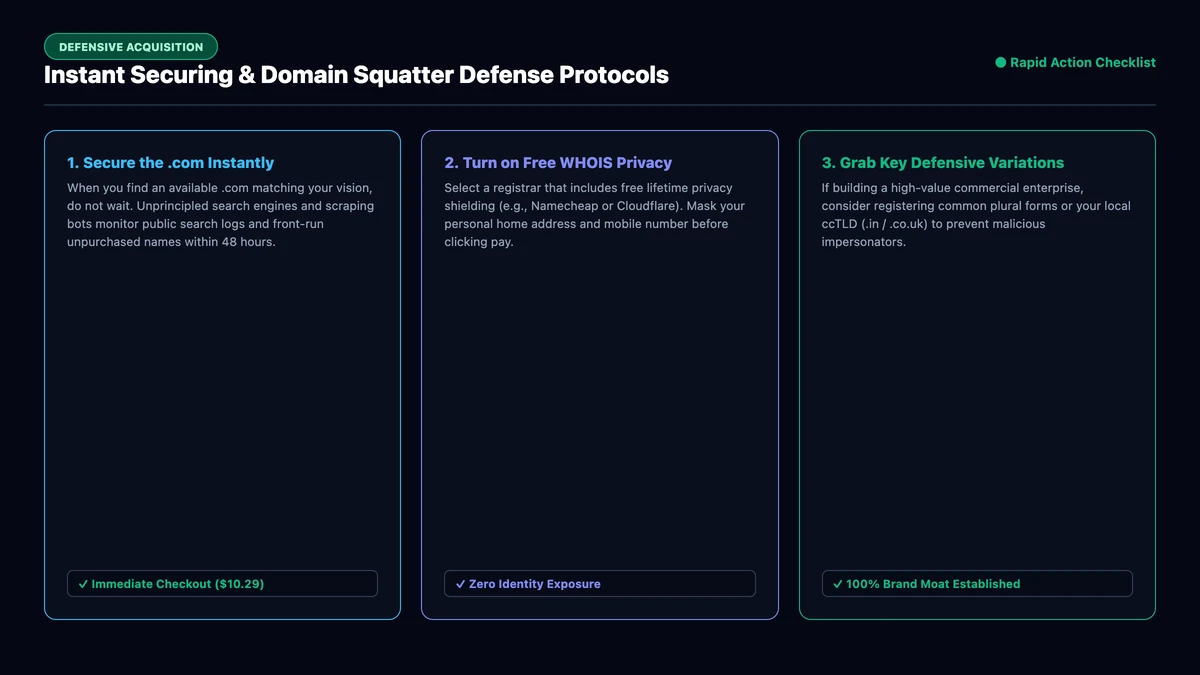
Consider the critical trade-offs between extension archetypes:
• The Unrivaled King: .com: The
• The Tech & SaaS Standard: .co and .io: For software engineering publications, developer tooling portals, and modern tech startups,
• The Direct Publishing Niche: .blog: Managed by Automattic (the company behind WordPress.com),
• Country-Code TLDs (ccTLDs): Extensions like
.com extension was created in 1985 and remains the universal default of the global internet. If a consumer hears your blog name and forgets the extension, they will type .com 90% of the time. Choosing a non-.com extension means you will inevitably bleed direct referral traffic to the owner of the matching .com domain. Always fight for the .com whenever possible.• The Tech & SaaS Standard: .co and .io: For software engineering publications, developer tooling portals, and modern tech startups,
.io (technically the ccTLD for the British Indian Ocean Territory) and .co (Colombia) have achieved mainstream consumer trust. Audiences in Silicon Valley and developer circles view .io as a badge of technical authenticity.• The Direct Publishing Niche: .blog: Managed by Automattic (the company behind WordPress.com),
.blog is a legitimate, recognized alternative when your dream .com is permanently parked or priced at six figures. It immediately signals editorial content.• Country-Code TLDs (ccTLDs): Extensions like
.in (India), .co.uk (United Kingdom), or .ca (Canada) are exceptionally powerful if your blog’s target audience is strictly localized to a specific nation. Google Search uses ccTLDs as an explicit geographic targeting signal.Domain Extension (TLD) Strategic Viability & Trust Matrix
Review the comparative breakdown below analyzing TLD performance across consumer trust, SEO neutrality, and average annual renewal expenses:
| Domain Extension (TLD) | Consumer Trust Score (1-10) | Global Recall Bias | SEO Ranking Neutrality | Average Annual Renewal | Recommended Strategic Use |
|---|---|---|---|---|---|
| .com | 10 / 10 (Universal Gold Standard) | Highest (Default reflex for 73%+ of users) | 100% Equal ranking potential | $10 – $14 / yr | Mandatory primary choice for global authority |
| .org | 9.2 / 10 (High Non-Profit Trust) | Moderate (Associated with causes/wikis) | 100% Equal ranking potential | $12 – $16 / yr | Open-source projects, foundations, communities |
| .net | 7.8 / 10 (Legacy Technical Tier) | Moderate (Dated 1990s perception) | 100% Equal ranking potential | $13 – $17 / yr | Telecommunications, network services fallback |
| .co | 8.1 / 10 (Modern Commercial Alt) | Moderate (Risk of user typing .com) | 100% Equal ranking potential | $24 – $32 / yr | Modern tech startups, e-commerce, lifestyle |
| .io | 8.7 / 10 (Developer Sacred Cow) | High within developer demographics | 100% Equal ranking potential | $45 – $65 / yr | Developer tools, coding tutorials, SaaS blogs |
| .blog | 7.2 / 10 (Editorial Explicit) | Moderate (Clear semantic purpose) | 100% Equal ranking potential | $22 – $28 / yr | Personal essays, lifestyle blogs, book reviews |
| ccTLDs (.in, .uk, .ca) | 9.0 / 10 (Within target nation) | High locally; Low internationally | Geotargeted to specific country | $8 – $20 / yr | Strictly local news, regional food, national travel |
Python Automation: Blog Name Generator and Brand Evaluator Script
To streamline the creative generation and quantitative evaluation of prospective blog name ideas, we have developed a production-ready Python script:
blog_name_generator_and_evaluator.py. This tool takes your core niche keywords, generates candidate names across compound, portmanteau, and evocative formulas, checks them against the Radio Test, flags duplicate adjacent characters, calculates a Brandability Score out of 100, and verifies availability formatting for WHOIS queries.You can run this script directly on your local machine, within a virtual environment, or on your staging server to evaluate dozens of blog name ideas in milliseconds:
pythonSecuring Your Domain: Best Registrars & Squatter Defense
Once you have selected the winning concept from your list of blog name ideas, speed and operational security are critical. Never search for available domain names on untrusted, third-party ‘free domain lookup’ websites. Some disreputable search portals log prospective queries and deploy automated bots to front-run registrations, buying the domain within minutes and demanding thousands of dollars in resale ransom.
Follow these institutional protocols when finalizing your registration:
1. Select an Ethical, ICANN-Accredited Registrar: Register your domain through an independent, accredited registrar known for transparent pricing and free privacy shielding. Top recommendations include Namecheap (famed for free lifetime WHOIS privacy and intuitive DNS management), Cloudflare Registrar (providing at-cost wholesale domain pricing with zero markup), or reputable hosting providers like Hostinger and Bluehost if purchasing an all-in-one startup bundle.
2. Enforce Free WHOIS Privacy Protection Immediately: Under ICANN regulations, every registered domain must have an associated public record containing the registrant’s name, physical mailing address, email address, and phone number. Failing to enable WHOIS privacy protection exposes your personal home address and mobile number to public scraping by telemarketers, spammers, and malicious actors. Ensure privacy redaction is active before submitting payment.
3. Enable Multi-Factor Authentication (2FA) & Registrar Lock: Domain hijacking is an active cyber threat. If an attacker breaches your registrar account, they can transfer your domain to an offshore server, completely stealing your website and search rankings. Immediately configure hardware security keys (YubiKey) or time-based authenticator apps (TOTP) on your registrar login, and ensure the domain status displays
clientTransferProhibited (Registrar Lock).4. Consider Defensive Registration of Common Typos and TLDs: If you are launching a high-stakes commercial blog, protect your intellectual property by defensively securing the primary typos and secondary extensions (such as registering both
.com and .co, or common misspellings of your brand). You can set up automatic 301 redirects in your DNS panel so that any visitor who mistypes your URL lands seamlessly on your primary website.Catchy blog name ideas rely on cognitive processing fluency: they are 2 to 3 syllables in length, utilize pleasant soft plosives, avoid confusing double letters, and evoke vivid sensory imagery. When a reader can hear the name once and immediately type it into a browser without asking for spelling clarification, the name achieves maximum memorability.
You must conduct a three-step trademark clearance audit: search the USPTO Trademark Electronic Search System (TESS) in the United States, query the WIPO Global Brand Database internationally, and search Google and social media networks for common-law commercial usage. Never assume that an available domain name guarantees legal freedom to operate.
Use your personal name if you are building a personal consulting, thought leadership, speaking, or artistic career where your personal reputation is the direct product. Choose an evocative or compound brand name if you want to build an enterprise publication, accept multi-author contributions, create a scalable asset, or eventually sell the website to a media company in the future.
Yes, but migrating to a new domain name carries significant SEO friction and operational overhead. You must purchase the new domain, migrate all server files and database records, update internal links, implement site-wide 301 redirects, and submit an address change in Google Search Console. It is vastly better to invest time upfront selecting the right name.
Hyphens and numbers severely fail the Radio Test. When sharing your site verbally, explaining ‘my hyphen tech hyphen blog dot com’ sounds unprofessional and leads to frequent mistypes. Furthermore, hyphens carry historical associations with low-tier affiliate spam and require extra keystrokes on mobile touchscreens.
For 95% of new bloggers, purchasing an expensive premium domain (costing $2,000 to $20,000+) is completely unnecessary. You can easily craft an exceptional, brandable compound name for standard registration pricing ($10 to $14/year). Invest your early capital into high-quality hosting, professional design, and world-class content production instead.
First, test adding a natural, punchy prefix or suffix (such as ‘The’, ‘Get’, ‘Go’, ‘HQ’, ‘Lab’, or ‘Craft’). Second, explore high-trust alternative extensions like .co, .io (for tech), or .blog (for lifestyle). Third, use our portmanteau and compound formulas to create a fresh, coined name that has an untouched, brand-new .com waiting for registration.
The ideal blog name contains 2 to 3 syllables. Two-syllable names (like Reddit, Google, or Medium) offer peak punchiness and auditory rhythm. Once a name stretches to 4 or 5 syllables, memory retention drops drastically and typing fatigue increases on mobile devices.
In modern SEO, exact-match keyword domains (e.g., bestcheapbuyingtips.com) no longer provide the ranking advantages they once did. Google’s ranking algorithms heavily favor strong brand signals, user engagement, and editorial authority. A memorable, brandable name earns significantly more organic backlinks, branded searches, and social shares than a sterile keyword-stuffed domain.
We recommend registering through reputable, ICANN-accredited registrars such as Namecheap or Cloudflare Registrar. Both provide free lifetime WHOIS privacy protection, robust DNS management, two-factor authentication security, and transparent renewal pricing without hidden price hikes.
Conclusion: Launching Your Brand with Unshakable Confidence
Brainstorming and finalizing extraordinary blog name ideas is an empowering creative milestone. By anchoring your brainstorming process in cognitive psychology, leveraging the six architectural naming formulas, auditing your candidates against the Radio Test, and verifying USPTO trademark clearance, you establish an intellectual property foundation that can support decades of audience growth, commercial partnerships, and brand expansion.
Remember that while a brilliant name provides a massive initial advantage, an iconic brand is ultimately forged through relentless editorial consistency, exceptional value delivery, and technical excellence. A great name attracts the first click; profound content keeps readers returning for a lifetime.
Now that you have chosen your brand identity, explore our subsequent publishing masterclasses: discover the fundamental infrastructure differences in domain vs hosting, learn how to choose a WordPress theme, follow our guide on how to install a WordPress theme, configure core options in WordPress plugin vs widget and WordPress settings, or explore whether you should hire a WordPress designer. Build bold, protect your brand, and turn your creative vision into an authoritative digital reality.