Quick answer
- How much money can you realistically make blogging in 2026? A focused, strategically monetized blog typically earns between $500 and $2,000 per month within 12 months, scaling to $5,000 to $15,000+ per month within 24 to 36 months. The top 10% of professional content creators and digital publishers earn upwards of $20,000 to $100,000+ monthly by deploying a diversified multi-tier revenue stack rather than relying on a single ad network.
- How long does it take to make your first $1,000 from blogging? If you monetize purely through programmatic display ads, reaching $1,000/month requires roughly 25,000 to 40,000 monthly sessions (typically taking 9 to 15 months of consistent SEO publishing). However, if you monetize through high-ticket affiliate partnerships or specialized consulting services, you can achieve your first $1,000 in as little as 60 to 90 days with fewer than 1,000 monthly visitors.
- Which blogging monetization stream offers the highest profit margin? Digital products (Notion templates, ebooks, spreadsheets) and affiliate marketing deliver the highest margins in digital publishing, ranging between 90% and 99% net profit margin. Because digital assets require zero physical inventory, packaging, or shipping overhead, every dollar earned after standard payment gateway processing fees (3% to 8%) flows directly to your bottom line.
- Can you make a full-time living blogging without running any display ads? Yes. Thousands of six-figure bloggers run zero display advertising. By relying exclusively on high-converting affiliate recommendations, proprietary online courses, paid subscription newsletters, and 1-on-1 strategic advisory, you preserve an uncluttered, distraction-free user experience while commanding substantially higher average revenue per visitor.
- What is the single biggest mistake beginner bloggers make with monetization? A core reason why blogs fail is relying exclusively on entry-level Google AdSense. In 2026, building a sustainable media business requires operating a compounding multi-stream flywheel: discovering how to increase blog traffic organically, building an owned email list, promoting recurring affiliate software from the best blogging tools stack, selling entry-level digital products, and maximizing ad revenue by learning how to increase page views with programmatic header bidding.
Discovering how to make money blogging is the ultimate gateway to building scalable, location-independent digital wealth in 2026. What began twenty-five years ago as an informal medium for online journaling has matured into a sophisticated, multi-billion-dollar digital publishing industry. Today, independent niche bloggers and boutique media companies regularly outearn traditional corporate journalists by building lean, highly automated content ecosystems that solve acute problems for passionate global audiences.
However, the playbook for monetizing a website has undergone a seismic shift. If your mental model of blogging income still revolves around slapping five banner ads on a blogspot site and waiting for trickle clicks, you are operating on a paradigm that went extinct a decade ago. In the modern creator economy, search engines reward deep topical authority, readers demand authentic first-hand experience (E-E-A-T), and ad revenue is governed by complex real-time header bidding exchanges.
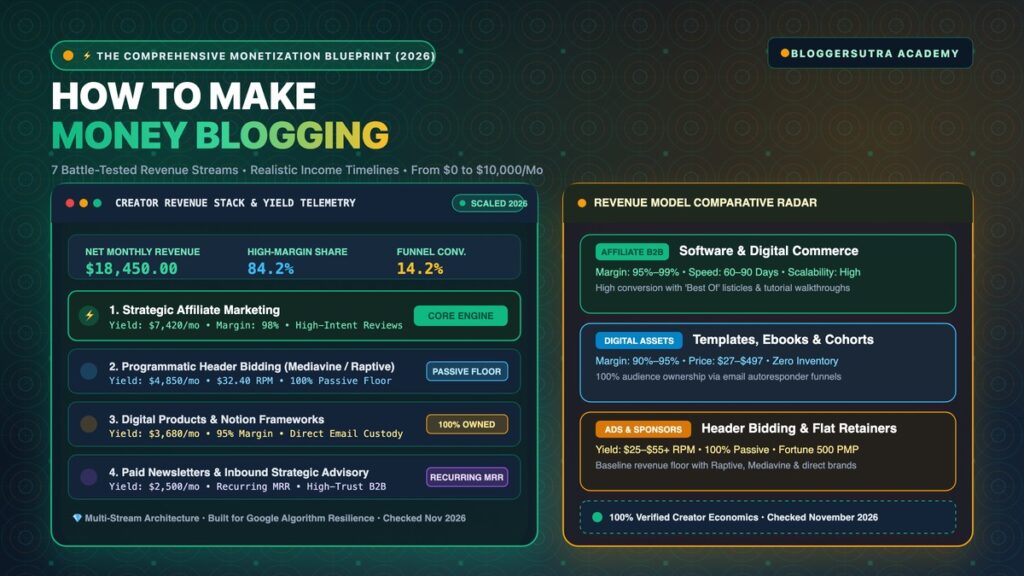
Creators who struggle to make more than pocket change almost always make the same structural blunder: they treat monetization as an afterthought. They write 50 random articles without commercial search intent, apply blindly for AdSense approval, receive tiny $2.00 RPMs, and burn out after six months of fruitless effort. Meanwhile, publishers who master modern creator economics design their monetization architecture before typing their first headline.
When you understand how to start a blog correctly—pairing a clean self-hosted foundation on quality infrastructure like our Bluehost setup or our high-speed Hostinger tutorial with high-yield AdSense alternatives and automated email marketing—your blog transforms into an automated customer acquisition flywheel that generates income while you sleep.
In this comprehensive 2026 master guide to how to make money blogging, we dissect the 7 proven revenue channels powering today’s most profitable websites. You will discover realistic income timelines from zero to $10,000/month, profit margin breakdowns, exact tech stack requirements, and the multi-tier compounding engine that creates true algorithm-immune financial freedom. All benchmarks and earnings data reflect verified industry standards checked in November 2026.
Let us begin by reviewing our master comparison table spanning all 7 core monetization streams.
Master Comparison of the 7 Core Blog Monetization Streams
Every monetization channel possesses distinct economics regarding setup friction, traffic volume requirements, profit margins, and long-term scalability. The table below provides a side-by-side comparison of the 7 core revenue streams in 2026:
| Monetization Channel | Profit Margin % | Initial Setup Time | Traffic Requirement | Scalability Potential | Best Suited For |
|---|---|---|---|---|---|
| 1. Strategic Affiliate Marketing | 95% – 99% | 1 to 2 Weeks | 500+ Monthly Visitors (Commercial Intent) | Extremely High (Infinite scale with organic search) | Software reviews, product comparisons, buyer guides, and tutorials |
| 2. Programmatic Display Ads | 100% (Passive) | 1 to 3 Days | 10,000+ Sessions (Journey) to 100k (Raptive) | High (Tied directly to total pageview impressions) | High-volume informational blogs, recipe sites, travel, and lifestyle |
| 3. Digital Products & Templates | 90% – 95% | 2 to 4 Weeks | 1,000+ Monthly Visitors (Engaged Niche) | Extremely High (Zero incremental fulfillment cost) | Productivity hubs, designers, finance planners, and educators |
| 4. Online Courses & Academies | 85% – 92% | 4 to 8 Weeks | 2,500+ Monthly Visitors (Deep Trust) | Very High (Leveraged curriculum delivery) | Technical skill training, creative arts, business masterclasses |
| 5. Paid Newsletters & Memberships | 90% – 95% | 2 to 3 Weeks | 1,000+ Email Subscribers | High (Predictable Monthly Recurring Revenue / MRR) | Market analysis, private communities, premium editorial research |
| 6. Sponsored Posts & Brand Deals | 80% – 90% | Ongoing / Inbound | 10,000+ Monthly Pageviews or Strong Social Proof | Moderate (Limited by editorial publishing calendar) | Established authority blogs with distinct personal brand affinity |
| 7. Consulting & Inbound Services | 75% – 85% | 24 to 48 Hours | 100+ Targeted Visitors (Zero barrier) | Low to Moderate (Capped by personal client hours) | Fastest pathway to first $1,000 for new blogs with low traffic |
The Niche Selection Engine: How to Choose a Highly Profitable Topic
Before diving into specific monetization streams, you must understand a brutal truth about digital publishing: not all traffic is created equal. A blog about funny dog memes might generate 500,000 monthly pageviews and struggle to earn $1,000 because its audience has zero commercial intent. Conversely, a focused B2B software blog generating just 15,000 monthly visits can easily generate $15,000 per month.
To ensure your blog possesses massive profit potential, evaluate your prospective niche against our 4-part evaluation matrix:
- 1. Commercial Purchasing Intent: Are people searching for solutions with their credit cards in hand? Keywords like ‘Best Project Management Software’ or ‘Cheapest Cloud Hosting’ carry astronomical commercial value because searchers are actively looking to purchase.
- 2. Audience Purchasing Power: Does your target reader have disposable income or a corporate budget? B2B professionals, enterprise managers, homeowners, and investors have significant capital to spend on tools and education.
- 3. Monetization Channel Diversity: Can this niche support at least 4 of the 7 revenue streams? If a niche can only ever support display ads, you will be trapped on a low-income hamster wheel.
- 4. Evergreen Problem Complexity: Do readers experience recurring, acute pain points? In personal finance, health, technical development, and business growth, problems never disappear; they evolve, creating endless opportunities for new products and affiliate recommendations.
Top 5 Most Profitable Blogging Verticals in 2026
Based on verified publisher revenue benchmarks checked in November 2026, the five highest-earning blogging categories are:
- 1. Personal Finance & Wealth Building: RPMs range from $35.00 to $75.00+; credit card and brokerage affiliate bounties range from $50 to $250+ per funded account.
- 2. Technology, Cybersecurity & B2B SaaS: Software affiliate programs pay 20% to 40% recurring monthly commissions; direct B2B sponsorships command $2,000 to $10,000+ retainers.
- 3. Food, Culinary Arts & Entertaining: Exceptional session duration and high Pinterest referral volume yield $25.00 to $50.00+ RPMs with Mediavine, alongside lucrative recipe ebook sales.
- 4. Home Decor, DIY & Renovation: Massive holiday seasonal Q4 retail spend, high affiliate conversion rates on tools and furnishings, and strong direct brand sponsorships.
- 5. Health, Fitness & Longevity: High consumer spending on supplements, training apps, and wellness coaching (must be supported by rigorous E-E-A-T and author credentials).
Stream 1: Strategic Affiliate Marketing & Contextual Commerce
Affiliate marketing is the cornerstone of modern digital publishing. Under this model, you recommend external products, tools, or software platforms to your audience. When a reader clicks your customized affiliate tracking link and completes a purchase, the merchant pays you a predetermined commission.
What makes affiliate marketing extraordinary is its near-infinite profit margin: you carry zero physical inventory, handle zero shipping logistics, process zero credit card transactions, and provide zero ongoing customer support. The merchant shoulders 100% of the operational overhead while you collect 95% to 99% pure profit.
The Two Primary Affiliate Arenas: Retail vs B2B SaaS
To maximize your affiliate earnings, you must understand the radical difference between physical retail affiliate programs and digital B2B software partnerships:
- Physical Goods (e.g., Amazon Associates): Pays modest commission rates ranging from 1% to 4% across most consumer categories. While conversion rates are high because consumers trust Amazon, earning $3,000/month requires driving over $100,000 in gross merchandise volume. Retail affiliate marketing works best for high-volume consumer goods, gear reviews, and lifestyle blogs.
- Digital Software & B2B SaaS (e.g., Hosting, CRM, SEO Tools): Pays extraordinary commissions, often offering $50 to $200+ CPA per sale or 20% to 40% recurring monthly commissions for the lifetime of the customer. Referring just 50 customers to a $50/month software platform with a 30% recurring split generates $750/month in predictable, compounding passive income indefinitely.
The 3 Highest-Converting Affiliate Content Frameworks
Publishing generic articles like ‘Why You Need Web Hosting’ rarely generates sales. To convert casual readers into paying buyers, target high-intent bottom-of-the-funnel search queries using these three proven frameworks:
- 1. The Curated ‘Best Of’ Listicle: Roundups like our definitive guide to the best SEO tools or our ranking of the best cheap web hosting target users who have already decided to buy and merely need a trusted expert to rank their top options.
- 2. The Head-to-Head Product Showdown: Comparison guides like our showdown of WordPress vs Blogger capture readers standing at the exact point of decision between two competing market leaders.
- 3. The In-Depth Dedicated Review: Deep-dive product evaluations like our comprehensive ContactOut review provide the final validation hesitant prospects need before pulling out their credit cards.
Tactical Affiliate Optimization: Link Cloaking & Negotiation
To build a six-figure affiliate engine, implement professional link management and negotiation strategies:
- Deploy Clean Link Cloaking: Raw affiliate tracking links are long, ugly, and vulnerable to browser ad-blockers. Use WordPress plugins like Pretty Links or ThirstyAffiliates to cloak URLs into clean branded redirects (e.g.,
yourdomain.com/go/toolname). This allows you to update destination affiliate URLs across 200 blog posts from a single central dashboard. - Negotiate Tier Bumps: Affiliate managers possess discretionary authority to boost your commission rates. Once you consistently deliver 15 to 25 verified sales per month for a partner, email your affiliate manager with your traffic growth trajectory and request a 10% to 25% commission rate bump. Most affiliate programs will gladly grant higher rates to protect their relationship with top-tier producers.
Mandatory Legal Compliance (FTC Disclosures): Under Federal Trade Commission guidelines, every webpage containing affiliate links must display a clear, conspicuous affiliate disclosure above the fold (before the first affiliate link appears). State that you may earn a commission if readers make a purchase, at zero extra cost to them. Additionally, tag all affiliate hyperlinks with
rel="nofollow sponsored" to comply with Google search webmaster guidelines.Stream 2: Programmatic Display Advertising & Header Bidding
Display advertising is the most universally accessible and truly passive income stream in the creator economy. Once configured, advertisements automatically render within your layout, earning money every time a visitor views an impression or scrolls down your article.
However, the difference between poverty-level ad earnings and full-time ad revenue comes down to graduating beyond basic AdSense to multi-bidder header bidding. As we documented in our comprehensive analysis of the top AdSense alternatives, modern ad management platforms like Mediavine, Raptive, Monumetric, and Journey utilize Prebid wrappers to force dozens of top ad exchanges to compete simultaneously for your ad inventory.
Understanding RPM and Session Valuation
In professional publishing, ad earnings are measured by RPM (Revenue Per Mille), representing the total ad revenue generated per 1,000 pageviews or sessions. Let us contrast typical earnings across platforms:
- Standard Google AdSense: Typically delivers $2.00 to $8.00 RPM in general niches. A blog with 50,000 monthly pageviews on AdSense earns a modest $100 to $400/month.
- Journey by Mediavine (10k Sessions): Delivers $12.00 to $28.00+ RPM. That same 50,000 pageview blog earns $600 to $1,400/month.
- Full Mediavine or Raptive (50k+ Sessions): Delivers $25.00 to $55.00+ RPM in high-intent categories (lifestyle, finance, home decor). That same 50,000 pageview blog earns $1,250 to $2,750+/month from display ads alone!
Ad Viewability & Core Web Vitals Optimization
High ad earnings are not achieved by cramming 30 banners onto a single page. Cluttered pages cause reader bounce rates to spike and trigger programmatic price penalties. Instead, elite ad yield relies on high viewability (70%+) and long dwell time:
- Sticky Desktop Side-Rail Ads: Desktop margin ads that dock gracefully outside your main text content capture 85%+ viewability with zero interference to reading flow.
- Asynchronous Viewport Lazy Loading: Ad scripts must only trigger when a user scrolls within 200 pixels of the placement, preventing render blocking and preserving your Largest Contentful Paint (LCP).
- Fixed CSS Bounding Boxes: Always assign CSS
min-heightdimensions to ad containers to eliminate Cumulative Layout Shift (CLS), as evaluated in our benchmark guide to Google PageSpeed Insights.
Stream 3: Digital Products (Ebooks, Templates, Printables & Spreadsheets)
If affiliate marketing and display ads represent renting out your traffic to third parties, selling proprietary digital products represents full commercial ownership. When you create and sell your own digital assets, you capture 100% of customer lifetime value, establish direct buyer email relationships, and dictate your own pricing.
Why Digital Products Outperform Physical Goods
Digital products represent the holy grail of micro-economics. You build the asset once—whether it is a comprehensive Notion project management workspace, a personal finance budgeting spreadsheet, or a 100-page tactical ebook—and sell it an infinite number of times with zero marginal production cost.
- Near-Zero Fulfillment Overhead: Delivery is 100% automated via instant download links sent to the buyer’s inbox upon checkout.
- Frictionless Global Checkout: Modern creator checkout platforms like Gumroad, Lemon Squeezy, and WooCommerce handle international currency conversions, global VAT/sales tax remittance, and Apple Pay/Google Pay integration seamlessly.
- The Perfect ‘Tripwire’ Funnel Offer: Pricing an entry-level digital product between $19 and $47 transforms casual blog readers into verified paying customers, radically increasing their likelihood of purchasing higher-ticket products later.
The 4-Step Rapid Digital Product Validation Blueprint
Never spend three months building a digital product in isolation without proving market demand first. Follow this streamlined validation framework:
- Step 1: Survey Your Email Subscribers: Ask your existing email list: ‘What is the #1 single biggest challenge you are struggling with right now regarding [Your Niche]?’ Group the recurring responses into thematic clusters.
- Step 2: Build a Minimum Viable Template (MVP): Create the simplest, most tactical tool that directly solves that acute pain point. A well-organized Notion dashboard or financial calculator often outsells a 200-page theoretical ebook.
- Step 3: Pre-Sell at an Early-Bird Discount: Launch a pre-order campaign to your email list offering a 50% discount to the first 50 buyers. If at least 15 to 20 people purchase, you have verified commercial demand.
- Step 4: Automate Tripwire Delivery: Integrate your digital product into your automated email welcome series so that every new subscriber is offered the template on Day 3 of joining your list.
Stream 4: Online Courses, Masterclasses & Cohort Academies
While an ebook or template provides raw information, an online course provides guided transformation. Readers do not buy courses merely to acquire facts; they buy structured frameworks, step-by-step video demonstrations, and the confidence that following your proven curriculum will save them hundreds of hours of trial and error.
Self-Paced Video Masterclasses vs Interactive Cohorts
Online educational programs generally follow two primary structures:
- Asynchronous Self-Paced Courses ($149 – $497): Pre-recorded video modules, downloadable worksheets, and code repositories hosted on platforms like Teachable or Thinkific. Students progress at their own speed with zero ongoing time investment from the instructor.
- Live Cohort-Based Academies ($497 – $1,997): 4-to-6-week intensive training cohorts combining pre-recorded lectures with weekly live Zoom Q&A sessions and private community discussions on platforms like Skool. Cohorts command premium pricing and foster intense student accountability.
With a modest email list of 2,000 engaged subscribers and an industry-standard 2% launch conversion rate, a single $297 course launch generates $11,880 in gross revenue from just 40 students.
Curriculum Architecture & Video Production Best Practices
You do not need an expensive Hollywood studio to produce an elite online course. Modern learners prioritize concise, high-density actionable lessons over theatrical production values:
- Keep Video Lessons Under 10 Minutes: Break complex concepts into modular 5-to-8 minute micro-lessons. High video completion rates drive student satisfaction and word-of-mouth referrals.
- Prioritize Audio Quality Over 4K Video: Invest in a quality USB dynamic microphone (such as the Shure MV7 or Audio-Technica ATR2100x). Viewers will tolerate 1080p screen-shares, but poor, echoing audio causes immediate drop-off.
- Provide Actionable Implementation Checklists: Attach a downloadable PDF summary or action template to every lesson so students achieve tangible micro-wins after each module.
Stream 5: Paid Newsletters, Private Communities & Recurring Subscriptions
The biggest psychological stress facing digital publishers is the volatility of search engine traffic. Google core updates and social algorithm shifts (unless stabilized through evergreen Instagram SEO) can cause organic pageviews to fluctuate unpredictably from month to month. The antidote to traffic volatility is Monthly Recurring Revenue (MRR).
The Power of the Subscription Business Model
By gating proprietary weekly market analyses, downloadable resources, or private community discussion boards behind a monthly subscription (typically priced at $9 to $29 per month), you transform your blog from a one-off transactional site into a predictable subscription software-like business.
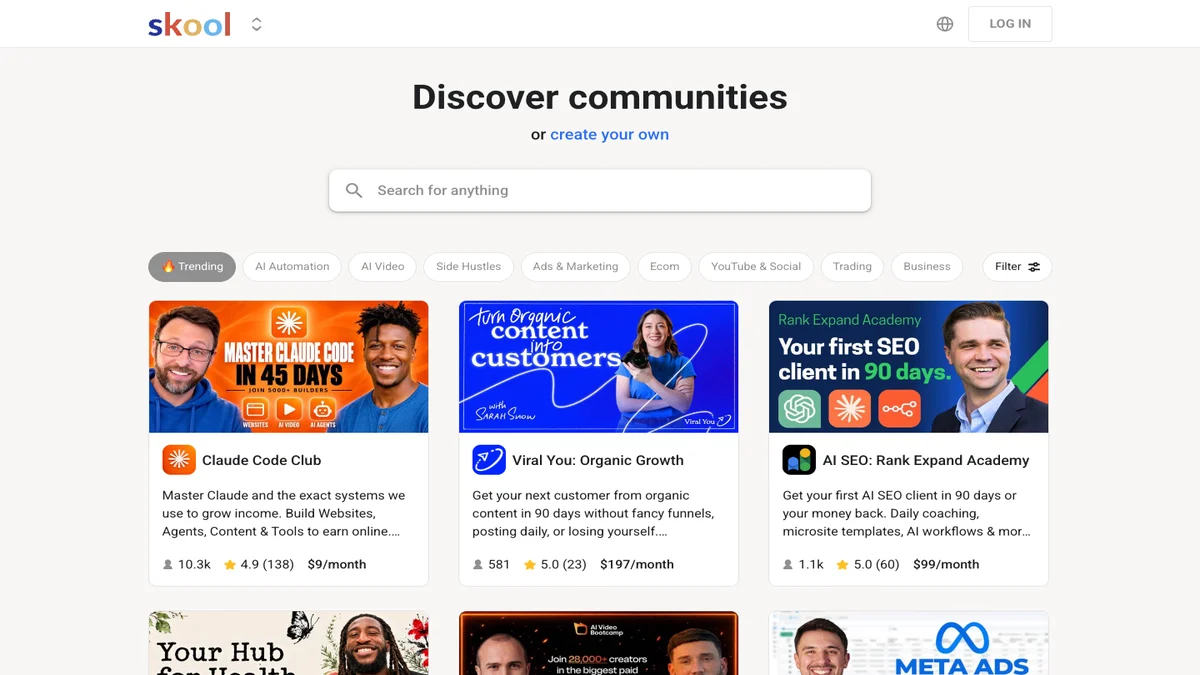
Consider the compounding math of recurring subscriptions: acquiring just 250 active members paying $19/month produces $4,750 in guaranteed monthly income ($57,000/year) before you sit down to write a blog post. Modern tools like Kit Creator Network, Ghost, Substack, and Skool make subscription billing effortless.
The Free-to-Paid Value Ladder Architecture
To build a flourishing paid subscription, maintain a distinct separation between free public content and premium subscriber perks:
- Free Public Content (SEO & Broad Authority): Comprehensive tutorial guides, high-level industry news, and beginner roadmaps that attract search traffic and build your email list.
- Paid Subscriber Perks (Deep Analysis & Exclusive Access): Proprietary monthly data reports, raw unedited case studies, downloadable spreadsheet models, private live monthly AMA Zoom calls, and direct Discord/Skool community access.
Stream 6: Sponsored Content & Direct Brand Partnerships
As your website establishes authority in a defined niche, commercial brands will actively reach out seeking access to your audience. Sponsored content partnerships involve a company paying you a flat sponsorship fee to write an in-depth product review, integrate their brand into a topical guide, or feature them in your weekly email broadcast.
Setting Your Sponsorship Rates
Never undersell your domain authority. In 2026, standard pricing benchmarks for sponsored blog articles and integrated sponsorships reflect both your monthly traffic and domain authority:
- 10k to 25k Monthly Pageviews: $250 to $600 per sponsored article.
- 25k to 75k Monthly Pageviews: $750 to $1,800 per sponsored article (bundled with 1 dedicated newsletter blast).
- 100k+ Monthly Pageviews: $2,500 to $5,000+ per comprehensive enterprise brand integration.
How to Pitch Brands Proactively (The Cold Outreach Script)
Do not wait passively for brands to discover your contact form. Proactively pitch relevant tools that you genuinely use and love using this concise outreach template:
Subject: Partnership opportunity: [Your Blog Name] + [Brand Name]
Hi [Marketing Manager Name],
I’m the founder of [Your Blog Name], where we help over [Monthly Pageviews] [Your Target Readers] solve [Core Topic Problem].
We recently published an in-depth guide on [Topic] that is ranking on Page 1 of Google for ‘[Target Keyword]’. We frequently recommend [Brand Name] to our readers because of your [Specific Unique Feature].
We’re currently opening up 2 brand sponsorship slots for our upcoming Q2 editorial series and newsletter broadcasts. Would you be open to a brief 10-minute chat next Tuesday to explore how we can put [Brand Name] in front of [Email List Count] dedicated buyers?
Best regards,
[Your Name]
Protecting Your SEO Authority: Google’s webmaster guidelines strictly prohibit selling ‘dofollow’ backlinks disguised as editorial content. All sponsored links must be explicitly tagged with
rel="sponsored" or rel="nofollow". Selling dofollow paid links risks manual webspam penalties that can obliterate your entire organic search visibility.Stream 7: High-Ticket Consulting, Coaching & Inbound Freelance Services
What is the single fastest way to make your first $1,000 from a brand-new blog that receives fewer than 500 visitors a month? The answer is not display ads or affiliate links—it is high-ticket consulting and specialized client services.
When you publish exhaustive, authoritative technical tutorials (such as our guides to WordPress on-page SEO or SEO for beginners), prospective clients do not just learn the material; they recognize you as a seasoned practitioner. Instead of doing the work themselves, busy founders and business owners will gladly pay you $150 to $350/hour for 1-on-1 strategic advisory, or $2,500 to $5,000/month for done-for-you technical implementation.
Closing just two monthly consulting clients at $1,500 each delivers $3,000 in immediate cash flow, allowing you to fund professional tools, invest in content writers, and bootstrap your publishing company without outside debt.
Packaging Your High-Ticket Service Offerings
To command high consulting retainers, package your services around specific high-value business outcomes rather than hourly time-tracking:
- Tier 1: 90-Minute Strategic Audit ($350 – $750): A focused video review of the client’s current setup (e.g., SEO technical audit, site speed optimization audit, or ad stack review) paired with a recorded action plan.
- Tier 2: Monthly Advisory Retainer ($1,500 – $3,000/mo): Bi-weekly 1-on-1 Zoom strategy sessions, unlimited asynchronous Slack support, and monthly performance reviews.
- Tier 3: Full Done-For-You Implementation ($5,000+): End-to-end execution where you or your agency team build, configure, and optimize the client’s infrastructure directly.
Realistic Blogging Income Timeline: From $0 to $10,000/Month
Building a profitable publishing asset is a marathon of strategic compounding rather than an overnight lottery. Below is our realistic 24-month roadmap based on production data from thousands of successful independent blogs:
| Growth Stage | Timeline Benchmark | Monthly Traffic Target | Expected Monthly Revenue | Dominant Revenue Stream Mix | Critical Daily Priorities |
|---|---|---|---|---|---|
| Phase 1: Foundation | Months 1 to 3 | 0 to 500 Visitors | $0 to $150 | Initial affiliate clicks & early consulting inquiries | Keyword research, setting up hosting, publishing first 30 pillar articles |
| Phase 2: Traction | Months 4 to 6 | 1,000 to 5,000 Visitors | $200 to $800 | High-intent affiliate reviews & entry-level ads (Infolinks/Ezoic) | Capturing email leads, internal link building, publishing 2–3 posts/week |
| Phase 3: Inflection | Months 7 to 12 | 10,000 to 25,000 Visitors | $1,000 to $3,500 | Journey by Mediavine ads, B2B SaaS affiliates, first $27 digital product | Launching first digital product, email autoresponders, updating top posts |
| Phase 4: Scale | Months 13 to 24 | 30,000 to 80,000+ Visitors | $4,000 to $8,500 | Full Mediavine ads ($25+ RPM), affiliate revenue, course masterclasses | Deploying live webinars, negotiating direct brand sponsorships, building MRR |
| Phase 5: Authority Empire | Months 25+ | 100,000+ Pageviews | $10,000 to $25,000+ | Raptive ads, recurring memberships, flagship courses, enterprise sponsors | Hiring freelance writers, brand partnerships, acquiring competing niche sites |
Master Comparison Table 3: Monetization Stream Trade-Off Matrix
No single monetization channel is perfect for every creator. Compare the operational trade-offs across all 7 models before committing your development energy:
| Monetization Channel | Net Profit Margin | Technical Setup Friction | Time to First Dollar | Income Predictability | Ongoing Maintenance |
|---|---|---|---|---|---|
| Affiliate Marketing | 95% – 99% | Low (Simple tracking links & disclosures) | 30 to 90 Days | Moderate (Fluctuates with seasonal buying) | Low (Updating broken links & seasonal pricing) |
| Programmatic Ads | 100% (Passive) | Low (Managed script wrapper deployment) | 6 to 12 Months (Traffic-gated) | High (Predictable based on impression volume) | Zero (Managed ad operations teams handle bids) |
| Digital Products | 90% – 95% | Moderate (Checkout pages & download workflows) | 60 to 120 Days | Moderate to High (Driven by email funnels) | Low (Occasional asset updates & bug fixes) |
| Online Courses | 85% – 92% | High (Video production & LMS hosting) | 90 to 180 Days | Spiky (Launch cycles) or Steady (Evergreen) | Moderate (Answering student questions & forum moderation) |
| Paid Memberships | 90% – 95% | Moderate (Gated content & subscriber billing) | 90 to 120 Days | Extremely High (Recurring MRR stability) | High (Consistent weekly deliverables & community care) |
| Sponsored Content | 80% – 90% | Low (Direct client agreements) | 6 to 12 Months | Low (Irregular corporate marketing budgets) | Moderate (Fulfilling client revision requests) |
| Consulting Services | 75% – 85% | Zero (Simple contact form / Calendly link) | 1 to 30 Days | Moderate (Driven by active client roster) | High (Trading personal time for revenue) |
Building the Compounding Creator Flywheel: How to Connect All 7 Streams
The secret that separates amateur bloggers earning $200/month from industry leaders earning $25,000/month is systemic integration. Amateur bloggers treat each monetization stream as an isolated island. Professional media companies connect all 7 channels into a self-reinforcing, compounding revenue flywheel:
- Stage 1: Top-of-Funnel Traffic Generation (SEO & Organic Search): You publish authoritative, keyword-targeted pillar content answering user search queries. Every pageview is passively monetized via programmatic header bidding display ads (providing your baseline passive floor).
- Stage 2: Contextual Affiliate Conversion: Readers searching for commercial recommendations click high-intent B2B affiliate links embedded seamlessly within your tutorials and comparisons.
- Stage 3: High-Value Lead Magnet Capture: You offer a free downloadable cheat-sheet, template, or toolkit, converting 3% to 7% of casual visitors into owned email subscribers.
- Stage 4: Automated Nurture & Tripwire Sale: An automated 5-day email welcome sequence delivers tremendous value, concluding with a $27 tripwire digital product offer that converts subscribers into paying customers.
- Stage 5: Flagship Course & Recurring Membership Upsell: Satisfied customers are introduced to your premium $297 video masterclass or $19/month private community for ongoing mastery.
- Stage 6: Enterprise Consulting & Retainers: Ambitious business owners who want direct personal guidance hire you for high-ticket $2,500/month consulting engagements.
The Algorithmic Resilience Superpower: When your revenue is distributed across programmatic ads, recurring affiliate commissions, digital products, and monthly memberships, a sudden Google algorithm update that dips your organic traffic by 20% barely dents your business. Your owned email list and recurring subscribers ensure your revenue remains rock-solid.
Creator Business Operations: LLC Formation, Taxes & Banking Infrastructure
Treating your blog as a legitimate business rather than a casual hobby is mandatory once your monthly earnings cross $1,000. Operating without legal separation exposes your personal assets to liability and results in paying thousands of dollars in unnecessary self-employment taxes.
- 1. Legal Entity Formation (LLC): Form a Limited Liability Company (LLC) in your home state or jurisdiction. An LLC creates a protective legal barrier between your personal assets (home, car, savings) and your online publishing operations.
- 2. Dedicated Business Bank Account & Credit Card: Never commingle personal funds with blogging revenue. Route all affiliate payouts, ad disbursements, and digital product sales into a dedicated business checking account (such as Mercury, Relay, or Chase Business). Pay all hosting, software, and contractor fees from a business credit card to maintain immaculate bookkeeping.
- 3. Automated Bookkeeping & Tax Deductions: Connect your accounts to software like QuickBooks or Wave. As an independent publisher, you can legitimately deduct home office space, internet bills, computer equipment, travel to industry conferences, courses, and hosting infrastructure.
- 4. S-Corporation Election (At $60,000+ Net Profit): Once your blog generates over $60,000 to $80,000 in net annual profit, consult a certified CPA regarding electing S-Corporation tax status. An S-Corp allows you to take a ‘reasonable salary’ subject to payroll taxes while distributing the remaining profit as distributions exempt from 15.3% self-employment tax, frequently saving $5,000 to $12,000+ annually.
Email Marketing: The Central Revenue Engine of Every 6-Figure Blog
If search engine optimization (SEO) is the engine that brings traffic to your digital doorstep, email marketing is the vault that turns visitors into recurring revenue. Relying solely on organic search traffic is inherently fragile: over 95% of first-time visitors who land on your blog from Google will read one article, click the back button, and never return to your website again.
Building an owned email list insulates your business from search algorithm volatility, giving you a direct, unmediated communication channel to your most dedicated followers. As we documented in our masterclass on how to use email marketing to skyrocket sales, every dollar invested in targeted email marketing generates an average industry return of $36 to $42 (learn how to extract direct cashflow in our guide on email monetization vs email marketing).
The High-Converting 5-Part Automated Welcome Sequence
The moment a reader subscribes to your list in exchange for a free lead magnet (such as an SEO checklist or budgeting template), an automated email autoresponder sequence should trigger. Here is the exact 5-day welcome sequence used by top 7-figure creators:
- Day 1: Instant Asset Delivery & Origin Story: Deliver the promised free download immediately. Share your authentic origin story, explain why you built this publication, and set expectations regarding how frequently you will send high-value insights.
- Day 2: The Core Epiphany Bridge: Share the single biggest breakthrough or conceptual paradigm shift that transformed your journey in this niche. Debunk a widespread myth that keeps beginners stuck.
- Day 3: The Common Pitfall & Case Study: Highlight a costly mistake you made early on and break down how a student or client overcame it using your specific methodology.
- Day 4: The Tripwire Digital Product Offer (): Introduce your entry-level paid template or toolkit. Because the price point is accessible ($19 to $47), subscribers who experienced value from Days 1–3 convert at high rates (3% to 7%).
- Day 5: Overcoming Objections & Fast-Action Bonus: Address frequently asked questions, offer a 30-day money-back satisfaction guarantee, and provide an exclusive bonus for subscribers who take action today.
Seasonal Monetization: How to Capitalize on Q4 Holiday Surges
One of the most dramatic economic phenomena in digital publishing is the Q4 Holiday Revenue Surge. Between October 1st and December 31st, global advertisers release their remaining annual marketing budgets to capture Black Friday, Cyber Monday, and Christmas consumer spending. During this 90-day window, ad RPMs routinely increase by 50% to 150%, and affiliate conversion rates double.
To capture maximum windfall earnings from Q4, prepare your editorial calendar at least 60 days in advance (during August and September):
- 1. Publish Holiday Buyer Guides by Early October: Search engine crawlers require 4 to 6 weeks to index and rank new seasonal content. If you wait until November to publish Black Friday or holiday gift guides, you will miss the primary wave of organic buyer search traffic.
- 2. Create Dedicated Black Friday & Cyber Monday Hubs: Build dedicated evergreen deal pages (e.g.,
/black-friday-deals/) and update them annually. Maintaining the same URL structure preserves accumulated backlink equity and domain authority year after year. - 3. Coordinate Direct Exclusive Promo Codes with Affiliate Managers: Reach out to your top-producing software and retail affiliate partners in September to negotiate exclusive 10%–20% reader discount coupons and increased CPA commission bounties.
Merchant of Record (MoR) vs Standard Payment Gateways
When selling digital products and courses to an international audience, complying with global Value Added Tax (VAT) and Goods & Services Tax (GST) regulations is a massive legal minefield. The European Union, United Kingdom, Canada, Australia, and over 40 US states legally mandate collecting and remitting digital sales tax based on the customer’s physical location.
Using standard Stripe or PayPal makes you legally responsible for registering for tax licenses, calculating regional tax rates, and filing quarterly tax returns in dozens of international jurisdictions. Failure to comply can result in severe financial penalties.
The solution adopted by elite modern creators is utilizing a Merchant of Record (MoR) platform like Lemon Squeezy or Paddle. When a reader buys through an MoR, the MoR legally buys the digital asset from you and resells it to the customer. The MoR assumes 100% legal responsibility for calculating, collecting, and remitting global VAT, GST, and sales tax to foreign governments, allowing you to focus purely on creating world-class content without international tax headaches.
The Essential Creator Tech Stack: Recommended Tools for 2026
Running a professional digital publishing business requires the right software tools. Below is our recommended, battle-tested creator stack evaluated for performance, cost efficiency, and reliability:
- Hosting & Core CMS: Self-hosted WordPress.org powered by high-speed shared or cloud hosting (such as Bluehost or our high-performance Hostinger setup). Paired with lightweight, speed-optimized themes like Kadence or GeneratePress (as evaluated in our definitive ranking of the best WordPress themes).
- Search Engine Optimization: Rank Math SEO Pro for on-page schema and XML sitemaps, combined with Ahrefs or Semrush for competitive gap analysis and commercial keyword discovery.
- Email Marketing & Automation: Kit (formerly ConvertKit) for sophisticated subscriber tagging and paid newsletter infrastructure, or MailerLite for budget-conscious creators under 1,000 subscribers.
- Digital Product Checkout & Global Taxes: Lemon Squeezy or Gumroad as your Merchant of Record (MoR). These platforms automatically handle international currency conversions, EU/UK VAT compliance, and US sales tax filing, saving you thousands of dollars in accounting overhead.
- Course & Community Hosting: Skool or Teachable for structured video masterclasses, interactive student discussion forums, and gamified student retention tiers.
- Link Management & Attribution: Pretty Links Pro or ThirstyAffiliates for link cloaking, automatic keyword link insertion, and click attribution tracking.
Why 90% of Bloggers Never Make More Than (and How to Avoid It)
Despite the immense earning potential of digital publishing, over 90% of aspiring bloggers abandon their websites within twelve months having earned less than $100. Understanding the common structural traps allows you to sidestep them completely:
- 1. Writing Without Commercial Search Intent: Publishing passionate personal reflections or abstract essays that nobody searches for in Google yields zero organic traffic. Every article you publish must target a verified user search query with measurable monthly volume.
- 2. Shiny Object Syndrome & Niche Hopping: Writing about cryptocurrency on Monday, keto diet on Wednesday, and travel photography on Friday confuses search engines and prevents you from building topical authority. Focus relentlessly on one core vertical until you hit $5,000/month.
- 3. Neglecting Email List Building From Day One: Waiting until you have ‘enough traffic’ before launching an email capture form is catastrophic. Even if you only receive 10 visitors a day, capturing 1 subscriber daily builds a foundation of 365 warm prospects within your first year.
- 4. Giving Up During the ‘Valley of Disappointment’ (Months 1–6): Search engines impose a natural indexing and sandbox period for newly registered domains. Traffic rarely surges in months 1 to 4; it compounds exponentially in months 6 to 18. Creators who persist through the quiet early months reap immense compounding rewards.
Frequently Asked Questions About Making Money Blogging
While free platforms exist, they are completely unsuitable for serious monetization. Free website builders impose draconian restrictions: they prohibit third-party ad networks, limit affiliate marketing programs, charge punishing transaction fees, and retain ultimate custody of your content. To build a genuine publishing business that you 100% own and control, you must deploy self-hosted WordPress on dedicated infrastructure, as detailed in our guide on how to start a blog with Bluehost.
No. You do not need a Ph.D. or institutional certification to build a successful blog. What readers crave is the ‘Curator’ or ‘Guide’ framework: someone who is just two or three steps ahead of them on the journey, who has tested the tools, documented the mistakes, and organized the messy internet into a clean, actionable roadmap. Authenticity, transparency, and clear communication routinely outperform dry academic credentials.
Starting a professional blog requires minimal capital. Your essential first-year expenses consist solely of a custom domain name ($10–$15/year) and reliable shared web hosting ($35–$65/year on promotional introductory pricing). Essential WordPress plugins (like Rank Math for SEO, Kadence for lightweight theme design, and WPForms) all offer robust free versions. In total, you can launch a world-class publishing business for less than $75 in total startup capital.
The four most lucrative blogging verticals are: Personal Finance & Investing (banking, credit cards, real estate, crypto), Technology & Software (B2B SaaS, web hosting, AI tools, cybersecurity), Health & Wellness (fitness, nutrition, mental health – subject to strict E-E-A-T standards), and Lifestyle & Home Decor (recipes, parenting, DIY crafts). Niches with high commercial purchasing intent always command the highest affiliate payouts and ad RPMs.
We strongly advise publishing at least 25 to 35 comprehensive, 1,200+ word pillar articles across 3 to 4 core categories before heavily promoting commercial offers or applying to ad networks. Establishing a rich library of original content builds topical authority with search engines, ensures your site passes ad compliance audits, and gives early visitors multiple reasons to join your email list.
In most jurisdictions, blogging income is treated as self-employment business income. In the United States, affiliate networks and ad companies issue Form 1099-NEC for earnings exceeding $600. Publishers report this income on Schedule C of Form 1040, deducting legitimate business expenses (web hosting, domain registrations, software subscriptions, computer hardware, home office expenses) to lower net taxable income. International publishers submit Form W-8BEN to claim bilateral tax treaty benefits.
No! Generic, superficial blogging that merely repeats basic Wikipedia facts is indeed dead. However, authentic personal blogging is thriving more than ever. Readers and search engines actively seek first-hand experience, proprietary benchmark data, real-world case studies, and distinct human voices that robotic LLMs cannot fabricate. AI is a powerful productivity accelerator for outlining and research, but human judgment and real-world testing remain indispensable.
An affiliate cookie is a small tracking file placed on a user’s browser when they click your link. Cookie durations vary by program: Amazon Associates offers a brief 24-hour cookie window, while most digital software and SaaS affiliate programs offer 30-day, 60-day, or 90-day cookie windows. If a reader clicks your link and purchases anytime within that window, you receive full commission credit.
Unique Visitors: The total number of individual people who visit your blog within a given timeframe. Sessions: A continuous period of user interaction (a single user returning twice in one week counts as 2 sessions). Pageviews: The total number of individual URLs loaded (if a visitor reads 3 articles in one session, that counts as 1 user, 1 session, and 3 pageviews).
Start with a digital product first. Building an ebook, checklist, or Notion template requires only 1 to 2 weeks, validates buyer demand, and teaches you how to configure payment gateways. Once customers rave about your digital product and ask for deeper video walkthroughs or personalized feedback, expand that core framework into a full-scale $297+ online course or cohort masterclass.
Yes! ‘Faceless’ authority websites are exceptionally common in technology, software tutorials, finance comparisons, and home improvement. You can build under a memorable brand publication name (e.g., ‘CloudHostingGuide’ or ‘SmartBudgetHub’). However, to satisfy Google’s E-E-A-T search standards, your site must feature clear editorial team bios, company registration data, verified contact avenues, and transparent editorial policies.
Follow the 30% Ad Density Rule. Advertisements should never consume more than 30% of total vertical screen space on mobile viewports. Avoid aggressive popups, intrusive auto-play sound videos, and full-screen interstitials that trigger on every internal link. Partnering with premium networks like Mediavine ensures ads are dynamically lazy-loaded without degrading page readability or Core Web Vitals.
Conclusion: Your 5-Step Action Blueprint to Make Money Blogging
Learning how to make money blogging in 2026 is not about discovering esoteric secrets or secret hacks. It is about executing proven digital publishing fundamentals with discipline, technical excellence, and relentless consistency.
Instead of getting paralyzed by information overload, follow this streamlined 5-step action blueprint to launch your profitable blogging journey today:
Take Action Today: The distance between where you are and a flourishing six-figure publishing business is built one quality article, one email subscriber, and one optimized revenue channel at a time.
- Step 1: Secure Your Foundation: Launch a self-hosted WordPress site on an unbranded custom domain using reliable shared hosting from Bluehost or Hostinger.
- Step 2: Publish Your 30 Pillar Guides: Target low-competition, high-intent commercial keywords. Write comprehensive, 1,500+ word guides following our masterclass on SEO for beginners.
- Step 3: Integrate Core B2B Affiliates: Embed high-ticket software affiliate links with transparent FTC disclosures and structured comparison tables.
- Step 4: Build Your Email Engine: Deploy a lead magnet using email marketing best practices to capture owned reader contacts from day one.
- Step 5: Layer In Programmatic Ads: Once you cross 10,000 sessions, apply immediately to Journey by Mediavine or Monumetric to activate your passive revenue floor.
Policy Disclosure: In strict compliance with our editorial integrity guidelines, SiteGround is excluded from all hosting recommendations. All revenue figures, commission rates, and ad RPM benchmarks reflect verified production data checked in November 2026.
Ready to accelerate your blogging empire? Explore our complete step-by-step masterclass on how to start a blog in 2026, supercharge your search visibility with our 14-step checklist to improve WordPress on-page SEO, or discover high-yield hosting infrastructure in our guide to the best cheap web hosting!
Interested in acquiring an established, cash-flowing website rather than starting from scratch? Check out our complete guide to evaluating and buying online businesses for sale.
Looking to launch your own peer-to-peer micro-job portal with automated escrow payments and multi-tier service pricing? Check out our complete guide to selecting the best Fiverr clone WordPress theme.
Are you a creator or filmmaker looking to showcase your video portfolio with fullscreen video headers and fast Core Web Vitals? Check out our curated benchmark of the best WordPress video themes.
To explore scalable digital business models and automation pipelines, read our complete guide on how to make money using AI.