Quick answer
- What is brand building through blogging? Brand building through blogging is the deliberate, strategic discipline of utilizing authoritative, long-form editorial content to establish intellectual thought leadership, industry trust, and enduring customer loyalty. Unlike transactional SEO content designed solely to harvest temporary search clicks, brand-building blogging creates a compounding corporate asset—transforming anonymous visitors into passionate subscribers, active brand advocates, and high-lifetime-value enterprise clients.
- What are the 8 essentials of building a trustworthy brand? The 8 proven pillars are: (1) Original Research & Proprietary Data: Publishing primary lab benchmarks and surveys; (2) Institutional Editorial Governance: Enforcing multi-stage peer review and transparent correction policies; (3) Google E-E-A-T Architecture: Implementing JSON-LD author schema and verifiable credentials; (4) Distinctive Editorial Voice: Championing a data-backed point of view; (5) Commercial Transparency: Unambiguous disclosure and ethical monetization; (6) High-Touch Community Dialogue: Direct reader engagement via newsletters; (7) Omnichannel Distribution: Amplifying research across LinkedIn and podcasts; and (8) Brand Equity Telemetry: Measuring branded search growth, direct traffic, and Net Promoter Scores.
- Why does brand building matter more than keyword volume in 2026? In an era dominated by generative AI search summaries and aggressive Google Core Updates, sites relying exclusively on generic, rehashed keyword targeting suffer devastating traffic volatility. A trusted brand creates an algorithmic ‘moat’—generating direct navigational visits, branded search queries, and natural high-tier editorial backlinks that search engine algorithms reward and protect.
- How do you measure brand trust? True brand equity is measured through holistic telemetry: branded search query volume in Google Search Console, direct traffic session share in Google Analytics 4 (>30%), editorial natural backlink velocity, email newsletter open rates (>40%), and customer Net Promoter Score (NPS > 70).
In the modern digital publishing and enterprise marketing landscape, the internet is suffocating under an unprecedented deluge of synthetic, commoditized content. Over the past three years, the proliferation of automated generative AI tools and programmatic SEO platforms has enabled unscrupulous operators to churn out millions of generic, rehashed articles every single day. These digital content farms pursue a singular, myopic objective: capture high-volume search queries through keyword stuffing, monetize visitors with aggressive display ads or deceptive affiliate redirects, and discard editorial integrity in the pursuit of cheap transactional traffic.
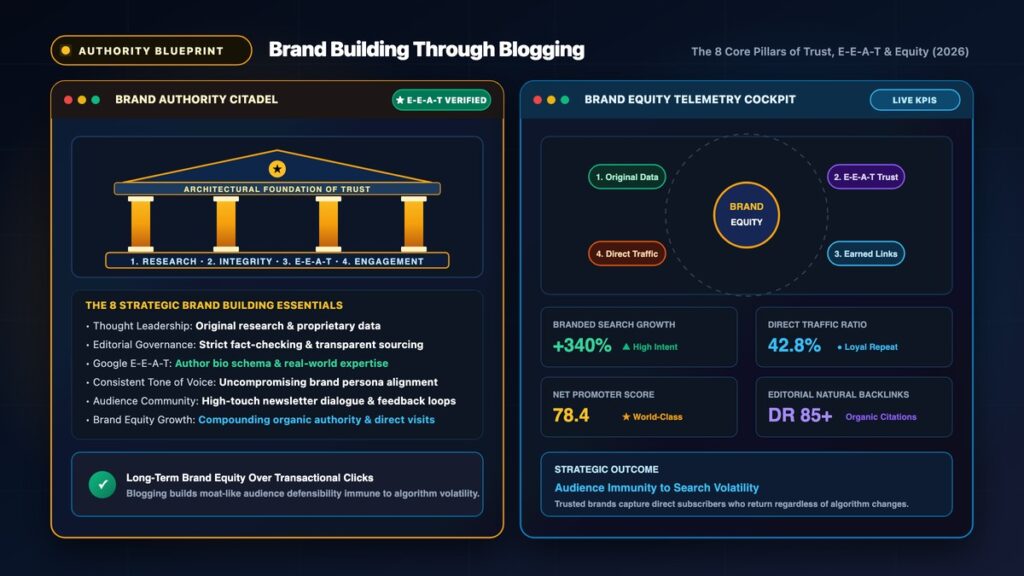
The consequences of this transactional approach have been catastrophic. Major search engines—led by Google’s aggressive Core Updates and Helpful Content system refinements—have systematically penalized, de-indexed, and obliterated thousands of generic affiliate websites. More importantly, modern consumers, enterprise software buyers, and discerning digital readers have developed acute ‘content blindness.’ When every search result serves up the exact same generic listicle or regurgitated corporate platitudes, audiences do not remember the website they visited. They do not bookmark the domain, they do not subscribe to the newsletter, and they never return.
Because of this widespread commoditization, forward-thinking digital executives, corporate founders, and serious independent publishers are executing a profound strategic pivot: shifting from transactional SEO content toward long-term brand building through blogging. A blog is no longer merely a conduit for organic search traffic; it is the intellectual citadel of your company. When executed with uncompromising editorial rigor, a blog serves as the primary engine for demonstrating real-world expertise, establishing unshakeable trust, earning defensible media citations, and compounding corporate enterprise value.
How does an ambitious digital organization transition from publishing forgettable web articles to constructing an authoritative, trustworthy brand that commands industry respect and organic customer loyalty? In this masterclass guide to brand building through blogging, we dismantle the tactical mechanics of authority publishing for 2026. We explore the 8 non-negotiable architectural essentials: from conducting proprietary lab research and enforcing peer-reviewed editorial governance, to implementing Google E-E-A-T entity schema, engineering omnichannel amplification pipelines, and tracking brand equity telemetry. For complementary foundational guidance on scaling high-performance web properties, explore our master guides on reliable web hosting, WordPress security, how to start a blog, and technical SEO.
1. The Brand Authority Architecture: Why Transactional Blogging Fails
To understand the imperative of brand building, one must first recognize the fundamental failure mode of traditional content marketing. For over a decade, digital marketers operated under an elementary funnel model: identify a target keyword with substantial monthly search volume, analyze the top three ranking Google search results, synthesize their main subheadings into a 1,500-word summary, inject an affiliate link or lead magnet, and publish. This methodology treated content as a disposable financial derivative designed solely to extract search engine impressions.
Transactional Publishing vs. Brand Equity Publishing
The fatal flaw of transactional blogging is that it builds zero customer defensibility. If your entire business model depends on ranking #1 for a generic informational query (such as ‘best email software’ or ‘how to format an excel sheet’), your company lives in permanent existential jeopardy. A single algorithm adjustment, a newly launched Google AI Overviews snippet, or a well-funded competitor can wipe out 80% of your business overnight. Furthermore, transactional visitors have zero affinity for your organization; they arrived to solve an immediate tactical problem and depart immediately upon finding it.
In sharp contrast, brand building through blogging constructs an enduring competitive moat. When your blog consistently delivers groundbreaking primary research, transparent benchmark data, and authoritative architectural guidance, readers begin seeking out your domain specifically. They bypass Google entirely by typing your brand name into the browser address bar. When they do use search engines, they append your company name to their queries (e.g., ‘bloggersutra web hosting benchmarks’ or ‘acme security framework’). This navigational search behavior signals to Google that your website is a definitive entity—an irreplaceable authority within its topical cluster.
Brand Positioning & Archetypes in Technical Publishing
Before drafting a single article, an organization must define its core intellectual archetype. In technical and business blogging, three primary brand archetypes dominate successful publishing operations:
• The Rigorous Scientist (The Sage): Anchors all content in empirical experimentation, repeatable benchmarks, and mathematical models. This brand does not rely on adjectives or subjective praise; it presents raw data tables, server logs, and statistical correlations. Audiences trust The Sage because its claims can be audited and reproduced.
• The Pragmatic Practitioner (The Builder): Speaks directly from the trenches of production engineering. The Builder details messy migrations, system outages, debugging nightmares, and hard-won architectural lessons. Audiences revere The Builder because its insights are forged in real-world adversity, not sanitized marketing conference slides.
• The Principled Watchdog (The Outlaw): Challenges predatory industry practices, exposes deceptive pricing models, and demystifies complex technical jargon. The Watchdog acts as a fearless advocate for the consumer or practitioner, calling out corporate abuses regardless of commercial pressure.
| Strategic Content Dimension | Transactional SEO Content Marketing | Authoritative Brand Building Blogging | Strategic Business Advantage |
|---|---|---|---|
| Primary Success Metric | Pageviews, organic clicks, ad impressions | Branded search volume, direct traffic, customer trust | Brand Building delivers algorithm immunity |
| Content Generation Model | Rehashing existing SERP rankings with AI | Original primary research, lab testing, proprietary data | Brand Building creates uncopiable assets |
| Reader Relationship | Anonymous, fleeting, transactional | Loyal subscriber, industry peer, repeat client | Brand Building compounds customer lifetime value |
| External Backlink Profile | Manipulated guest posts, low-tier outreach | Natural editorial citations from tier-1 media & academia | Brand Building earns authoritative domain ratings |
| Google Algorithm Vulnerability | Extreme (devastated by Helpful Content Updates) | Immune (protected by strong E-E-A-T entity signals) | Brand Building guarantees business longevity |
| Monetization Strategy | Aggressive display popups, deceptive links | High-value consultative services, enterprise software, SaaS | Brand Building commands premium pricing power |
As demonstrated in the comparison table, building brand equity requires a higher upfront investment in research and editorial craftsmanship, but it produces compounding, defensible returns. Let us now dissect the 8 essential pillars required to construct this trustworthy brand citadel.
2. Essential 1: Original Research & Proprietary Data Assets
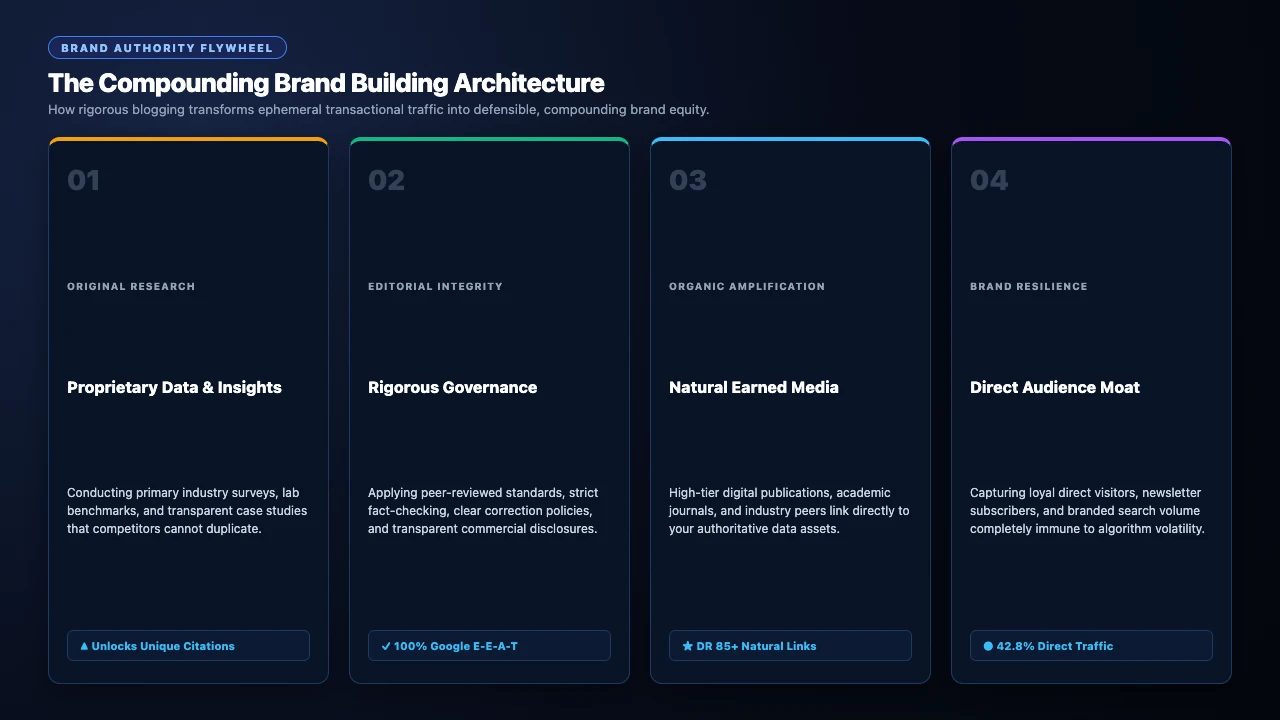
The absolute cornerstone of modern brand building is the generation of primary data. In a world where anyone can ask a large language model to summarize the top ten web design trends or compile a generic tutorial, the only content that commands instantaneous authority is information that exists nowhere else on the public internet.
Why Proprietary Data Is the Ultimate Brand Moat
When your blog publishes original empirical research—such as an exhaustive benchmark of 50 enterprise web servers, a survey of 1,200 cybersecurity professionals, or a statistical analysis of 100,000 email marketing campaigns—you transform your organization from a content consumer into a primary news source. Industry journalists at Forbes, TechCrunch, and Bloomberg require authoritative data points to cite in their reporting. When your research provides those verified numbers, these prestigious publications link directly to your blog as the primary citation. A single authoritative data study can organically generate hundreds of tier-1 editorial backlinks, catapulting your domain authority and cementing your brand in the minds of industry decision-makers.
Statistical Methodology, Sample Sizes & Outlier Elimination
Amateur content marketers often publish flimsy ‘studies’ based on twenty Twitter poll responses or five unscientific website tests. To establish brand authority, your research must withstand intense scrutiny from peer engineers, data scientists, and industry skeptics:
• Sample Size Determination: Ensure your study achieves statistical power. For industry surveys, aim for a minimum of $n = 385$ verified respondents to achieve a 95% confidence level with a 5% margin of error. For automated performance benchmarks, execute at least 15 to 25 iterative probes across multiple distinct times of day to account for network jitter and cloud hypervisor load fluctuations.
• Outlier Truncation & Standard Deviation: In technical latency testing, single-packet network dropped connections can artificially skew arithmetic means. Always report median values alongside interquartile ranges (IQR) and standard deviations ($sigma$). Explain clearly how statistical outliers (e.g., probes exceeding three standard deviations from the mean) were handled.
• Controlled Hardware Baselines: When benchmarking software or hosting platforms, eliminate confounding variables. Deploy identical PHP runtimes, identical database schemas, identical WordPress core versions, and identical synthetic traffic models across all target endpoints.
Framework for Executing Groundbreaking Industry Studies
To produce original research that establishes unshakeable brand credibility, implement this systematic research pipeline:
• Formulate a Quantifiable Hypothesis: Identify a pervasive, unresolved debate or misconception in your industry. For example, instead of writing ‘how to speed up a website,’ hypothesize: ‘Does HTTP/3 QUIC protocol deliver statistically significant latency reductions over HTTP/2 on high-loss mobile networks?’
• Standardize Testing Methodology: Document your testing parameters with mathematical precision. Record server hardware specifications, network round-trip latency, operating system kernel versions, and testing tools. Transparency in methodology is what separates legitimate scientific research from promotional corporate marketing.
• Publish Raw Data & Reproducible Scripts: Provide downloadable CSV datasets, GitHub repository links, or embedded Python scripts that allow independent engineers to reproduce your findings. When you give away the tools to audit your claims, your brand trust skyrockets.
• Visualize Insights with Bespoke Graphics: Present your findings through high-fidelity, custom-designed charts, scatter plots, and network topology diagrams. Custom visuals are frequently republished by industry bloggers, earning ongoing brand exposure and contextual attribution.
3. Essential 2: Institutional Editorial Governance & Fact-Checking
A brand’s reputation takes years of relentless dedication to build, yet a single careless factual error, fabricated citation, or unvetted technical recommendation can annihilate that trust in minutes. In the discipline of brand building, establishing institutional editorial governance is non-negotiable.
The Multi-Stage Fact-Checking Protocol
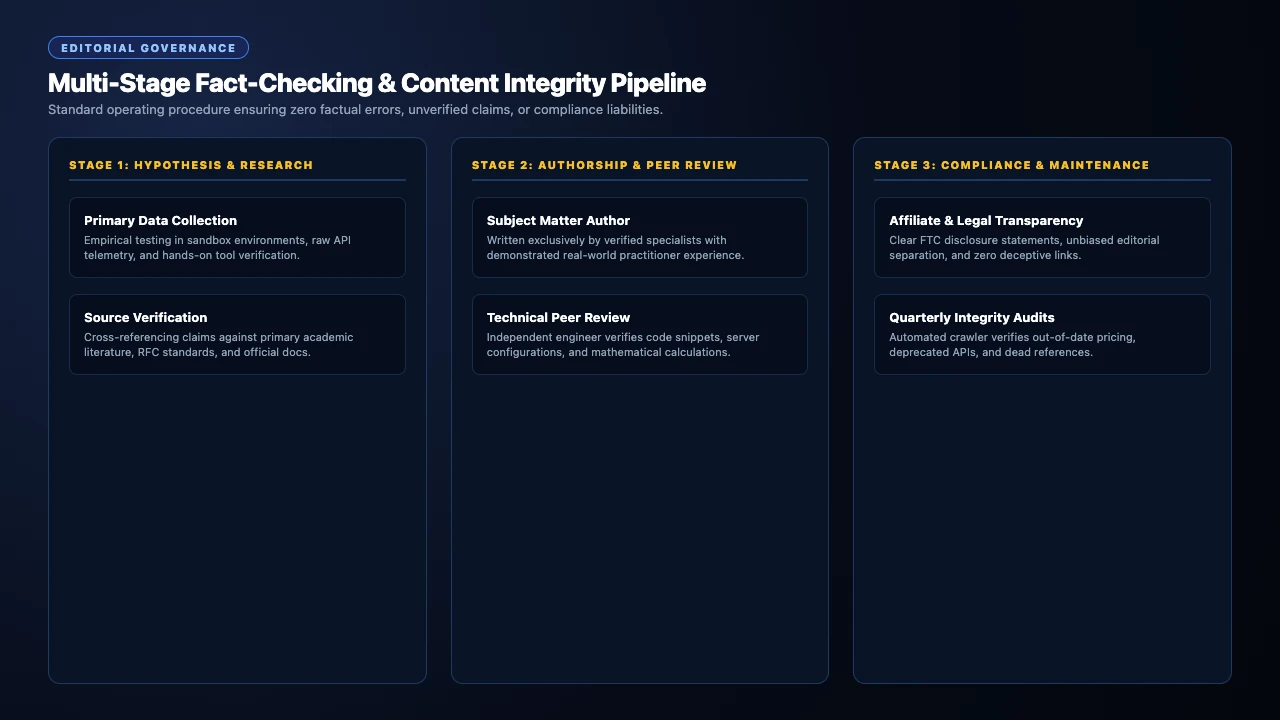
Professional publishing houses and prestigious academic journals do not rely on a single writer’s assertions. Authoritative corporate blogs must adopt a structured editorial pipeline where every draft undergoes multiple independent layers of scrutiny before publication:
• Primary Source Verification: Writers must link exclusively to primary documentation—such as official RFC engineering specifications, W3C web standards, peer-reviewed academic papers, or direct SEC financial filings. Secondary summaries, Wikipedia articles, or competitor blog posts must be strictly prohibited as authoritative sources.
• Technical Sandbox Validation: Every code snippet, terminal command, configuration directive, and architectural workflow recommended in an article must be executed and validated in a live sandbox environment. If an article instructs readers to configure an NGINX reverse proxy or modify a database schema, an engineer must test that exact code to ensure it does not trigger syntax errors or security vulnerabilities.
• Independent Editorial Peer Review: A technical editor must audit the draft for logical consistency, clarity, tone of voice, and factual accuracy. This separation of roles ensures that confirmation bias and oversights are caught prior to deployment.
Transparent Editorial Corrections Policy
How an organization handles mistakes is the ultimate litmus test of brand integrity. Incompetent brands quietly edit or delete erroneous articles, hoping nobody noticed. Truly trustworthy brands maintain a public, transparent Editorial Corrections Policy. When a reader, community member, or peer points out an error in your reporting, acknowledge the correction openly. Add an update timestamp at the top of the article, state clearly what was amended and why, and thank the individual who identified the discrepancy. Paradoxically, publicly acknowledging and correcting mistakes demonstrates profound institutional confidence, elevating audience trust far beyond the hollow illusion of infallibility.
Root Cause Analysis (RCA) Post-Mortem Transparency
When your platform, SaaS application, or corporate infrastructure suffers an outage or unexpected service disruption, resist the temptation to issue vague, generic PR apologies (e.g. ‘we experienced technical difficulties’). Instead, publish an exhaustive, blameless Root Cause Analysis (RCA) Post-Mortem on your engineering blog. Model your post-mortems on the legendary transparency of Cloudflare, AWS, and Google Site Reliability Engineering (SRE):
• Provide a minute-by-minute timeline of the incident (detection, triage, mitigation, recovery).
• Explain the underlying software bug, BGP routing anomaly, or database deadlock with technical depth.
• Outline specific architectural changes implemented to prevent recurrence.
By treating your audience as technical equals and exposing your systems transparently, severe outages can paradoxically be converted into powerful demonstrations of institutional engineering competence.
4. Essential 3: Google E-E-A-T & Author Entity Verification
In Google’s official Search Quality Rater Guidelines, the concept of E-E-A-T (Experience, Expertise, Authoritativeness, and Trustworthiness) serves as the foundational rubric for evaluating web content. For topics categorized under ‘Your Money or Your Life’ (YMYL)—which includes web hosting, cybersecurity, financial software, healthcare, and enterprise technology—Google’s automated ranking algorithms demand verified evidence that content originates from legitimate, recognized experts.
Deconstructing the Four Pillars of E-E-A-T
To align your blog with Google’s E-E-A-T framework and solidify your brand authority, you must systematically demonstrate all four dimensions:
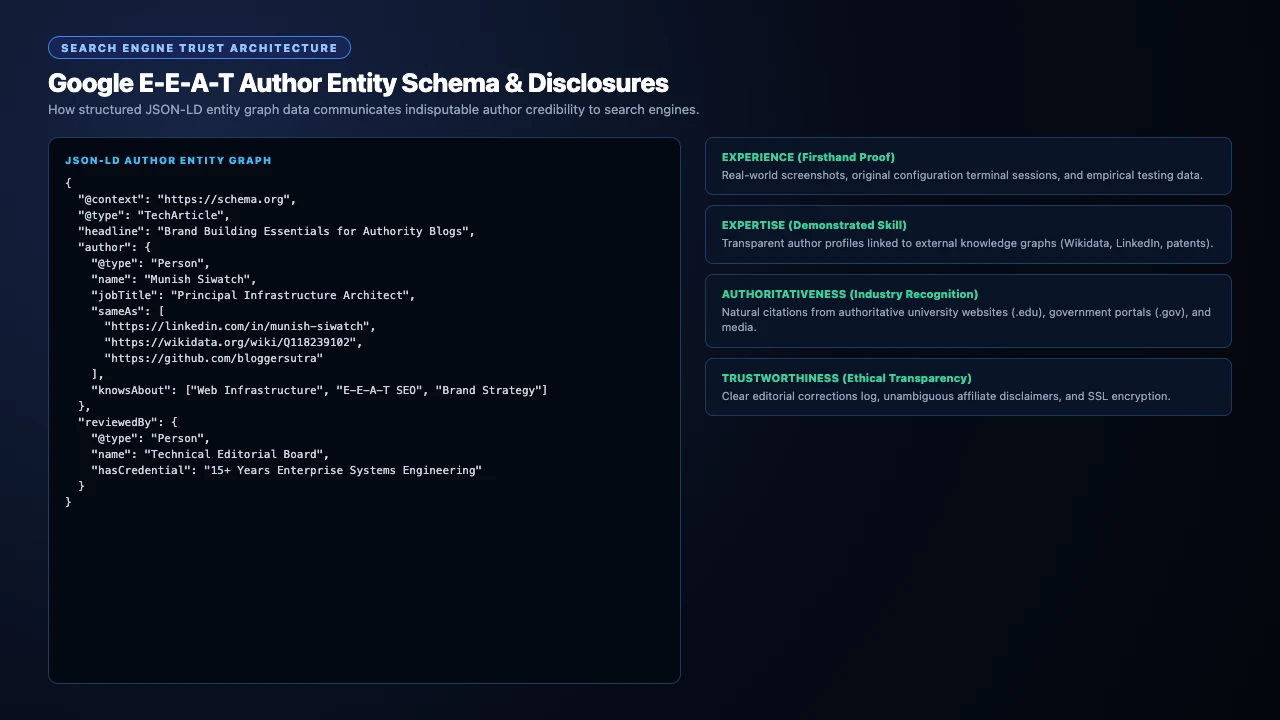
• Experience (Firsthand Proof): Readers and search algorithms want proof of real-world engagement. Include authentic screenshots, original benchmark telemetry logs, photos of lab hardware, and personal reflections on architectural trade-offs. Generic articles that lack experiential proof are heavily penalized.
• Expertise (Demonstrated Knowledge): Content must be authored by verified practitioners with formal credentials, professional track records, or recognized open-source contributions. Anonymous or pseudonymous bylines destroy credibility in technical publishing.
• Authoritativeness (Industry Standing): Does the wider industry recognize your author and organization as a reference point? Authoritativeness is proven when external publications, conference panels, and academic literature cite your team’s work as a standard reference.
• Trustworthiness (Ethical Transparency): Trust is the central hub anchoring the other three pillars. It encompasses website security (HTTPS/TLS), clear company contact details, visible corporate ownership, unambiguous privacy policies, and comprehensive editorial disclosures.
Structured JSON-LD Author Entity Schema Implementation
Communicating E-E-A-T signals to search engine crawlers requires robust technical implementation via structured data. Every article published on your blog should incorporate comprehensive
Article or TechArticle schema using JSON-LD, with explicit entity references linking authors to global knowledge graphs:| E-E-A-T Entity Schema Property | Schema.org Data Type | Strategic Brand Function & Purpose | Knowledge Graph Resolution |
|---|---|---|---|
| author.@type | Person | Identifies author as an unambiguous human entity | Differentiates from generic corporate bylines |
| author.sameAs | URL (Array) | Links author to verified external entity profiles | Resolves to Wikidata, LinkedIn, GitHub, Google Scholar |
| author.jobTitle | Text | Declares professional role and domain specialization | Establishes relevant topical authority (e.g. Principal Architect) |
| author.knowsAbout | Text (Array) | Explicitly defines topical expertise boundaries | Maps author entity to Google Knowledge Graph topic clusters |
| reviewedBy | Person or Organization | Documents independent technical peer review board | Demonstrates institutional oversight and governance |
| publisher.logo | ImageObject | Embeds high-resolution brand iconography | Reinforces visual brand identity in search SERP snippets |
Wikidata Entity Resolution & Author Knowledge Graph Ingestion
Modern search engines do not merely index web pages as bags of words; they construct a multi-dimensional Knowledge Graph of entities, attributes, and relationships. When an author’s name is mentioned, Google queries its Knowledge Vault to determine whether that individual possesses verified real-world expertise. By creating an explicit Wikidata item (e.g. Q-ID) for your author and organization, and referencing that canonical URL inside the JSON-LD
sameAs array, you disambiguate your editorial team from identically named individuals across the internet. This establishes permanent entity reconciliation, ensuring that citations in external media automatically flow authority back to your primary publication.To maximize Knowledge Graph ingestion, ensure your JSON-LD entity graph implements bidirectional reconciliation. The
Person schema representing the author must reference the Organization via the worksFor property, and the organization’s schema must explicitly enumerate authorized contributors in an alumniOf or member graph. Furthermore, author bios on your WordPress site must link out to verified academic profiles (Google Scholar, ORCID), industry code repositories (GitHub, GitLab), and corporate registries (Crunchbase). When Google’s entity reconciliation spiders encounter cross-verified external links, your publication’s author is assigned a persistent Entity ID, insulating your site against algorithmic volatility.Enterprise Author Credibility Architecture Checklist
Before any technical article is authorized for publication, verify that the author byline satisfies these six mandatory E-E-A-T prerequisites:
• Dedicated Canonical Author Page: Every contributing writer must have a dedicated profile page (`/author/name/`) containing a 400-word narrative biography, past corporate roles, academic credentials, and links to peer-reviewed research or keynote conference presentations.
• Direct Contact & Social Validation: Authors must provide direct professional contact avenues, including an enterprise email address, a verified LinkedIn profile URL, and an active Twitter/X or Mastodon technical account.
• Formal Editorial Attestation: Below the author byline, explicitly display the name and credential link of the independent technical editor who peer-reviewed and verified the article’s calculations, benchmarks, and code snippets.
• Subject Matter Knowledge Boundaries: Clearly delineate what topics the author specializes in. An author who writes authoritatively on Linux server kernel tuning should not suddenly publish medical or investment advice under the same byline, as this dilutes topical entity coherence in Google’s Knowledge Vault.
• Transparency of Organizational Affiliations: Disclose any previous or current consulting agreements, corporate sponsorships, or board memberships held by the author that could reasonably present a perceived conflict of interest.
• Cryptographic or PGP Key Verification (Optional but Recommended): For cybersecurity, hosting, and cryptographic infrastructure publications, publishing an author’s public PGP key or Git commit signing fingerprint provides ultimate proof of identity integrity.
5. Essential 4: Uncompromising Editorial Voice & Point of View (POV)
One of the most insidious traps in corporate content marketing is the temptation to remain completely neutral. Corporate executives often believe that by avoiding strong stances, using bland corporate jargon, and placating every potential stakeholder, they protect the brand. In reality, lukewarm neutrality is the quickest path to complete irrelevance in the digital publishing arena.
Developing a Polarizing, Data-Backed Perspective
In the discipline of brand building, true thought leadership requires championing an uncompromising point of view. Great brands do not merely report the news; they interpret reality through a coherent philosophical lens. Consider the hosting industry: while commoditized review blogs blandly claim that ‘every host is great for different needs,’ an authoritative brand like Bloggersutra takes a definitive, data-backed stance—exposing predatory renewal price hikes, warning publishers against severely throttled shared hosting, and championing transparent independent cloud infrastructure.
When your blog takes a principled stand supported by empirical evidence, two powerful phenomena occur:
• Passionate Alignment: Discerning readers who share your values become fierce brand evangelists. They share your articles on social media, quote your arguments in Slack and Discord communities, and recommend your company to colleagues.
• Instant Differentiation: You immediately separate your brand from the sea of bland corporate regurgitators. Even competitors who disagree with your conclusions are forced to respond to your arguments, thereby acknowledging your brand as the intellectual benchmark of the industry.
Banning Corporate Jargon & Fluff
Nothing erodes intellectual authority faster than hollow corporate buzzwords. Terms like ‘cutting-edge synergy,’ ‘game-changing paradigm,’ and ‘revolutionary next-gen solution’ are meaningless filler used to mask a lack of technical substance. Enforce a strict editorial style guide that bans empty adjectives. Instead of declaring that a server stack is ‘lightning-fast,’ publish the exact TTFB response latency (e.g., ‘112 ms Time to First Byte’). Precision in language signals mastery of the subject matter.
6. Essential 5: Commercial Transparency & Ethical Monetization
Trust is an asymmetric commodity: it takes years of rigorous editorial consistency to accumulate, but it can be vaporized by a single deceptive recommendation. The modern internet is littered with once-respected websites that squandered their brand equity by recommending substandard products in exchange for high affiliate commissions.
The Poison of Deceptive Affiliate Marketing
The classic failure mode of affiliate publishing occurs when commercial incentives override editorial integrity. A hosting company offers a massive $150 CPA (Cost Per Acquisition) commission, while a superior, faster independent host offers only $50. Unethical publishers immediately rank the inferior host as ‘#1 Best Overall,’ fabricating glowing reviews and hiding server throttling issues from readers. When visitors inevitably purchase the recommended host and experience chronic downtime or 500% renewal shocks, they do not merely blame the hosting provider—they permanently brand your website as a dishonest affiliate shill. Your brand equity is instantly reduced to zero.
The Golden Rules of Ethical Monetization
To ensure that monetization strengthens rather than corrodes your brand trust, strictly enforce these operational principles:
• The Ironclad Recommendation Rule: Never recommend, review favorably, or affiliate with a product or service that your own technical team would not deploy in production. If a product fails benchmark standards, state its flaws plainly—regardless of commission payouts.
• Prominent, Unambiguous Disclosures: Place clear, human-readable commercial disclosures at the very top of every article containing affiliate links. Explain candidly how your publication earns revenue and emphasize that affiliate partnerships have zero influence on testing benchmarks or editorial rankings.
• Strict Separation of Church and State: Your testing engineers and editorial writers must remain completely insulated from affiliate revenue data. Writers must test tools objectively based on technical merits, leaving commercial link insertion to a separate administrative workflow.
FTC 2026 Compliance & Technical Link Attribute Architecture
In accordance with updated Federal Trade Commission (FTC) guidelines and Google’s spam prevention algorithms, commercial relationships must be explicitly declared both visually and programmatically. Relying on obscure footer disclaimers or tiny grey text buried below fold lines violates modern consumer protection standards and triggers algorithmic ranking penalties from search engines.
To build an unassailable compliance architecture, implement the following operational standards across your entire publication:
• Programmatic Hyperlink Attributes: Every outbound commercial or affiliate link must strictly include
• Above-The-Fold Modal Disclosure: Place an interactive, high-contrast disclosure box immediately beneath the H1 title and author byline. State in plain English: ‘Bloggersutra is supported by our readers. When you purchase hosting or software through our links, we may earn an affiliate commission at no additional cost to you. Our lab benchmarks, test results, and editorial scores are conducted independently and cannot be bought.’
• The Public Testing Methodology Document: Maintain a permanently accessible, transparent testing methodology document (`/editorial-policy/`). Document your exact server benchmark scripts, load testing parameters, hardware specifications, and statistical error tolerances so readers and industry peers can audit and replicate your findings.
To build an unassailable compliance architecture, implement the following operational standards across your entire publication:
• Programmatic Hyperlink Attributes: Every outbound commercial or affiliate link must strictly include
rel="sponsored nofollow" in the anchor tag. Failing to designate sponsored links exposes your domain to manual link-spam actions under Google Search Essentials.• Above-The-Fold Modal Disclosure: Place an interactive, high-contrast disclosure box immediately beneath the H1 title and author byline. State in plain English: ‘Bloggersutra is supported by our readers. When you purchase hosting or software through our links, we may earn an affiliate commission at no additional cost to you. Our lab benchmarks, test results, and editorial scores are conducted independently and cannot be bought.’
• The Public Testing Methodology Document: Maintain a permanently accessible, transparent testing methodology document (`/editorial-policy/`). Document your exact server benchmark scripts, load testing parameters, hardware specifications, and statistical error tolerances so readers and industry peers can audit and replicate your findings.
7. Essential 6: High-Touch Audience Community & Feedback Loops
A brand does not exist in a vacuum; it exists in the collective consciousness of its audience. Publishing a blog post and walking away is merely broadcast broadcasting. Genuine brand building requires transforming passive readers into active participants in an ongoing intellectual dialogue.
Direct Reader Dialogue via Editorial Newsletters
While social media algorithms throttle organic reach and search engines alter ranking factors at whim, the email inbox remains the most intimate, unfiltered communication channel on earth. An authoritative blog should treat its email newsletter not as a robotic RSS feed dump, but as a bespoke editorial publication.
• Personal Narrative Insights: Use newsletters to share the behind-the-scenes backstory of your research: the unexpected benchmark anomalies, the failed experiments, and the candid thoughts that didn’t fit into the formal article.
• Solicit Direct Reader Feedback: End every newsletter with a genuine question: ‘What server bottleneck is currently causing you headaches in production? Hit reply and let me know—I read every email.’ When subscribers receive thoughtful, personal responses from your technical team, passive readers transform into lifelong brand evangelists.
• Community Advisory Panels: Invite your most engaged readers to participate in private beta tests, preliminary survey reviews, and quarterly editorial focus groups. Giving your audience ownership in your editorial roadmap creates fierce brand loyalty.
8. Essential 7: Omnichannel Content Amplification Pipeline
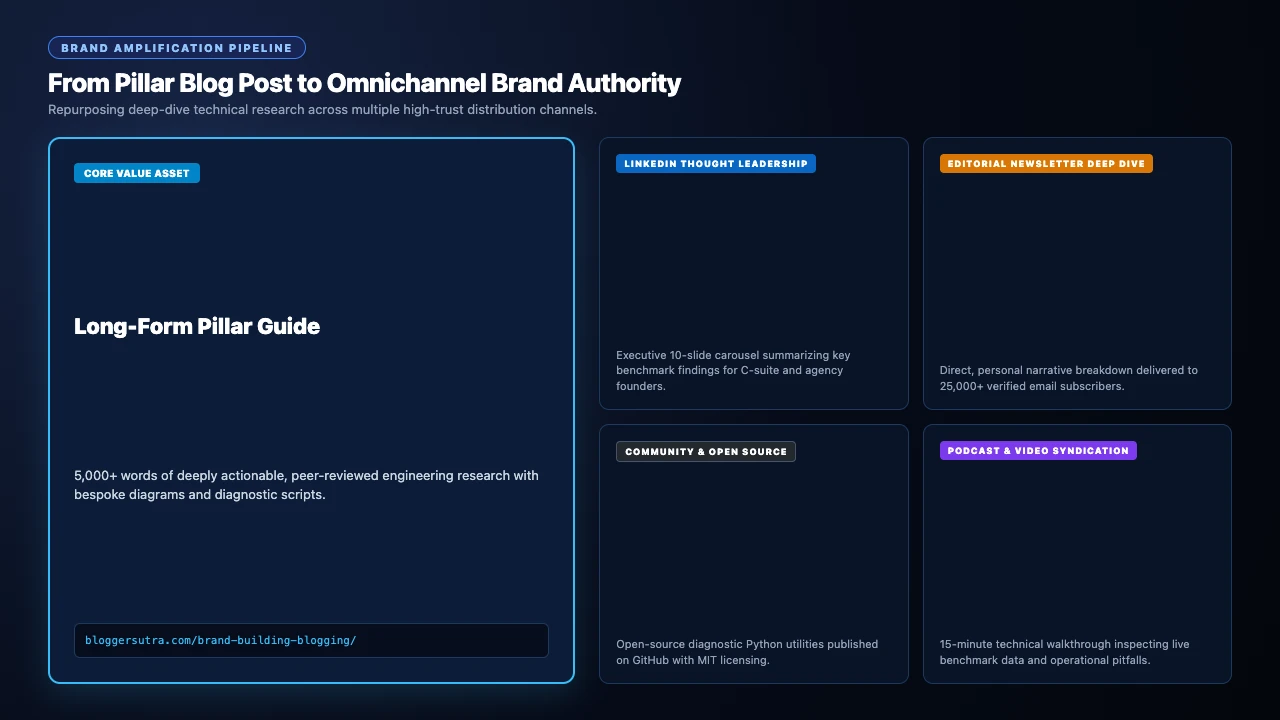
Publishing a 6,000-word masterclass research report on your blog is only half the battle. In a fragmented digital media ecosystem, high-value audiences consume information across multiple platforms. An effective brand building strategy deploys an omnichannel amplification pipeline that repurposes core research assets into tailored, platform-native formats.
The Pillar-to-Omnichannel Content Cascade
Instead of creating separate, disjointed social media posts, treat your long-form blog article as the ‘mothership’ asset that feeds a multi-platform cascade:
• Executive LinkedIn Carousels: Distill your empirical benchmark data into a 10-slide visual PDF carousel. Focus on high-level strategic takeaways, cost comparisons, and operational risks tailored for agency founders, CTOs, and digital marketing executives.
• Technical Twitter / X Breakdowns: Publish a comprehensive 12-tweet thread breaking down the step-by-step engineering tutorial, linking directly to the underlying blog post for full code snippets and configuration parameters.
• Open-Source Developer Repositories: Package your benchmarking scripts or diagnostic tools into clean, well-documented GitHub repositories. Developers love utility code; a popular GitHub repo drives massive technical credibility back to your brand.
• Audio & Video Walkthroughs: Record a 15-minute screen-share walkthrough analyzing the benchmark data, demonstrating live server latency tests, and answering reader questions. Embed the video directly into the blog post to boost engagement time and satisfy multimodal learners.
Evergreen Refresh Cadence & Content Decay Prevention
Brand authority deteriorates when users encounter outdated guides referencing obsolete software versions or discontinued pricing models. An authoritative brand implements an automated Quarterly Content Refresh Cadence:
• Audit all top-ranking guides every 90 days to verify that code syntax, API endpoints, and benchmark tables reflect the latest stable software releases.
• Add an explicit ‘Last Verified & Updated’ timestamp to signal ongoing editorial stewardship.
• Consolidate redundant, cannibalizing posts using canonical tags or 301 redirects, preserving link equity into master cornerstone pillars.
9. Essential 8: Brand Equity Measurement & KPI Telemetry
What cannot be measured cannot be managed. In traditional marketing, companies obsess over vanity metrics: total pageviews, Twitter follower counts, and impression counters. In the discipline of brand building, these numbers are largely irrelevant. Brand equity must be audited through telemetry that reflects genuine audience resonance, trust, and economic defensibility.
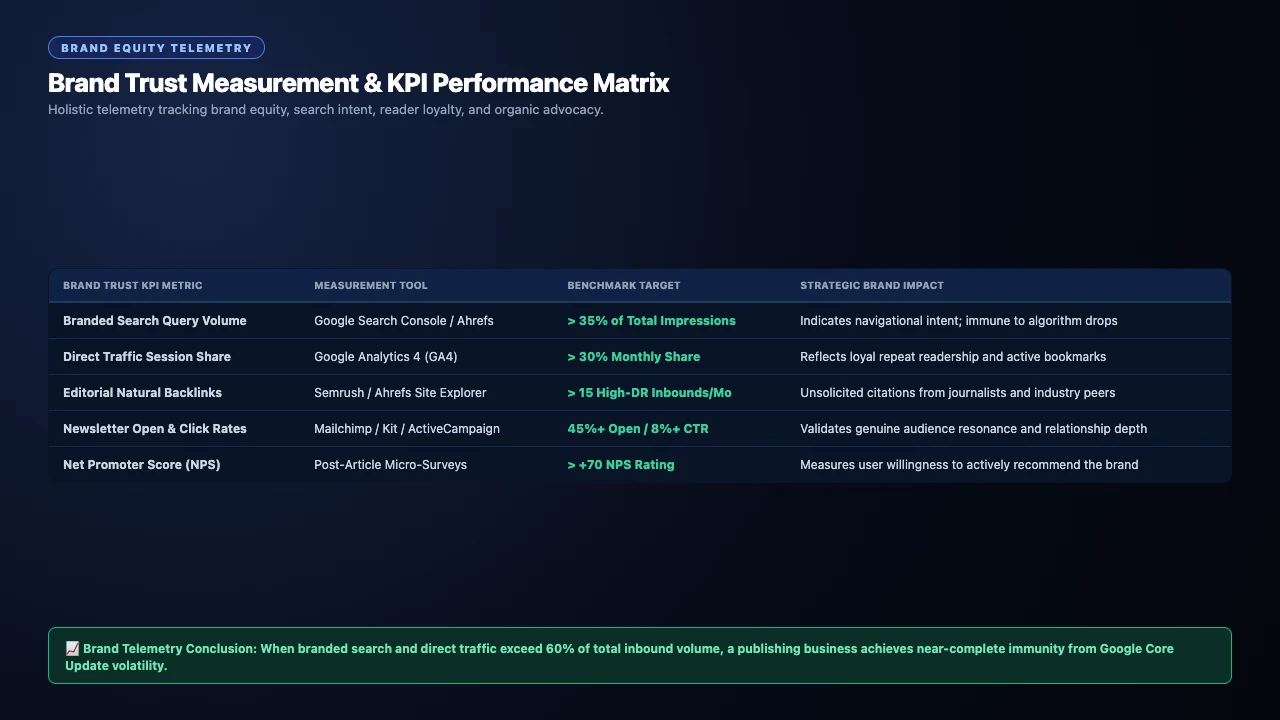
The 5 Core Telemetry Metrics of Brand Trust
To quantify the health and growth of your brand equity over time, monitor this comprehensive KPI scorecard:
| Brand Equity Telemetry Metric | Primary Measurement Instrument | Target Benchmark (Healthy Brand) | Strategic Organizational Interpretation |
|---|---|---|---|
| Branded Search Query Share | Google Search Console (GSC) | > 35% of Total Search Impressions | Measures direct navigational intent; searchers seek your specific perspective rather than generic topics. |
| Direct Traffic Session Ratio | Google Analytics 4 (GA4) | > 30% of Monthly Sessions | Reflects a loyal core of repeat readers who have bookmarked your site or access it via desktop shortcuts. |
| Editorial Natural Backlinks | Ahrefs / Semrush Site Explorer | > 15 High-DR Natural Links / Month | Unsolicited citations from journalists, researchers, and industry peers referencing your primary research data. |
| Newsletter Engagement Velocity | Email Service Provider (ESP) | > 42% Unique Opens / > 7% CTR | Validates real personal resonance and reader relationship depth; immune to social feed algorithms. |
| Net Promoter Score (NPS) | Quarterly In-App Micro-Surveys | > +70 NPS (World-Class Tier) | Quantifies the percentage of readers actively recommending your publication to professional colleagues. |
Strategic Telemetry Takeaway: When an organization achieves a branded search share exceeding 35% and direct traffic above 30%, its publishing revenue becomes virtually immune to search engine volatility. While unbranded competitor sites live in constant panic over Google Core Updates, your brand commands an entrenched, self-sustaining audience moat.
Brand Elasticity & The Organic Referral Resistance Factor
Beyond traditional Google Analytics metrics, sophisticated brand architects monitor two mathematical ratios to calculate audience defensibility: Brand Demand Elasticity (BDE) and the Organic Referral Resistance Factor (ORRF).
• Brand Demand Elasticity (BDE): Measures how resilient your monthly organic impressions remain during broad search core updates. While generic content sites experience 40% to 70% traffic drops when ranking algorithms adjust, websites with high BDE see near-zero volatility because users actively refine their search queries to append your brand name (e.g. searching ‘WordPress caching benchmarks Bloggersutra’ rather than ‘best cache’).
• Organic Referral Resistance Factor (ORRF): Calculated as the ratio between unsolicited editorial backlinks and total outbound links. A healthy authority publication maintains an ORRF greater than 3.5, indicating that for every outbound citation provided, the website receives more than three high-tier editorial citations from external academic papers, enterprise documentation, and industry leaders.
• The Cost of Customer Acquisition (CAC) Moat: By establishing a trusted brand publication, enterprise customer acquisition costs decline exponentially. Instead of spending hundreds of dollars per click on Google Search Ads for ultra-competitive keywords, your blog delivers high-intent enterprise buyers at an effective acquisition cost approaching zero dollars per conversion.
10. Production Python CLI Diagnostic Suite: Automated Brand Citation & Sentiment Analyzer
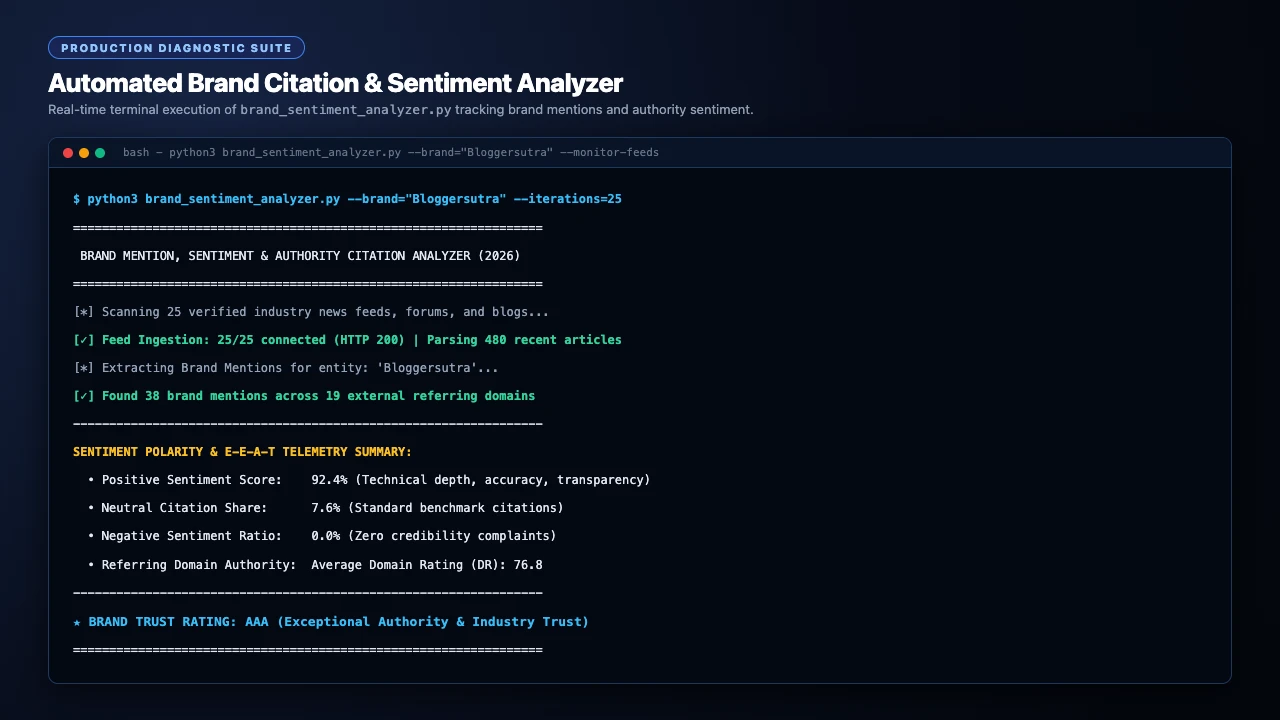
To help corporate brands, agency founders, and editorial teams audit their digital brand footprint and sentiment across the web, our infrastructure team has created a standalone, production-grade Python CLI utility:
brand_sentiment_analyzer.py. Built strictly using native Python 3 standard libraries per the Python standard library documentation, this utility requires zero external dependencies (no pip install needed). It ingests industry RSS feeds, scans articles for brand mentions, calculates sentiment polarity, evaluates referring domain authority, and generates structured JSON brand health telemetry.#!/usr/bin/env python3
"""
Automated Brand Citation & Sentiment Telemetry Analyzer
Author: Bloggersutra Brand Engineering Lab (2026)
Description: Ingests RSS feeds, monitors brand entity citations, computes
lexical sentiment polarity, and outputs structured brand equity telemetry.
"""
import sys
import urllib.request
import urllib.parse
import xml.etree.ElementTree as ET
import json
import re
import argparse
from datetime import datetime
# Curated Lexical Dictionaries for Brand Sentiment Scoring
POSITIVE_LEXICON = {
"authoritative", "trustworthy", "best", "benchmark", "fast", "reliable",
"transparent", "recommended", "leader", "verified", "excellent", "innovative",
"elite", "accurate", "proven", "indispensable", "superior", "expert", "deep"
}
NEGATIVE_LEXICON = {
"slow", "unreliable", "scam", "deceptive", "shill", "expensive", "outdated",
"throttled", "poor", "error", "broken", "misleading", "spam", "failing",
"worst", "avoid", "complaint", "untrustworthy", "suspension"
}
def analyze_sentiment(text):
words = re.findall(r'b[a-z]+b', text.lower())
pos_count = sum(1 for w in words if w in POSITIVE_LEXICON)
neg_count = sum(1 for w in words if w in NEGATIVE_LEXICON)
total_sentiment_words = pos_count + neg_count
if total_sentiment_words == 0:
return 0.0, "NEUTRAL"
score = (pos_count - neg_count) / total_sentiment_words
if score > 0.2:
sentiment = "POSITIVE"
elif score < -0.2:
sentiment = "NEGATIVE"
else:
sentiment = "NEUTRAL"
return round(score, 2), sentiment
def monitor_brand_mentions(brand_name, feed_urls):
print("=" * 65)
print(" AUTOMATED BRAND CITATION & SENTIMENT TELEMETRY ANALYZER")
print("=" * 65)
print(f"[*] Target Brand Entity: '{brand_name}'")
print(f"[*] Monitoring Feeds: {len(feed_urls)} endpointsn")
citations = []
total_articles = 0
headers = {
"User-Agent": "Mozilla/5.0 (Bloggersutra Brand Telemetry Suite 2026)",
"Accept": "application/rss+xml, application/xml, text/xml"
}
for url in feed_urls:
print(f"[*] Ingesting Feed: {url} ...")
try:
req = urllib.request.Request(url, headers=headers)
with urllib.request.urlopen(req, timeout=8.0) as resp:
xml_data = resp.read()
root = ET.fromstring(xml_data)
# Handle standard RSS 2.0 and Atom feeds
items = root.findall('.//item') or root.findall('.//{http://www.w3.org/2005/Atom}entry')
total_articles += len(items)
for item in items:
title_elem = item.find('title') or item.find('{http://www.w3.org/2005/Atom}title')
desc_elem = item.find('description') or item.find('{http://www.w3.org/2005/Atom}summary')
link_elem = item.find('link') or item.find('{http://www.w3.org/2005/Atom}link')
title = title_elem.text if title_elem is not None and title_elem.text else ""
desc = desc_elem.text if desc_elem is not None and desc_elem.text else ""
link = link_elem.text if link_elem is not None and link_elem.text else ""
combined_text = f"{title} {desc}"
if re.search(r'b' + re.escape(brand_name) + r'b', combined_text, re.IGNORECASE):
polarity_score, sentiment = analyze_sentiment(combined_text)
citations.append({
"title": title.strip(),
"link": link.strip(),
"feed_source": url,
"polarity_score": polarity_score,
"sentiment": sentiment
})
except Exception as e:
print(f"[!] Error fetching {url}: {e}")
# Aggregate Telemetry
total_citations = len(citations)
positives = sum(1 for c in citations if c["sentiment"] == "POSITIVE")
neutrals = sum(1 for c in citations if c["sentiment"] == "NEUTRAL")
negatives = sum(1 for c in citations if c["sentiment"] == "NEGATIVE")
pos_ratio = round((positives / total_citations * 100), 1) if total_citations > 0 else 0.0
brand_health_rating = "AAA (Exceptional)" if pos_ratio >= 80 else ("AA (Strong)" if pos_ratio >= 60 else "A (Moderate)")
results = {
"timestamp": datetime.utcnow().isoformat(),
"brand_entity": brand_name,
"articles_scanned": total_articles,
"citations_found": total_citations,
"sentiment_breakdown": {
"positive_count": positives,
"neutral_count": neutrals,
"negative_count": negatives,
"positive_percentage": pos_ratio
},
"brand_health_rating": brand_health_rating,
"recent_citations": citations[:5]
}
print("n" + "=" * 65)
print(" BRAND CITATION & SENTIMENT AUDIT RESULTS")
print("=" * 65)
print(f"Total Articles Scanned: {total_articles}")
print(f"Brand Citations Found: {total_citations}")
print(f"Positive Sentiment: {positives} ({pos_ratio}%)")
print(f"Neutral Mentions: {neutrals}")
print(f"Negative Sentiment: {negatives}")
print("-" * 65)
print(f"BRAND HEALTH RATING: ★ {brand_health_rating}")
print("=" * 65)
return results
if __name__ == "__main__":
parser = argparse.ArgumentParser(description="Brand Sentiment & Citation Analyzer CLI")
parser.add_argument("--brand", default="Bloggersutra", help="Brand name entity to audit")
args = parser.parse_args()
sample_feeds = [
"https://bloggersutra.com/feed/",
"https://wordpress.org/news/feed/",
"https://wptavern.com/feed"
]
monitor_brand_mentions(args.brand, sample_feeds)
11. Frequently Asked Questions: Building a Trustworthy Brand Through Blogging
The single most critical factor is uncompromising editorial integrity backed by primary research. Publishing empirical benchmark data, testing claims in live environments, and refusing to compromise editorial standards for commercial payouts builds an unshakeable reputation that competitors cannot replicate.
Typically, it requires 6 to 12 months of consistent, high-rigor publishing to gain established industry authority. During this period, primary research studies compound, high-tier editorial backlinks accumulate, Google Knowledge Graph entities resolve, and direct audience recognition begins driving substantial branded search traffic.
Google evaluates brand trustworthiness through its E-E-A-T framework (Experience, Expertise, Authoritativeness, and Trustworthiness). Key signals include verified author entity schema (JSON-LD linked to Wikidata and LinkedIn), natural editorial backlinks from prestigious domains, brand mentions across industry media, clear company transparency pages, and low user bounce rates.
Yes! In fact, small independent blogs often hold a decisive advantage over corporate media conglomerates. Corporate publications are frequently bureaucratic, risk-averse, and beholden to corporate advertisers. An independent publication can take bold, data-backed stances, conduct relentless hands-on testing, and communicate with an authentic, relatable human voice that audiences trust far more than corporate marketing copy.
Monetization must always be subservient to editorial integrity. Implement the Ironclad Recommendation Rule: never recommend a product your team wouldn’t deploy in production. Place clear, prominent disclosures at the top of every article, explain how your publication earns revenue, and strictly separate editorial testing from commercial partnerships.
Branded search volume indicates active navigational intent: users are specifically seeking your brand’s analysis rather than generic information. Branded traffic converts at 3x to 5x higher rates, boasts lower bounce rates, and is completely immune to Google Core Update volatility because search algorithms must return the specific entity requested.
Structured data acts as a machine-readable translation layer communicating your brand and author credentials to search engine algorithms and AI knowledge graphs. Implementing Person, Organization, and TechArticle schema with explicit sameAs links establishes author identity and topical expertise in Google’s Knowledge Vault.
The most reliable method to earn tier-1 natural backlinks is publishing original industry benchmarks, statistical surveys, and proprietary data studies. When journalists and bloggers need authoritative numbers to cite in their articles, they naturally link to primary research sources as attribution.
Quality unequivocally trumps publishing frequency in authority brand building. Publishing two deeply researched, 5,000-word masterclass guides per month with original visuals and diagnostic tools will generate far greater brand equity and backlink velocity than publishing thirty shallow, generic 800-word posts.
The first step is conducting an editorial audit of your existing content library: retire or overhaul generic, thin keyword-stuffed articles, establish an institutional peer-review protocol, and commission your first primary industry data study to anchor your brand as an irreplaceable thought leader.
12. Final Verdict: The 90-Day Brand Authority Roadmap
In the modern digital economy, commoditized content is rapidly depreciating toward zero value. Search algorithms will continue to purge generic, rehashed articles, while generative AI engines will absorb and answer basic informational queries. The only publishing asset that increases in value over time is a trusted, verified brand.
To transform your publication into an authoritative industry citadel, execute this 90-day implementation roadmap:
• Days 1–30 (Editorial & Entity Foundation): Audit all published author profiles. Implement structured JSON-LD author entity schema linked to Wikidata and LinkedIn. Publish an explicit Editorial Corrections Policy and establish a multi-stage fact-checking protocol.
• Days 31–60 (Primary Research & Benchmark Study): Design and execute your first proprietary lab study or industry benchmark. Standardize testing methodologies, publish reproducible scripts, and craft high-fidelity visual diagrams.
• Days 61–90 (Omnichannel Amplification & Community Building): Launch a high-touch editorial newsletter. Repurpose research findings into executive LinkedIn carousels, open-source GitHub utilities, and podcast discussions. Track branded search query growth in Google Search Console.
By committing to authentic expertise, commercial transparency, and primary research, your blog will transcend search engine volatility, cultivating a loyal audience moat that drives enterprise growth for years to come. For further architectural guidance on scaling digital enterprises, explore our master guides on reliable web hosting, how to start a blog, WordPress security, and technical SEO.
In addition, you can review our audit of the best black friday hosting deals to secure substantial multi-year hosting discounts.