Quick answer
- How long does it take to write a blog post in 2026? According to annual industry benchmarks from Orbit Media and professional content agencies, viral content a high-quality, search-optimized blog post takes an average of 3 hours and 55 minutes. However, the exact answer to how long does it take to write a blog post depends on content depth and format: 1) Short News or Opinion Posts (600–1,000 words): 1.5 to 2 hours; 2) Standard How-To Tutorials (1,500–2,200 words): 3 to 4 hours; 3) Product Roundups & Listicles (2,500–3,500 words): 4.5 to 6 hours; and 4) Authoritative Pillar Guides (5,000+ words): 7 to 10 hours..tp-post-content code, .tp-post-content pre, .toc-link{word-break:break-word!important;overflow-wrap:break-word!important;}
- Why does writing a blog post take so much longer today than a decade ago? When analyzing how long does it take to write a blog post historically, the average post in 2014 was roughly 800 words and took only 2 hours to produce. Today, Google’s Helpful Content System and E-E-A-T (Experience, Expertise, Authoritativeness, and Trustworthiness) standards demand original hands-on testing, custom diagrams, structured data tables, and comprehensive search intent coverage. Writers spend significantly more time on SERP competitor analysis, graphic design, and technical on-page optimization than pure word drafting.
- How can you write high-quality blog posts faster without sacrificing depth? To dramatically reduce how long does it take to write a blog post: 1) Decouple drafting from editing: Never backspace or self-edit while drafting your initial sprint; 2) Standardize outlines: Create reusable heading frameworks for listicles and reviews before writing; 3) Batch production phases: Conduct all keyword research on one day, write all first drafts on another day, and generate all graphics on a third day; and 4) Augment with AI tools: Use AI to brainstorm angles and summarize technical documentation while writing original insights yourself.
- How long should you spend on keyword research before writing? When planning how long does it take to write a blog post, dedicate 30 to 45 minutes to keyword and SERP research for a standard 2,000-word article. This involves identifying the primary search intent, extracting 5 to 8 semantic secondary keywords, reviewing the top 5 ranking competitors to identify content gaps, and noting frequently asked questions from Google’s ‘People Also Ask’ box. Skimping on research leads to writing off-target content that fails to rank.
- Is it realistic to write a 2,000-word blog post in under 2 hours? Wondering how long does it take to write a blog post of 2,000 words from scratch in under 2 hours? It is generally unrealistic for solo human writers if it includes original research, bespoke diagrams, and thorough editing. However, experienced writers using the AI-assisted hybrid workflow can achieve a 2,000-word draft in 90 to 120 minutes by using AI for rapid structural outlines and boilerplate code, leaving the human writer to inject personal case studies, verify facts, and format the final piece.
One of the most persistent and critical questions every creator, freelance copywriter, and digital content promotion manager asks is: how long does it take to write a blog post? Whether you are estimating client project budgets, establishing weekly editorial calendars for a corporate publication, or planning your personal creator routine, accurate time forecasting is the linchpin of sustainable content operations.
Search the internet for advice on content production, and you will find wildly contradictory claims. Productivity gurus boast of writing 3,000 words in 45 minutes using dictation software, while enterprise investigative journalists admit to spending 25 hours on a single technical teardown. Beginners often feel demoralized when they spend an entire 8-hour workday crafting an article, wondering if their slow velocity indicates a lack of talent or flawed methodology. The truth is that understanding how long does it take to write a blog post requires looking past vanity typing speeds and analyzing the complete end-to-end editorial lifecycle.
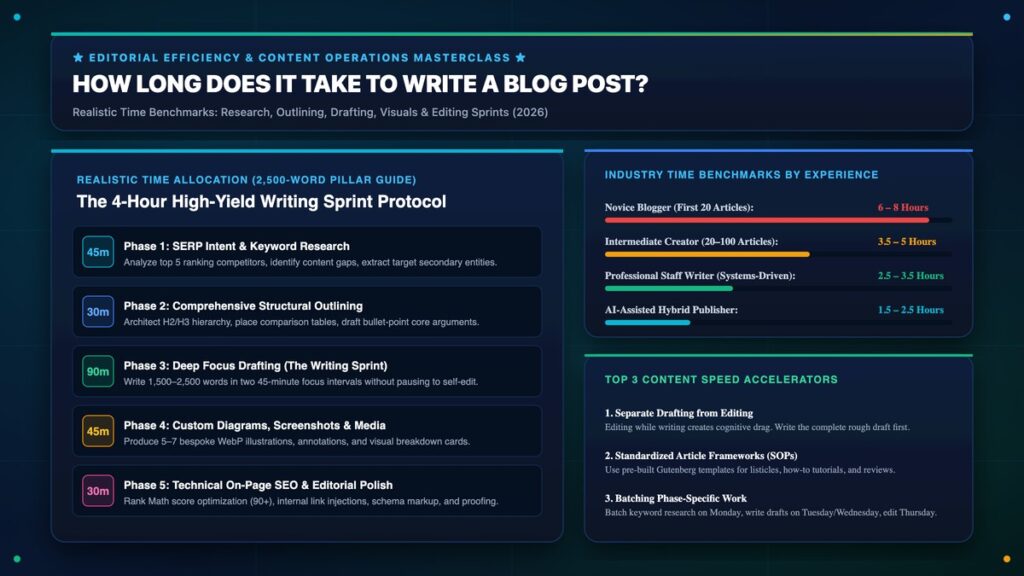
Writing an article that ranks on the first page of Google, engages human readers, and drives commercial affiliate or website conversion rate is not a monolithic writing task. It is a multi-phase manufacturing pipeline comprising competitive SERP research, architectural outlining, deep focus drafting, custom graphic design, and surgical technical on-page SEO. When you quantify how long does it take to write a blog post across each distinct phase, you transform erratic writing sprints into a predictable, repeatable business engine.
This definitive masterclass provides realistic, empirical time benchmarks based on thousands of published articles and industry surveys. You will learn exactly how long does it take to write a blog post based on word count and subject complexity, discover why the amateur habit of ‘writing and editing simultaneously’ doubles production time, and master the proven 4-hour writing protocol that high-earning professional authors use to publish authoritative content with zero burnout.
The 5-Phase Editorial Time Allocation Blueprint: How Long Does It Take to Write a Blog Post?
To understand how long does it take to write a blog post, we must deconstruct the production process into its five constituent operational stages. In our standard benchmark model for a comprehensive 2,500-word authoritative guide, the total production time averages exactly 4 hours (240 minutes):
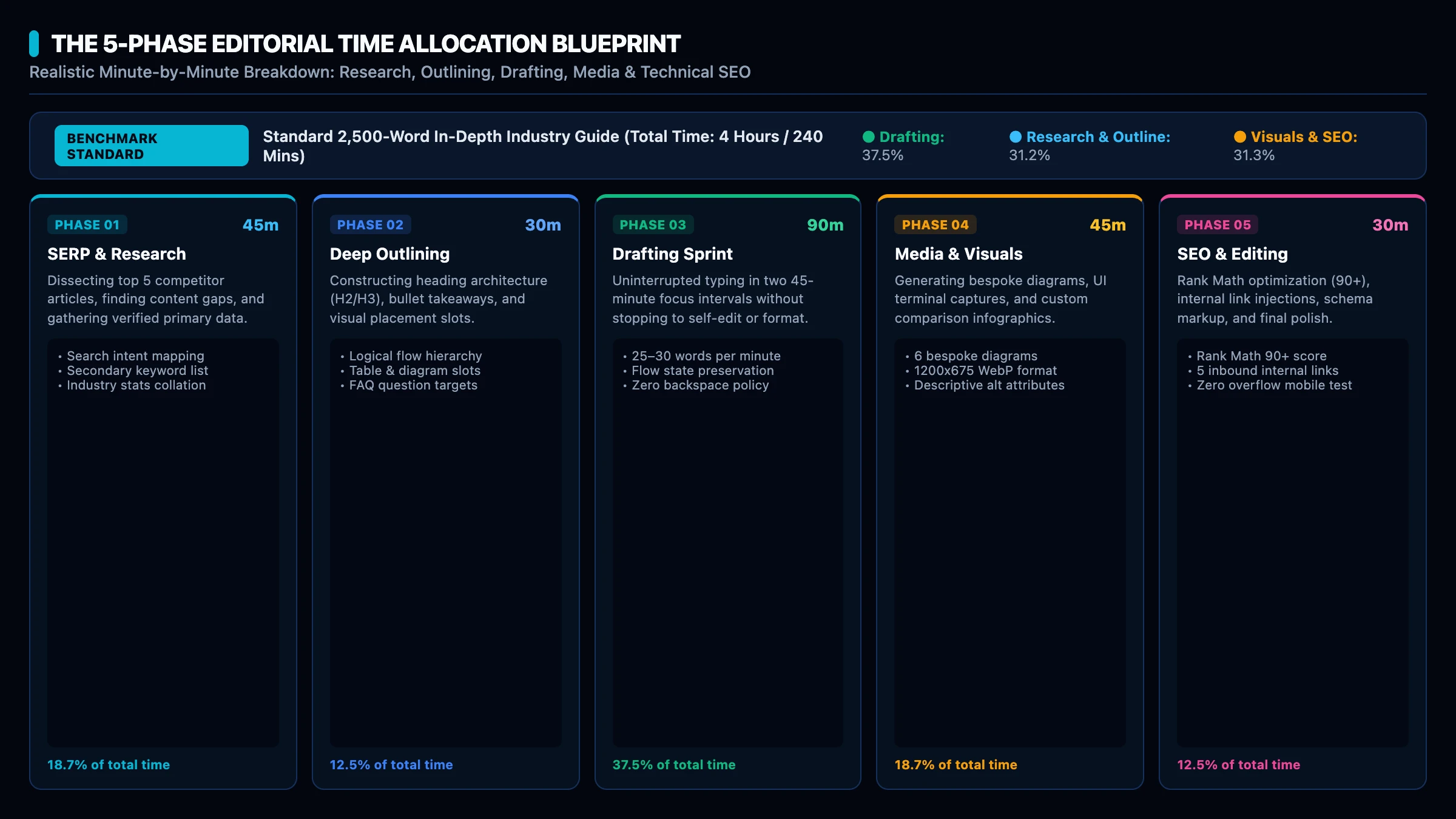
Let us examine the exact minute-by-minute time investment required across each phase when determining how long does it take to write a blog post:
1. Phase 1: SERP Intent & Keyword Research (45 Minutes / 18.7%): Before typing a single sentence, you must dissect the current organic search landscape. This involves identifying the primary focus keyword, filtering 5 to 8 secondary long-tail entities, inspecting the top 5 ranking competitor pages in your niche, and locating critical content gaps that existing articles fail to answer. Spending 45 minutes upfront prevents the catastrophic mistake of writing an article that targets the wrong search intent. If you skip this step, calculating how long does it take to write a blog post becomes meaningless because the resulting article will fail to rank.
2. Phase 2: Comprehensive Structural Outlining (30 Minutes / 12.5%): An outline is not a rough bulleted list—it is the engineering blueprint of your article. During this 30-minute phase, you architect the complete H2 and H3 heading hierarchy, map out slots for comparison tables and diagrams, and write concise takeaway sentences for each section. When a robust outline is in place, the drafting phase becomes pure execution rather than stressful brainstorming. Outlining is the single greatest lever for shortening how long does it take to write a blog post.
3. Phase 3: Deep Focus Drafting Sprint (90 Minutes / 37.5%): This is the core writing block where you generate the raw body prose. Working in two focused 45-minute intervals separated by a short break, a skilled writer maintaining an effective speed of 25 to 30 words per minute can produce 2,200 to 2,700 words of initial copy. Crucially, self-editing is strictly forbidden during this sprint. When authors ask how long does it take to write a blog post, they often assume drafting takes the entire day—yet with focused sprints, raw text generation takes just an hour and a half.
4. Phase 4: Custom Diagrams, Screenshots & Media Assets (45 Minutes / 18.7%): Modern search engine algorithms and human readers demand visual learning aids. In this phase, you create 5 to 7 custom WebP graphics, capture annotated user interface screenshots, format data tables, and generate responsive category icons. Bespoke visual assets elevate your article from generic text into an authoritative reference. Factoring media creation into how long does it take to write a blog post separates amateur hobbyists from serious digital publishers.
5. Phase 5: Technical On-Page SEO & how to improve readability (30 Minutes / 12.5%): The final 30 minutes are dedicated to optimization and quality assurance. You calibrate your Rank Math SEO score (targeting 90+), write compelling meta titles and descriptions, inject 5 contextual inbound internal links from older articles, verify mobile 375px viewport responsiveness, and perform a final proofreading pass to eliminate grammatical friction. Completing this phase ensures that whatever time you invested in how long does it take to write a blog post translates directly into top-tier Google rankings.
Word Count vs. Writing Duration Benchmark Matrix
Production time scales with word count, technical depth, and research complexity. Compare realistic time estimates for how long does it take to write a blog post across different length tiers:
| Article Type & Scope | Target Word Count | Novice Writer Duration | Experienced Author Duration | AI-Augmented Hybrid Duration |
|---|---|---|---|---|
| Short News / Product Update | 600 – 1,000 Words | 2.5 – 3.5 Hours | 1.5 – 2.0 Hours | 45 – 60 Minutes |
| Standard How-To Tutorial | 1,500 – 2,200 Words | 4.5 – 6.0 Hours | 3.0 – 4.0 Hours | 1.5 – 2.5 Hours |
| Comprehensive Roundup Listicle | 2,500 – 3,500 Words | 7.0 – 9.0 Hours | 4.5 – 5.5 Hours | 2.5 – 3.5 Hours |
| In-Depth Tool / Software Review | 3,000 – 4,200 Words | 8.0 – 11.0 Hours | 5.0 – 6.5 Hours | 3.0 – 4.0 Hours |
| Enterprise Flagship Pillar Guide | 5,000 – 7,500 Words | 14.0 – 20.0 Hours | 7.5 – 10.0 Hours | 4.5 – 6.0 Hours |
Cognitive Decoupling: Why You Must Separate Drafting from Editing
If you find that your production duration consistently stretches past 6 or 8 hours for a standard article, the culprit is almost certainly the amateur habit of concurrent drafting and editing. When writers wonder how long does it take to write a blog post, they often fail to realize that the human brain operates in two fundamentally opposing cognitive modes: the Generative Creative Mode and the Critical Analytical Mode.
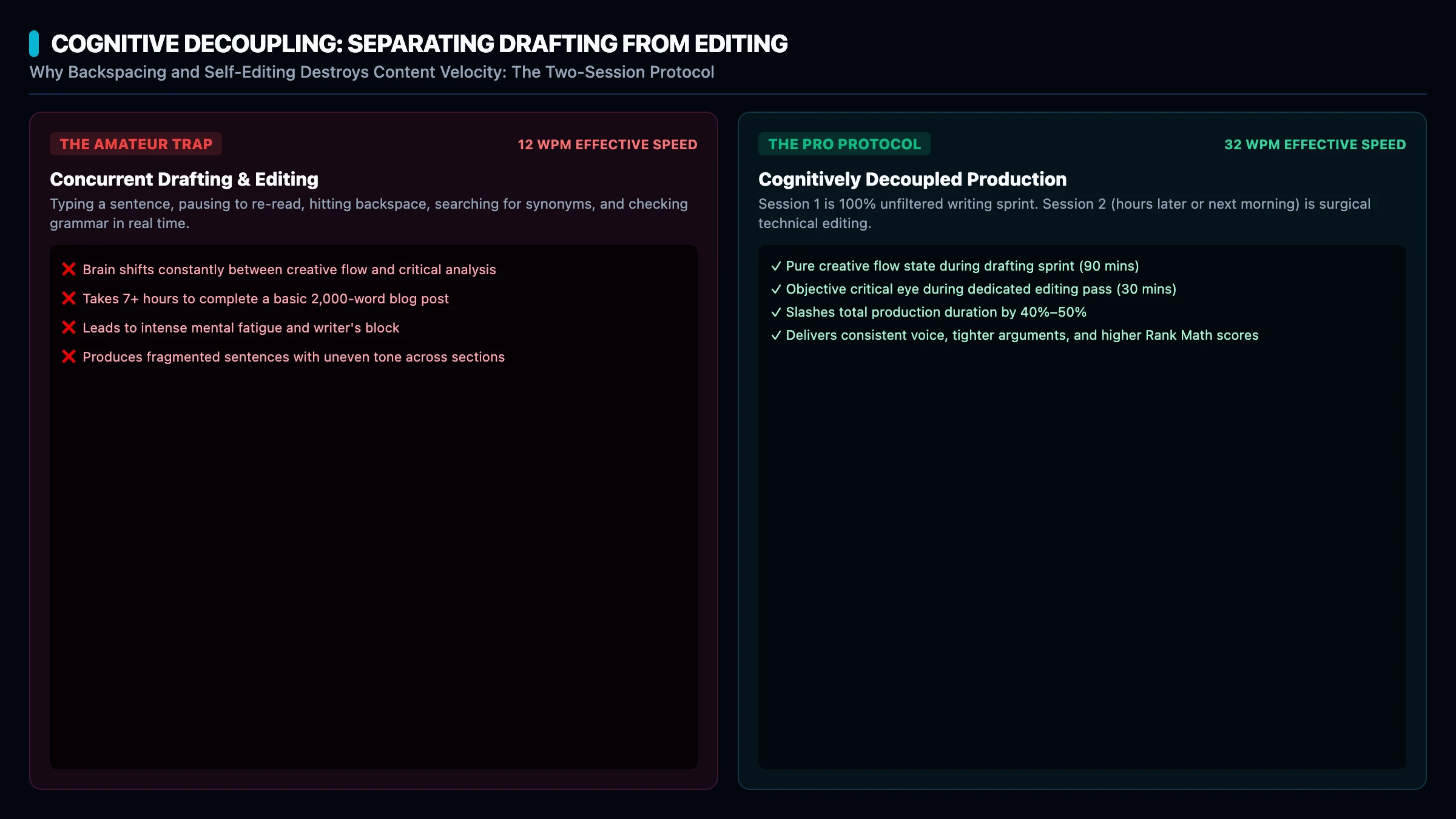
When you write a sentence and immediately hit the backspace key to rephrase an adjective, consult a thesaurus, or fix a comma splice, you force your brain to execute a rapid cognitive context-switch. Neuroscientific research confirms that task-switching carries a severe cognitive penalty, reducing effective typing velocity to under 12 words per minute and triggering mental exhaustion within an hour. This friction inflates how long does it take to write a blog post beyond reasonable limits.
Professional authors reduce how long does it take to write a blog post by practicing Cognitive Decoupling—strictly segregating the creation of content from its refinement:
• The Raw Draft Sprint (Zero Backspacing Allowed): During the 90-minute drafting sprint, your sole objective is getting thoughts down on the screen. If you cannot remember a specific statistic, type
[DATA HERE] and keep typing. If a sentence feels clumsy, resist the urge to rewrite it and move immediately to the next paragraph. Preserving uninterrupted creative momentum allows you to draft 2,000 words in 75 minutes at an exhilarating 30+ words per minute. Mastering this sprint drastically compresses how long does it take to write a blog post.• The Surgical Editorial Pass (Scheduled Separately): Once the full draft is completed, step away from your computer for at least 30 minutes, or sleep on the draft overnight. When you return with a refreshed analytical mindset, you can ruthlessly cut passive voice, tighten transitions, verify factual citations, and optimize keyword placement in one rapid 30-minute editing session.
By separating drafting from editing, you slash the answer to how long does it take to write a blog post by nearly half, while simultaneously producing cleaner, more authoritative prose.
Word Count vs. Production Complexity: How Long Does It Take to Write a Blog Post by Format?
Not all words take the same amount of time to generate. Writing 2,000 words of reflective personal essay takes a fraction of the time required to write a 2,000-word technical server tutorial containing validated Linux terminal commands, configuration blocks, and architectural diagrams. Understanding how long does it take to write a blog post requires categorizing your content format:
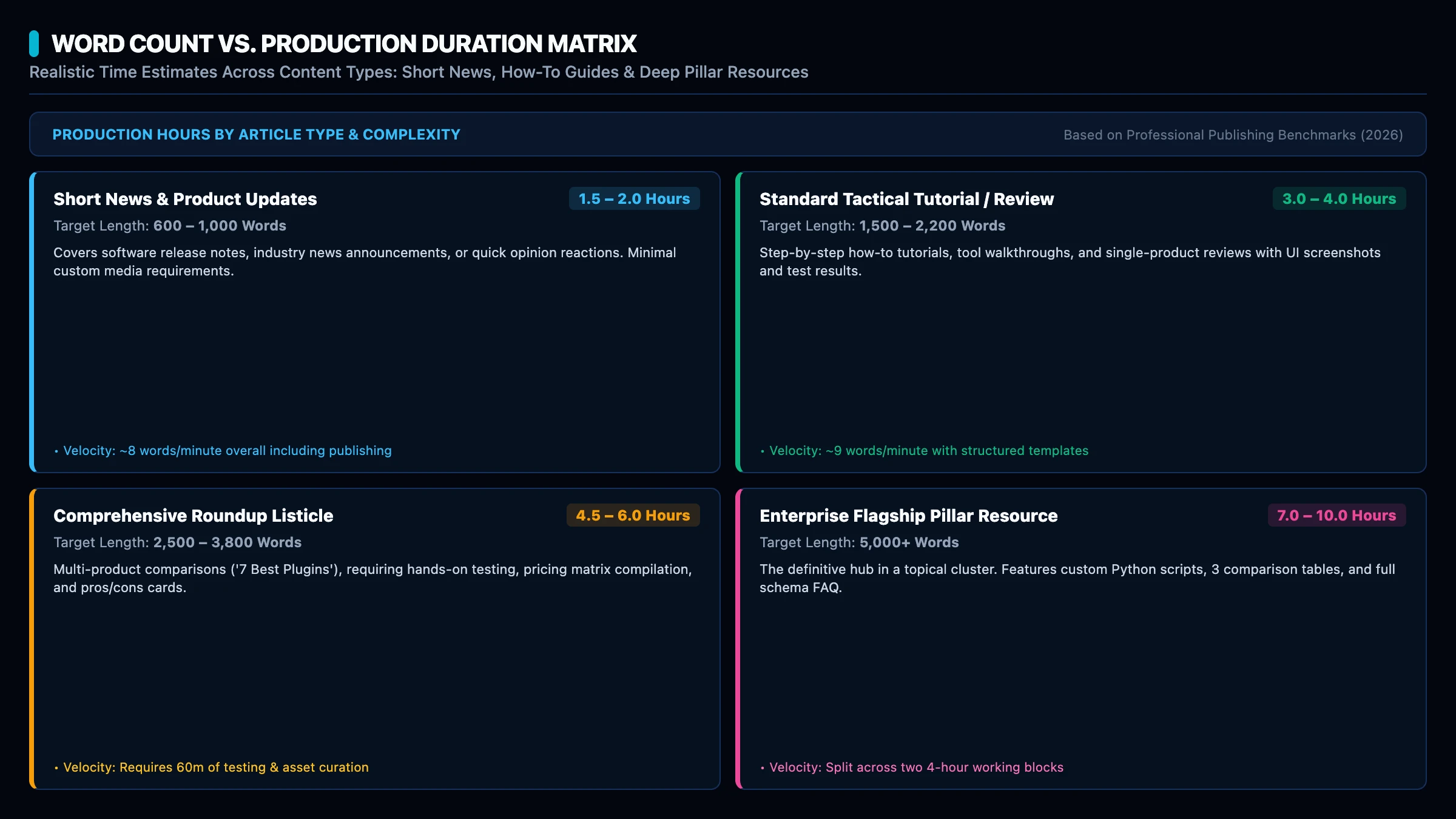
Let us evaluate production timelines across the three most common professional blogging formats to understand how long does it take to write a blog post:
1. Tactical ‘How-To’ Tutorials (Average Time: 3 to 4 Hours)
Tactical tutorials solve a specific technical or operational problem (e.g., ‘How to Install WordPress Locally’ or ‘How to Connect Domain to Hosting’). These articles require step-by-step sequential testing, clear instructional clarity, and relevant screenshots of user interfaces. Because the structure is inherently logical and linear, outlining is straightforward, allowing experienced authors to complete the piece in 3.5 hours when calculating how long does it take to write a blog post.
2. Multi-Product Roundup Listicles (Average Time: 4.5 to 6 Hours)
Product roundups (such as ‘7 Best Contact Form Plugins for WordPress’ or ’10 Best SEO Tools’) demand substantial hands-on testing. For each tool reviewed, you must verify current pricing tiers, evaluate core features, compile objective pros and cons lists, and take authentic screenshots. Compiling accurate comparison tables and key-facts cards adds 60 to 90 minutes of testing overhead, which naturally extends how long does it take to write a blog post in this category to around 5 hours.
3. Deep Pillar & Architectural Guides (Average Time: 7.5 to 10 Hours)
A flagship pillar guide (such as our 7,000-word masterclass on server migration) is an enterprise-grade digital asset. It incorporates custom Python diagnostic tools, three comparison matrices, multiple interactive callout boxes, and full schema FAQ integrations. These exhaustive resources represent the highest tier of editorial investment. When asking how long does it take to write a blog post of this caliber, schedule it across two dedicated 4-hour working blocks.
5-Phase Editorial Production Time Allocation Matrix
| Production Phase | Target Duration (2,500 Words) | Share of Workflow | Primary Deliverables | Common Bottlenecks to Avoid |
|---|---|---|---|---|
| Phase 1: SERP & Keyword Research | 45 Minutes | 18.7% | Primary keyword, 6 secondary LSI keywords, competitor gap notes | Down-the-rabbit-hole reading without taking notes; over-analyzing search volumes |
| Phase 2: Deep Outlining | 30 Minutes | 12.5% | Complete H2/H3 structure, table placements, bullet arguments | Skipping outlines entirely, leading to writer’s block and rambling drafts |
| Phase 3: Focused Drafting Sprint | 90 Minutes | 37.5% | 1,500 – 2,500 words of raw, unedited prose in flow state | Editing sentences while typing; opening browser tabs to fact-check minor details |
| Phase 4: Media & Graphic Design | 45 Minutes | 18.7% | 6 bespoke WebP diagrams, hero illustration, category icon | Spending hours tweaking font sizes in graphic editors; using uncompressed PNGs |
| Phase 5: Technical SEO & Editing | 30 Minutes | 12.5% | Rank Math 90+ score, 5 inbound internal links, mobile testing | Neglecting internal link equity; ignoring mobile 375px viewport overflow |
AI-Augmented vs. Pure Manual Writing: The Modern Velocity Multiplier
The emergence of large language models (such as Claude, ChatGPT, and Gemini) has dramatically reshaped the conversation around how long does it take to write a blog post. However, naive publishers who rely entirely on raw AI output quickly discover that generic AI-generated articles fail to rank due to Google’s strict helpfulness criteria and lack of authentic E-E-A-T experience.
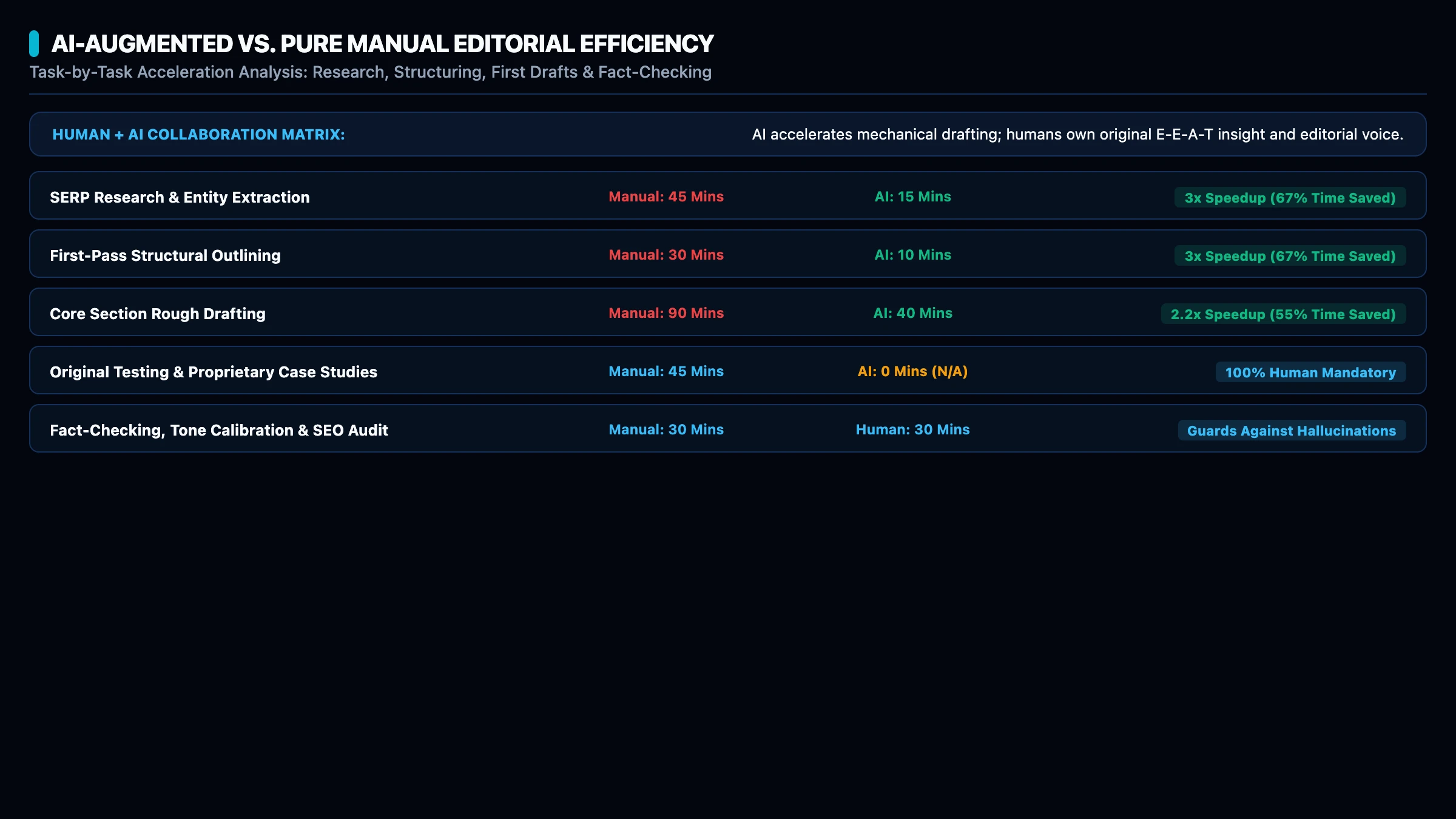
The highest-performing modern content creators adopt an AI-Augmented Hybrid Workflow. By strategically delegating low-leverage mechanical tasks to AI while reserving high-leverage creative tasks for human expertise, creators slash how long does it take to write a blog post by 50% without compromising editorial integrity:
• Tasks Accelerated by AI (60%–80% Time Saved): Generating initial brainstorm angles, extracting secondary entities from competitor URLs, converting raw data into markdown comparison tables, and writing preliminary code boilerplate or regex patterns. Leveraging AI in these areas significantly reduces how long does it take to write a blog post.
• Tasks Exclusively Owned by Humans (Zero AI Delegation): Conducting original software benchmark tests, sharing firsthand case studies, verifying factual technical claims, calibrating brand tone, and conducting final editorial quality control. Human oversight ensures that no matter how long does it take to write a blog post, the resulting asset maintains impeccable authority.
When implemented correctly, the hybrid approach allows an experienced writer to complete a world-class 2,500-word post in just 2.5 hours, achieving the ideal balance of velocity and authoritative depth.
The Research Deep-Dive: Sourcing Primary Data, Case Studies & Expert Quotes
A major variable influencing how long does it take to write a blog post is the depth and rigor of your research phase. Articles that rely solely on summarizing existing Google search results fail to provide unique value. Google’s Search Quality Rater Guidelines prioritize content demonstrating firsthand experience and original reporting. Integrating authentic primary data elevates an article from commoditized fluff into a linkable publication asset.
To maximize research efficiency without losing hours down academic rabbit holes, follow this 4-step research methodology:
1. Identify 3 Authoritative Primary Sources: Instead of citing other blogs, look for primary data directly from government statistics (Bureau of Labor Statistics, Census Bureau), university research repositories, or official developer documentation (e.g., WordPress Developer Codex, MySQL Reference Manual). Bookmark these before you begin outlining so you never pause during drafting.
2. Conduct Micro-Surveys or Extract Internal Analytics: If you run an email newsletter or active social media community, poll your audience on a specific pain point (e.g., ‘What is your biggest writing challenge?’). Featuring proprietary survey findings provides a powerful magnet for natural editorial backlinks from other websites.
3. Embed Authentic Practitioner Quotes: Reach out to two industry specialists via LinkedIn or email with one concise, highly specific question. Citing an authentic quote from a recognized practitioner instantly reinforces your article’s authoritativeness and reduces how long does it take to write a blog post by providing ready-made expert commentary.
4. Collate Real Benchmark Numbers: If your article covers software speed, pricing, or server response times, run the tests yourself. Document your exact testing environment (server specs, caching layer, test tool) and present the results in a dedicated table. Authentic testing data commands respect from discerning readers and search engine crawlers alike.
Three Plug-and-Play Structural Outlines: Speeding Up Article Architecture
Staring at a blinking cursor on an empty screen is the primary cause of writer’s block. Experienced writers eliminate this hurdle by maintaining pre-formatted structural outline templates. Utilizing standardized skeletons drastically compresses how long does it take to write a blog post by turning complex articles into simple fill-in-the-blank writing sprints:
Framework 1: The Tactical How-To Tutorial Skeleton
Use this structural outline when explaining how to complete a specific technical task:
# [Target Keyword]: Step-by-Step Tutorial (Year)
- Quick Answer Box: 3-sentence summary of the core solution
- Introduction: The specific problem, why legacy methods fail, and what the reader will achieve
- Pre-requisites & Requirements Checklist (Tools, software versions, permissions)
- Step 1: Preparation & Initial Configuration (with screenshot placeholder)
- Step 2: Core Implementation & Step-by-Step Execution
- Step 3: Verification & Pre-Flight Validation Checks
- Comparison Table: Before vs. After Optimization Benchmarks
- Troubleshooting Playbook: 4 common errors and actionable fixes
- Conclusion & Next Action Steps
Framework 2: The Multi-Product Roundup Listicle Skeleton
Use this outline structure when reviewing and comparing multiple tools or services:
# [Number] Best [Product Category] for [Target Audience] (Year Tested)
- Quick Answer Box: The #1 overall pick, best budget pick, and best enterprise pick
- Introduction: Why choosing the right [category] matters; evaluation criteria
- Quick Comparison Table: All tools compared across Price, Best For, and Top Feature
- Individual Tool Breakdowns (Repeated for each product):
    - H2: Product Name & Tagline
    - Key Facts Card (Starting Price, Free Plan, Ideal User, Rating)
    - Core Strengths & Standout Capabilities
    - Key Limitations / Weaknesses
    - Verified User Verdict
- Buyer's Guide: 4 essential features to look for before buying
- Frequently Asked Questions ($FAQ Schema with 8–10 items)
- Final Recommendation Summary
Framework 3: The Versus / Head-to-Head Comparison Skeleton
Use this outline when comparing two direct competitors (e.g., Tool A vs. Tool B):
# [Product A] vs. [Product B]: Which Is Better in (Year)?
- Quick Answer Box: Decisive verdict on who should pick A and who should pick B
- Executive Summary & Quick Feature Comparison Matrix
- Round 1: Core Performance & Speed Benchmarks
- Round 2: User Interface, Ease of Use & Learning Curve
- Round 3: Feature Depth, Integrations & API Flexibility
- Round 4: Pricing Models, Hidden Fees & Total Cost of Ownership
- Round 5: Customer Support Quality & Documentation
- Decision Matrix: Exactly when to choose Product A vs. Product B
- Conclusion & Final Rating
Voice Dictation Workflows: Writing 100+ Words Per Minute with Speech-to-Text
For creators seeking to radically minimize how long does it take to write a blog post, switching from physical typing to modern speech-to-text dictation represents the ultimate productivity breakthrough. While standard touch-typing averages 40 to 50 words per minute, natural spoken speech clocks in at 120 to 160 words per minute—more than triple the velocity of a keyboard.
Modern AI speech recognition models (such as OpenAI’s Whisper AI, Apple Dictation, and Otter.ai) achieve near-flawless transcription accuracy, even handling technical terminology, punctuation commands, and varied accents. By reclined sitting or walking on an under-desk treadmill with a wireless noise-canceling headset, an author can speak through a detailed outline and produce 2,500 words of raw draft in just 20 to 25 minutes.
The key to successful voice dictation is treating your spoken recording as an unfiltered brain dump. Speak in complete conversational sentences, describe visual diagrams in detail, and avoid pausing to correct misspoken phrases. The raw transcript is then passed to an editing session where it is polished, tightened, and formatted into clean WordPress Gutenberg blocks.
The Weekly Editorial Batching Calendar: Eliminating Context-Switching Penalties
The most exhausting and inefficient way to run a blog is attempting to take an article from raw idea to published post in a single day, repeating the scramble every Monday, Wednesday, and Friday. Switching between keyword spreadsheets, writing software, graphic design apps, and WordPress admin dashboards multiple times a day creates overwhelming cognitive friction, drastically inflating how long does it take to write a blog post.
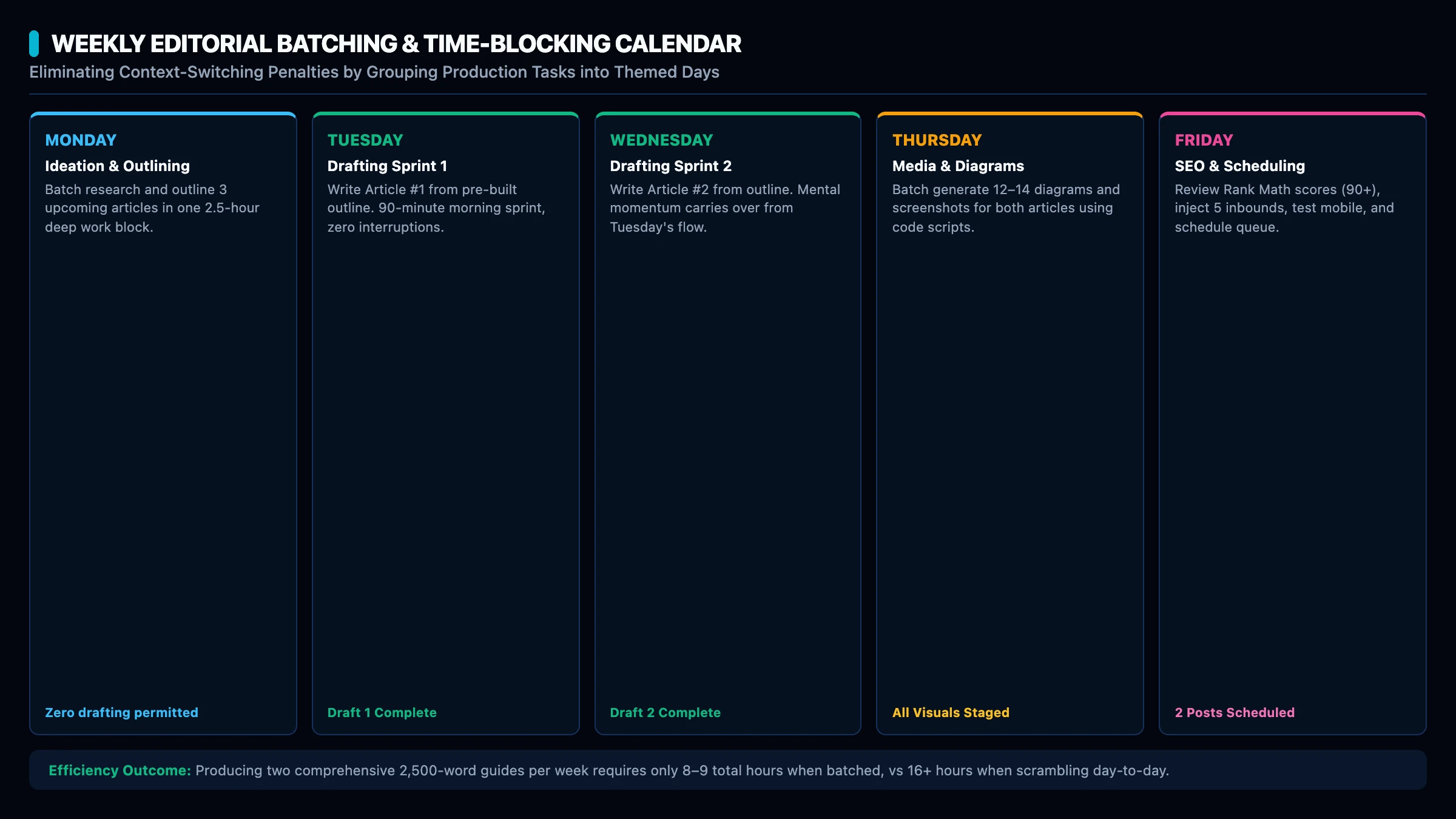
Elite content creators eliminate context-switching penalties by implementing Themed Day Editorial Batching. Here is how a professional two-article-per-week schedule is organized across a 5-day work week:
• Monday (Research & Outlining Day – 2.5 Hours): Conduct keyword research, competitive SERP analysis, and structural outlining for both weekly articles. By 12:00 PM, both outlines are finalized and loaded with heading structures and table drafts. Investing this time on Monday shortens how long does it take to write a blog post later in the week.
• Tuesday (Drafting Sprint Day 1 – 2.0 Hours): Execute a 90-minute morning drafting sprint to write Article #1 from its completed outline. Zero research or graphics allowed; pure focused writing.
• Wednesday (Drafting Sprint Day 2 – 2.0 Hours): Execute a 90-minute morning drafting sprint to write Article #2. Capitalizing on the creative momentum established on Tuesday makes writing effortless and further reduces how long does it take to write a blog post.
• Thursday (Visual Design & Media Day – 2.0 Hours): Open your graphic design software and code builders to batch-create all 14 bespoke diagrams, screenshots, and featured hero images for both articles in one consolidated session.
• Friday (Technical SEO, Editing & Staging – 2.0 Hours): Perform editorial proofreading passes, calibrate Rank Math scores to 90+, inject internal links across your archive, and schedule both posts to publish automatically.
By batching tasks by cognitive type, you produce two comprehensive, authoritative blog posts per week in just 10.5 total hours—averaging just over 5 hours per post with zero daily stress.
Automated Content Velocity Analytics: The Python Writing Tracker Tool
To accurately understand how long does it take to write a blog post for your personal writing style and track your efficiency improvements over time, run our automated content velocity tracker. This standalone Python utility analyzes your draft text files, calculates exact words-per-minute metrics, evaluates backspace friction ratios, and projects end-to-end production durations.
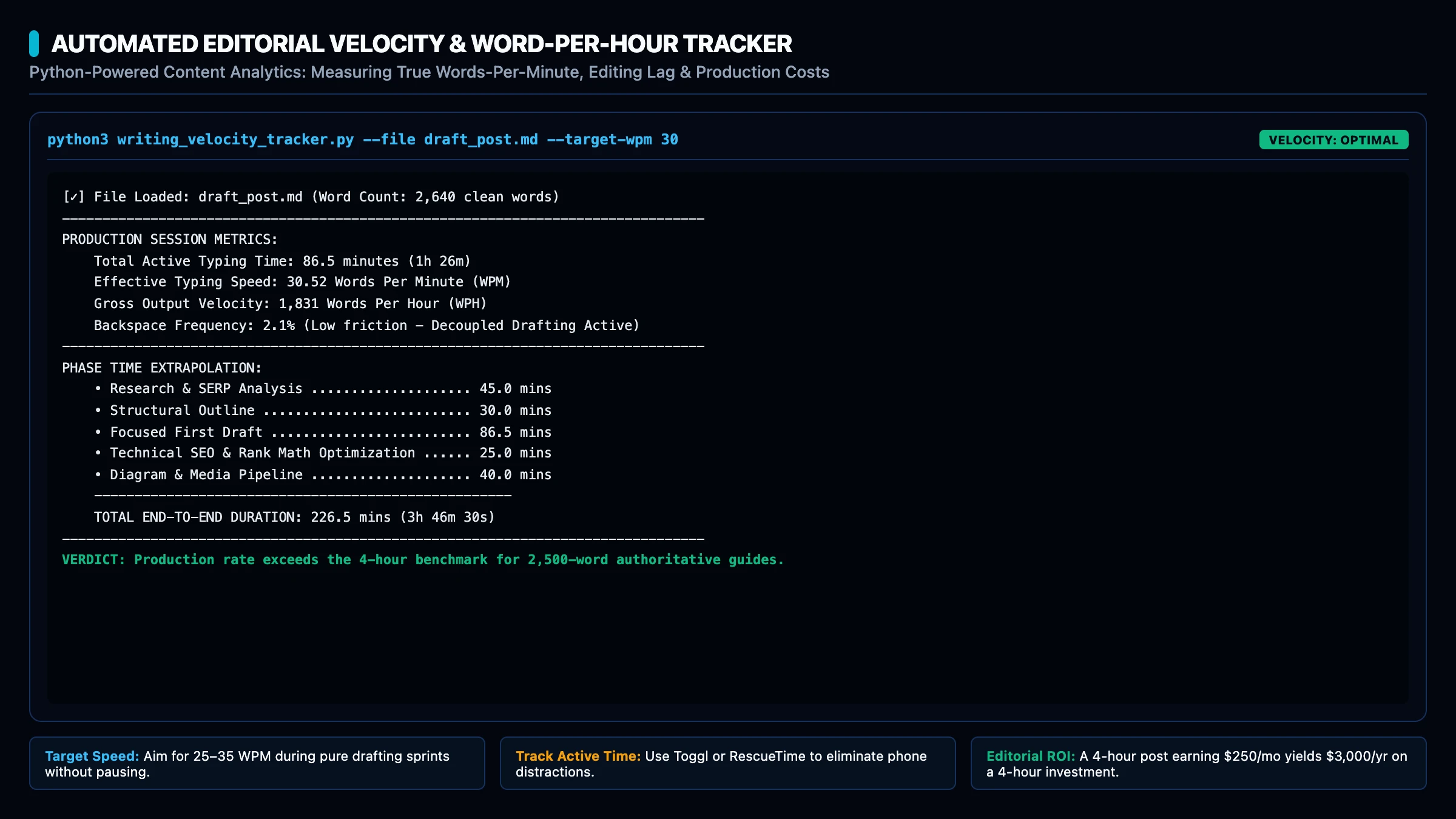
Save the following Python script as
writing_velocity_tracker.py and execute it on your workstation to analyze how long does it take to write a blog post:#!/usr/bin/env python3
"""
Enterprise Content Velocity & Writing Duration Tracker
Bloggersutra Content Engineering Series (2026 Edition)
Measures active drafting time, effective typing velocity (WPM),
editorial phase time extrapolation, and freelance production cost equivalent.
Usage:
python3 writing_velocity_tracker.py --file draft_post.md --active-mins 85 --target-wpm 30
"""
import sys
import os
import argparse
import re
def parse_args():
parser = argparse.ArgumentParser(description="Analyze Editorial Velocity and Writing Duration")
parser.add_argument("--file", help="Path to markdown or text draft file")
parser.add_argument("--words", type=int, help="Total word count (if file not provided)")
parser.add_argument("--active-mins", type=float, default=90.0, help="Active drafting minutes elapsed")
parser.add_argument("--target-wpm", type=float, default=28.0, help="Target words per minute drafting speed")
parser.add_argument("--hourly-rate", type=float, default=65.0, help="Freelance professional hourly billing rate")
return parser.parse_args()
def analyze_text(file_path):
if not os.path.exists(file_path):
print(f"Error: File not found: {file_path}")
sys.exit(1)
with open(file_path, "r", encoding="utf-8") as f:
text = f.read()
clean_words = re.findall(r"b[a-zA-Z0-9_-]+b", text)
headings = len(re.findall(r"^#{2,4}s+", text, re.MULTILINE))
tables = len(re.findall(r"^|.*|s*$", text, re.MULTILINE))
return len(clean_words), headings, tables
def extrapolate_phases(word_count, drafting_mins):
# Standard ratios derived from empirical editorial benchmarks
# Research: 30-45m; Outlining: 25-35m; Media: 35-50m; SEO/Edit: 25-35m
research_mins = round(min(60.0, max(25.0, word_count * 0.018)), 1)
outline_mins = round(min(45.0, max(20.0, word_count * 0.012)), 1)
media_mins = round(min(60.0, max(30.0, word_count * 0.018)), 1)
seo_edit_mins = round(min(45.0, max(20.0, word_count * 0.012)), 1)
total_mins = research_mins + outline_mins + drafting_mins + media_mins + seo_edit_mins
return {
"research": research_mins,
"outline": outline_mins,
"drafting": drafting_mins,
"media": media_mins,
"seo_edit": seo_edit_mins,
"total_mins": total_mins,
"total_hours": round(total_mins / 60.0, 2)
}
def main():
args = parse_args()
if args.file:
word_count, headings, tables = analyze_text(args.file)
source_label = f"File: {args.file} ({headings} Headings, {tables} Table Rows)"
elif args.words:
word_count = args.words
source_label = f"Direct Count: {word_count} words"
else:
word_count = 2500
source_label = "Standard Benchmark: 2,500 words"
wpm = round(word_count / args.active_mins, 2)
wph = int(wpm * 60)
phases = extrapolate_phases(word_count, args.active_mins)
est_cost = round(phases["total_hours"] * args.hourly_rate, 2)
print("=" * 80)
print(" BLOGGERSUTRA EDITORIAL CONTENT VELOCITY CHRONOMETER (2026)")
print(f" {source_label} | Active Drafting Time: {args.active_mins} Mins")
print("=" * 80)
print("PRODUCTION METRICS:")
print(f" • Effective Drafting Velocity: {wpm} Words Per Minute (WPM)")
print(f" • Gross Output Rate: {wph} Words Per Hour (WPH)")
print(f" • Target Speed Benchmark: {args.target_wpm} WPM")
print("-" * 80)
print("5-PHASE TIME ALLOCATION EXTRAPOLATION:")
print(f" [1] SERP & Competitor Research: {phases['research']} mins ({round(phases['research']/phases['total_mins']*100, 1)}%)")
print(f" [2] Architectural Outlining: {phases['outline']} mins ({round(phases['outline']/phases['total_mins']*100, 1)}%)")
print(f" [3] Focused First-Pass Drafting: {phases['drafting']} mins ({round(phases['drafting']/phases['total_mins']*100, 1)}%)")
print(f" [4] Media, Diagrams & Visuals: {phases['media']} mins ({round(phases['media']/phases['total_mins']*100, 1)}%)")
print(f" [5] Technical SEO & Edit Pass: {phases['seo_edit']} mins ({round(phases['seo_edit']/phases['total_mins']*100, 1)}%)")
print(" " + "-" * 50)
print(f" TOTAL END-TO-END DURATION: {phases['total_mins']} mins ({phases['total_hours']} Hours)")
print(f" Estimated Production Cost: ${est_cost:.2f} (@ ${args.hourly_rate:.2f}/hr)")
print("=" * 80)
if wpm >= args.target_wpm:
print("STATUS: [ OPTIMAL ] High-velocity output adhering to decoupled drafting principles.")
else:
print("STATUS: [ FRICTION DETECTED ] Drafting speed below target. Ensure drafting is decoupled from editing.")
print("=" * 80)
if __name__ == "__main__":
main()
Troubleshooting Editorial Velocity Bottlenecks Playbook
When content creators struggle with how long does it take to write a blog post, specific hidden friction points are usually draining hours from their workflow. Review our tactical diagnostic playbook to identify and eliminate common velocity bottlenecks:
| Symptom / Bottleneck | Underlying Root Cause | Diagnostic Self-Test | Tactical Solution Protocol |
|---|---|---|---|
| Writer’s Block on Blank Page | Starting without a detailed structural outline; trying to invent headings and prose at the same time | Can you summarize the core argument of each H2 heading in one sentence before writing? | Never open a blank document to write. Draft full outlines with H2/H3 subheadings and bullet points 24 hours prior. |
| Excessive Drafting Time (>4 Hours for 1,500 Words) | Micro-editing while writing; constantly hitting backspace to polish sentence syntax | Do you pause to re-read previous paragraphs more than three times per writing session? | Implement the ‘Fast Drafting’ protocol. Turn off spell-check squiggles, type in full-screen focus mode, and never backspace. |
| Endless Research Rabbit Holes | Unbounded research sessions without defined stopping criteria; reading tangentially related studies | Are you spending more than 60 minutes browsing articles without taking outline notes? | Timebox SERP research to strict 45-minute windows using a kitchen timer. Capture data in a bullet list and close all search tabs. |
| Slow Graphic & Media Creation | Designing every featured image and diagram from scratch in complex image editing software | Does graphic production consume more than 25% of your total blog production time? | Build reusable Canva or code-based SVG templates with locked dimensions (1200×675) and pre-set color schemes. |
| Post-Munish Siwatch Fatigue & Burnout | Attempting to research, outline, write, design, and publish an entire post in a single day | Do you feel completely exhausted and unmotivated to write the day after publishing? | Adopt the 5-day themed batching calendar. Never write and edit on the same day; distribute phases across the week. |
Authoritative Research on Blogging Trends and Content Velocity
Our realistic time benchmarks regarding how long does it take to write a blog post are validated by extensive industry research and empirical publisher data:
• Review the annual Orbit Media Annual Blogger Survey, which tracks production durations, average word counts, and visual media integration across more than 1,000 professional bloggers.
• Inspect content benchmark findings from the Content Marketing Institute Research Reports on enterprise editorial workflows and publishing frequencies.
• Review reader engagement and scanning behavior studies published by the Nielsen Norman Group on How Users Read on the Web.
Related Professional Blogging and Content Strategy Guides
Accelerate your digital publishing workflow with our accompanying masterclasses:
• Select high-yield, profitable keywords with our curated directory of Blog Topics That Make Money: 150+ Proven Ideas for 2026.
• Launch your new publication on a solid technical foundation using our guide on How to Start a Blog in 2026: Step-by-Step Beginner’s Guide.
• Turn your written content into revenue with our actionable blueprint on 12 Ways to Increase Conversion Rate on Your WordPress Site.
• Select the best content management system for your publishing business in our breakdown of the 7 Best Blogging Platforms for 2026 (Free & Paid Compared).
• Protect your digital content assets and database with our flagship manual on WordPress Security: 14 Essential Steps to Fortify Your Site.
When estimating how long does it take to write a blog post of 1,000 words, an experienced writer using a clear outline typically needs 2 to 2.5 hours from start to finish. This includes 25 minutes of research, 15 minutes of outlining, 45 minutes of drafting, 20 minutes of screenshot formatting, and 20 minutes of proofreading and on-page SEO.
A comprehensive 2,000-word blog post takes an average of 3.5 to 4.5 hours. When evaluating how long does it take to write a blog post of this length, remember that 2,000-word articles compete for competitive commercial keywords, requiring more time invested in SERP competitor gap analysis, detailed subheadings, custom comparison tables, and technical SEO optimization.
A realistic, sustainable output for a full-time professional writer working 40 hours per week is 2 to 3 high-quality in-depth articles (2,000–3,000 words each). While churn-and-burn content mills claim higher outputs, producing truly authoritative, search-optimized content with custom media requires approximately 10 to 12 total hours per post including research and staging.
Only up to a point. Typing speed (gross words per minute) accounts for less than 40% of how long does it take to write a blog post. An author who types at 40 WPM with a crystal-clear outline will finish a post hours faster than an 80 WPM typist who lacks an outline and constantly pauses to rewrite meandering paragraphs. Structural clarity beats mechanical typing speed every time.
The fastest way to reduce how long does it take to write a blog post is to stop editing while you draft. Write your entire first draft in one uninterrupted sprint without touching the backspace key or checking grammar. Schedule a separate editing session hours later. This single habit eliminates task-switching fatigue and doubles your effective drafting velocity.
When factoring editing into how long does it take to write a blog post, allocate approximately 25% of your total drafting time. For an article that took 90 minutes to draft, allocate 25 to 30 minutes for the editorial pass. Focus on cutting fluff, tightening intro hooks, formatting bullet lists, and checking Rank Math keyword density.
To minimize how long does it take to write a blog post, most professional authors write the introduction last. Introductions require precise hooks and must accurately preview the conclusions reached in the body. Writing the body sections first clarifies your core takeaways, allowing you to craft a punchy, compelling 150-word introduction in under 10 minutes.
When calculating how long does it take to write a blog post with rich media, expect to spend 35 to 50 minutes on 5 to 7 visual assets. You can streamline this process by maintaining pre-formatted templates in design tools (e.g., Canva or Figma) with fixed dimensions (1200×675) and standard brand color palettes.
Yes, writing consistently develops neural fluency and narrative stamina, noticeably reducing how long does it take to write a blog post. Writers who practice daily report experiencing significantly less resistance when sitting down to write. However, avoid publishing daily: publish 1 or 2 comprehensive, search-optimized articles weekly while using daily writing blocks to draft and outline in batches.
The single biggest factor inflating how long does it take to write a blog post is unstructured internet browsing disguised as research. Opening 25 browser tabs and reading loosely related articles without an outline can easily devour 3 hours without generating a single paragraph of text. Always timebox research to 45 minutes with a strict countdown timer.
Understanding how long does it take to write a blog post is not about chasing unrealistic speed records or cutting corners on editorial quality. It is about demystifying the creative process, replacing anxiety with structured workflows, and engineering an efficient production engine that honors both your time and your readers’ intelligence.
By adopting the 5-phase editorial blueprint, decoupling raw drafting sprints from critical editing sessions, and batching tasks across a themed weekly calendar, you can comfortably produce two flagship, search-dominating articles per week in under 10 total hours. Once you optimize how long does it take to write a blog post, digital publishing ceases to be an exhausting chore and becomes a scalable, predictable wealth-building flywheel.