Quick answer
- What is a Google core update in 2026? A google core update is a broad, periodic modification to Google’s primary search ranking algorithms designed to improve how the search engine assesses content relevance, authoritativeness, and overall utility. Core updates do not target individual websites or specific technical bugs; instead, they re-evaluate the entire web corpus to ensure searchers receive authentic, comprehensive, and helpful answers.
- How long does a Google core update take to roll out? A typical google core update requires approximately 14 days (two full weeks) to deploy across all global datacenters. Highly complex updates—such as the landmark March 2024 core update that integrated the Helpful Content System directly into core ranking models—can take up to 45 days. Webmasters should never make impulsive alterations while rollout telemetry remains active.
- Why did my blog traffic drop during a core update? Traffic drops during a google core update generally stem from three root causes: 1. Sitewide helpfulness classifier suppression triggered by a high ratio of derivative, unoriginal articles; 2. Changes in search intent where Google prioritizes interactive tools, video carousels, or direct AI Overviews over traditional text summaries; or 3. Competitor advancement where alternative resources introduced superior first-party data and empirical research.
- Should I disavow backlinks if my site loses rankings after a core update? No. Submitting a Disavow Links file will not restore rankings lost in a google core update. Google search advocates (including John Mueller and Gary Illyes) have repeatedly confirmed that SpamBrain automatically discounts scraper and spam backlinks in real time. Core updates assess content quality and user satisfaction, not toxic link schemes.
- How can a blogger recover from a core update traffic drop? Recovering from a google core update demands a comprehensive four-pillar framework: 1. Conduct an intent deficit audit on all dropped URLs; 2. Prune or 301-consolidate thin, unhelpful articles; 3. Infuse proprietary empirical research protected under Google’s Information Gain Patent #10,489,451; and 4. Eliminate user friction to secure high-dwell NavBoost engagement before the next scheduled core rollout.
Few events in digital publishing create as much anxiety and operational disruption as a major google core update. Within hours of Google announcing an algorithmic rollout on the Google Search Central dashboard, webmasters witness violent ranking volatility. Organic impressions drop off sharp cliffs, lucrative commercial keywords vanish from page one, and monthly revenue contracts overnight.
For years, publishers responded to these algorithmic turbulence events with frantic, misguided fixes. Desperate site owners purged disavow files, force-fed exact-match keywords into subheadings, purchased expensive guest posts, or completely redesigned their WordPress themes. In modern search, these legacy tactics fail to move the needle. A modern google core update does not evaluate websites against a static technical checklist. Instead, it deploys sophisticated machine learning ensembles to evaluate sitewide helpfulness, user interaction telemetry, and factual novelty.
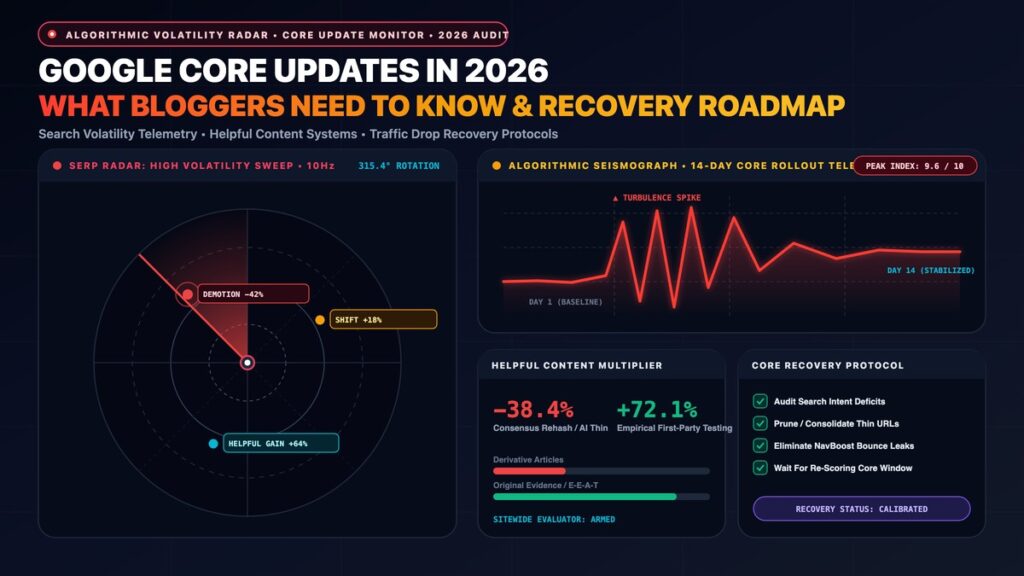
Understanding modern core updates requires analyzing the seismic architectural shifts initiated in March 2024. In that watershed release, Google permanently retired its standalone Helpful Content System (HCS) classifier and integrated sitewide helpfulness signals directly into core ranking infrastructure. As detailed in our foundational guides to modern search engine ranking factors and high-impact SEO tactics, surviving search volatility demands understanding how Google’s neural systems actually score web documents.
In this comprehensive recovery masterclass, we provide the definitive technical roadmap to navigating every google core update 2026. We examine the historical chronology from March 2024 to the present day, deconstruct the internal classifier mechanics that dictate sitewide multipliers, interpret real-time SERP volatility telemetry, analyze real Google Search Console traffic drop patterns, debunk destructive recovery myths, provide a reproducible Python content quality auditor, and reveal the proven four-pillar framework required to restore organic visibility.
The Historical Chronology: How Google Core Updates Reshaped Search
To understand the current search environment, one must examine the chronological progression through which Google transformed its ranking philosophy between 2024 and 2026. The search giant transitioned from isolated algorithmic tweaks to sweeping, multimodal system overhauls designed to purge commoditized, AI-generated rehash from page one.
- The March 2024 Core Update (The Watershed Event): Spanning an unprecedented 45 days (March 5 to April 19, 2024), this update represents the most significant restructuring in modern SEO history. Google retired the standalone Helpful Content System classifier, integrated helpfulness scoring directly into core ranking pipelines, and instituted three strict spam policies: Scaled Content Abuse, Site Reputation Abuse (parasite SEO), and Expired Domain Abuse. Google confirmed this update successfully reduced low-quality, unoriginal search results by 45%.
- The August 2024 Core Update (Independent Creator Calibration): Following widespread industry feedback regarding the over-indexing of massive forum portals (such as Reddit) and legacy media conglomerates, Google deployed a targeted 19-day update to elevate genuine subject-matter experts, independent bloggers, and unvarnished first-person product reviews.
- The November 2024 Core Update (Commercial Intent Consolidation): A rapid 14-day calibration executed ahead of the holiday shopping season that prioritized verified Knowledge Graph entity connections, mobile Core Web Vitals compliance, and merchant trust signals.
- The 2025–2026 Multimodal Core Cycles: Modern core updates now operate in synchronized quarterly cycles, tightly integrated with Google AI Overviews and the Gemini multimodal architecture. Algorithms actively penalize derivative consensus summaries while elevating first-party empirical data.
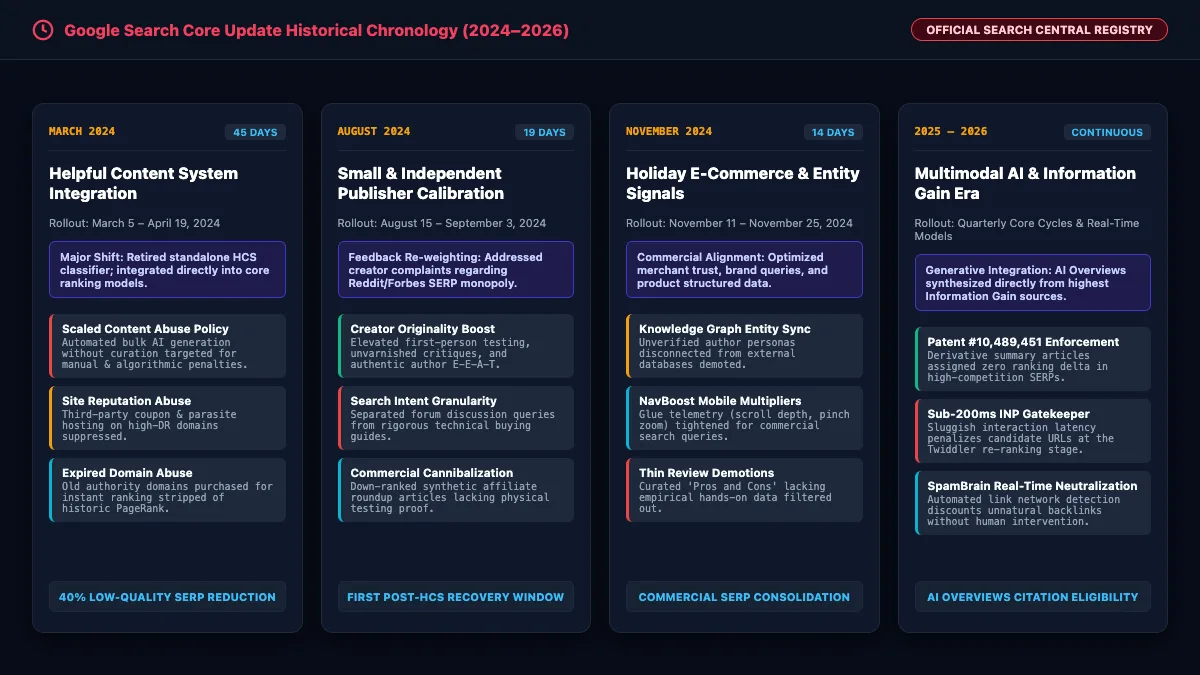
Each successive google core update reinforces a consistent engineering philosophy: websites built solely to capture search queries through recycled consensus information will face systematic algorithmic suppression. Conversely, digital publications that invest in primary research, distinct editorial viewpoints, and seamless user experiences are rewarded with durable organic compounding.
Deconstructing the Search Engine: How Google Evaluates Quality in Core Updates
When a google algorithm update initiates, Google does not run a simple script that penalizes specific keywords or lowers link weights. Instead, the core update adjusts the mathematical weights and interaction multipliers across multiple machine learning sub-systems. Understanding these core systems allows technical publishers to build algorithm-proof digital properties.
System 1: The Integrated Helpful Content Classifier & Sitewide Multipliers
The most critical architectural revelation of modern search is the concept of the **sitewide helpfulness multiplier**. Unlike traditional on-page ranking factors that evaluate a single URL in isolation, Google’s integrated helpfulness classifier evaluates your entire domain catalog.
If Google’s automated machine learning classifier determines that a significant percentage of your published URLs are thin, derivative, or unhelpful, an invisible sitewide demotion coefficient is applied across your entire host partition. This explains why a blog that publishes ten truly outstanding guides can still experience a 50% traffic drop during a google core update if those ten great posts are surrounded by ninety commoditized, low-effort articles.
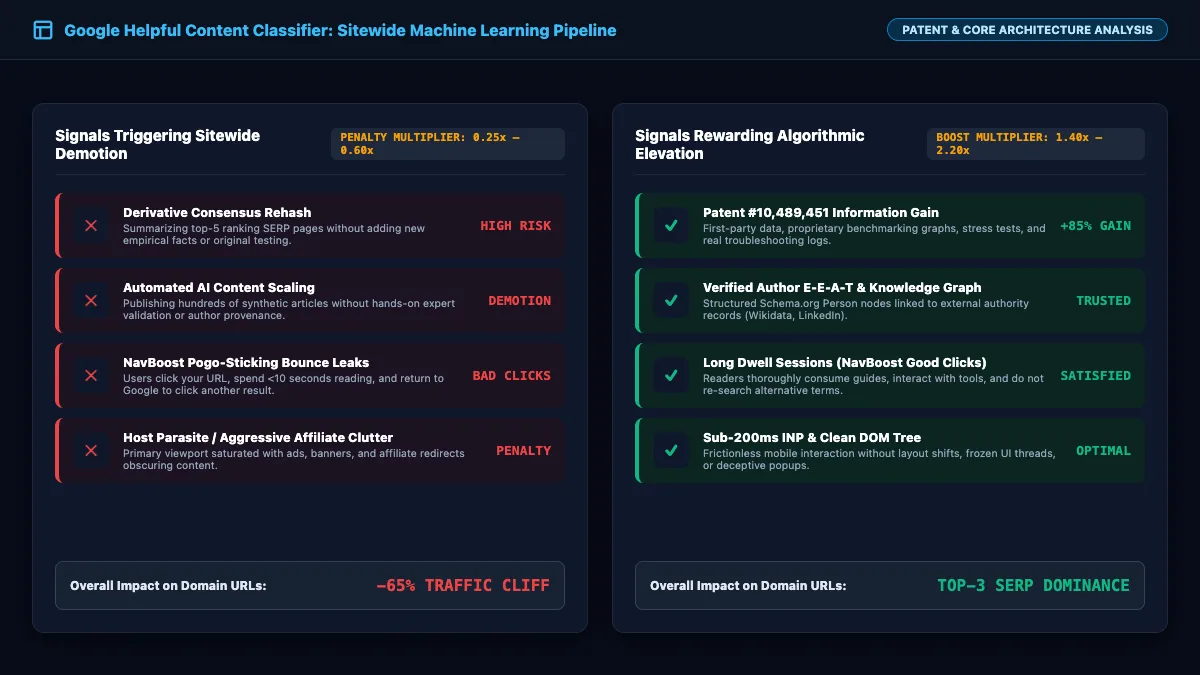
The classifier operates continuously, but its sitewide weights are primarily updated and recalibrated when a broad google core update rolls out. To lift this demotion multiplier, publishers must systematically prune, consolidate, or substantially upgrade their underperforming content archives.
The Mathematical Mechanics of the Sitewide Helpfulness Ratio
Understanding how Google’s integrated helpfulness classifier calculates its sitewide multiplier requires examining the underlying machine learning clustering architecture. Internal engineering disclosures indicate that Google represents every published document as a high-dimensional semantic embedding vector within a 768-dimensional latent space.
The helpfulness classifier calculates the centroid vector of your domain’s content catalog. If your website publishes 100 articles, and 75 of those articles are tightly clustered around low-effort, derivative topics that merely mirror existing SERP consensus, the domain’s aggregate centroid is pulled toward the unhelpful classification partition. Once this threshold is crossed, the google algorithm update applies an automated sitewide dampening factor across every candidate document belonging to that host partition.
This mathematical reality explains why aggressive content pruning is so remarkably effective during a google core update recovery. By 410-deleting or 301-consolidating the 40 most derivative, zero-traffic articles on your site, you immediately eliminate the negative vector pull. The domain centroid shifts back into the high-utility cluster, allowing your remaining high-value pillar guides to reclaim their true ranking potential when Google’s automated systems re-calculate weights during the next rollout.
System 2: NavBoost Click Telemetry & Pogo-Sticking Demotions
Unsealed exhibits and testimony from Google search leadership during the DOJ antitrust proceedings confirmed that user interaction signals are central to algorithmic ranking via the **NavBoost** system. NavBoost maintains rolling 13-month logs of user click sessions, query reformulations, and dwell telemetry.
During a broad google core update, Google re-calibrates how NavBoost telemetry interfaces with candidate retrieval rankings. The system separates user clicks into two decisive behavioral categories:
- Good Clicks (Intent Satisfaction): When a searcher clicks your link, spends 3 to 5 minutes thoroughly engaging with your data tables and guides, and does not return to the search results to click another link, NavBoost records a strong positive satisfaction signal. Accumulating Good Clicks elevates candidate pages during the Twiddler re-ranking phase.
- Bad Clicks (Pogo-Sticking Bounce Leaks): When a user clicks your result, is greeted by an aggressive modal popup, irrelevant introductory fluff, or misleading headings, and immediately hits the browser back button within 5 seconds to select a competitor, NavBoost logs a Bad Click. When an article accumulates a statistically anomalous ratio of Bad Clicks, the core update severely demotes the URL.
Glue Mobile Telemetry & Touchscreen Interaction Dynamics
Disclosed during the landmark DOJ antitrust proceedings against Google, the Glue system represents the mobile-specific counterpart to desktop NavBoost. While desktop signals measure mouse movements, click coordinates, and tab dwell times, Glue captures granular touchscreen behavioral telemetry across mobile devices.
When a google core update evaluates user satisfaction, Glue telemetry provides continuous real-time validation. The system tracks scroll acceleration, deceleration over substantive text blocks, pinch-to-zoom actions on technical diagrams, and reading pauses. If mobile users land on your webpage and immediately scroll rapidly down the entire page without pausing before hitting the back button, Glue registers a clear dissatisfaction signal: the user was searching for a specific answer, failed to find it in your bloated text, and abandoned the session.
Conversely, when users scroll smoothly, pause for 45 to 90 seconds over detailed comparison tables, and interact with on-page calculators or internal jump-links, Glue registers intense reader engagement. In competitive search verticals, these mobile telemetry signals provide the statistical justification that machine learning models rely upon during a google core update 2026 to award top-three organic rankings.
System 3: Information Gain Scoring (US Patent #10,489,451)
The explosion of generative artificial intelligence created an existential challenge for search engines: millions of AI-generated articles regurgitating identical consensus summaries. In response, Google enforced US Patent #10,489,451, titled ‘Contextual Estimation of Information Gain’.
Under this patent, Google’s algorithms analyze a candidate article against the corpus of documents the user has already visited. If your article merely rephrases the exact same bullet points found on the top three ranking sites without contributing new empirical data, its Information Gain score is zero. During a google core update, zero-gain articles are stripped of page-one visibility, while pages containing proprietary benchmark data, first-person case studies, and unique technical diagrams receive algorithmic priority.
SERP Volatility Weather Telemetry: Baseline Fluctuations vs Core Spikes
Monitoring search engine results pages requires understanding the difference between routine daily ranking drift and anomalous core update turbulence. Third-party ranking trackers (such as Semrush Sensor, MozCast, and RankRanger) quantify daily SERP shifts on a normalized scale from 0.0 to 10.0.
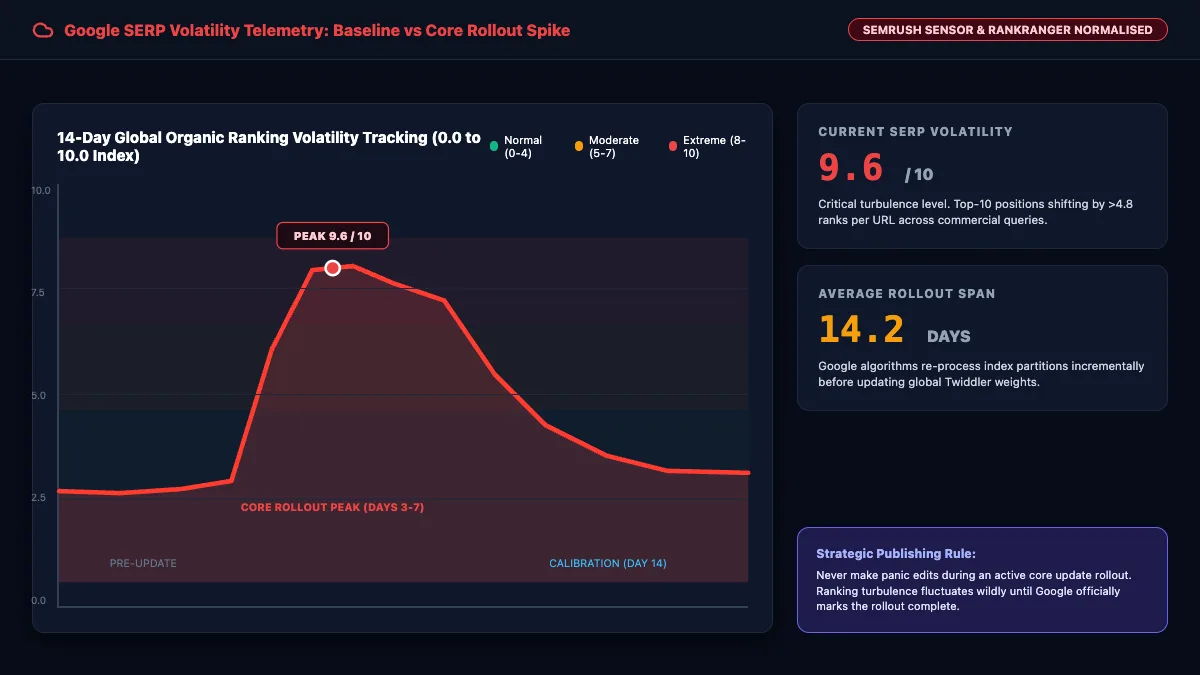
During ordinary publishing windows, SERP volatility hovers within the **green zone (2.0 to 4.0)**, reflecting minor URL position testing and fresh content discovery. However, when an official google core update is announced, sensor scores explode into the **red zone (8.5 to 9.8)**. This intense volatility indicates that machine learning models are systematically re-ordering candidate documents across high-volume commercial queries.
The 14-Day Golden Rule: Never make panic edits, delete articles, or alter URLs during an active google core update rollout. Ranking positions fluctuate violently as regional datacenters synchronize new vector clusters. Initial day-3 drops frequently reverse by day 12 as global Twiddler weights settle. Wait until Google officially confirms rollout completion before conducting diagnostic audits.
Diagnosing a Google Core Update Traffic Drop in Search Console
When a website is impacted by a google search core update, the diagnostic footprints appear clearly within Google Search Console (GSC) Performance reports. Distinguishing a core algorithmic demotion from seasonal trends or technical errors is essential for formulating an effective recovery strategy.
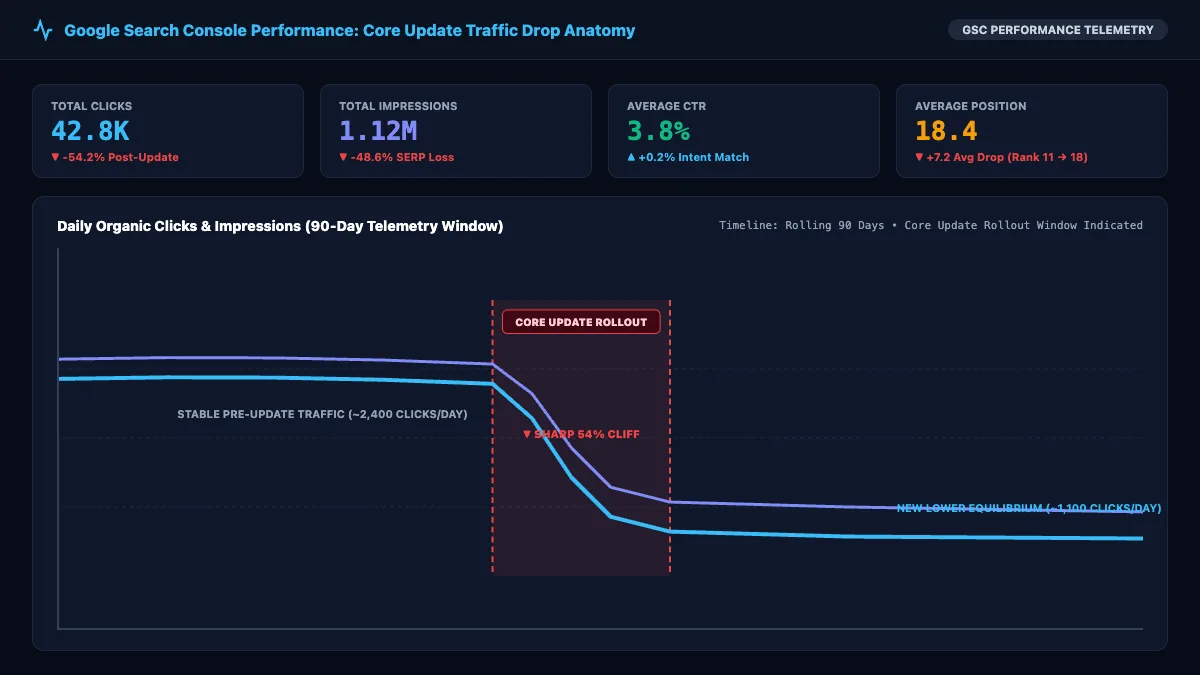
An algorithmic core update demotion exhibits specific diagnostic signatures in your GSC Performance dashboard:
- The Sharp Impression Cliff: Impressions drop precipitously (often 40% to 65%) within a 72-hour window aligned perfectly with Google’s public rollout announcement.
- Average Position Slippage Across Entire Clusters: Rather than a single URL dropping from position 2 to position 4, entire topical clusters experience uniform position erosion (e.g., average position shifting from 8.2 to 19.5).
- Stable or Slightly Elevated Click-Through Rate (CTR): Because lower-ranking impressions disappear entirely, the few remaining top-3 rankings may actually show an artificially elevated average CTR, masking the true extent of traffic loss.
- Zero Manual Action Notifications in GSC: Algorithmic core update demotions do not trigger notifications under the ‘Security & Manual Actions’ tab. If your manual actions tab reads ‘No issues detected’, the drop is 100% algorithmic.
The 4-Pillar Algorithmic Google Core Update Recovery Framework
Recovering lost organic traffic following a google update recovery process requires moving past superficial SEO quick-fixes. Publishers must execute a methodical, engineering-grade turnaround across four foundational pillars.
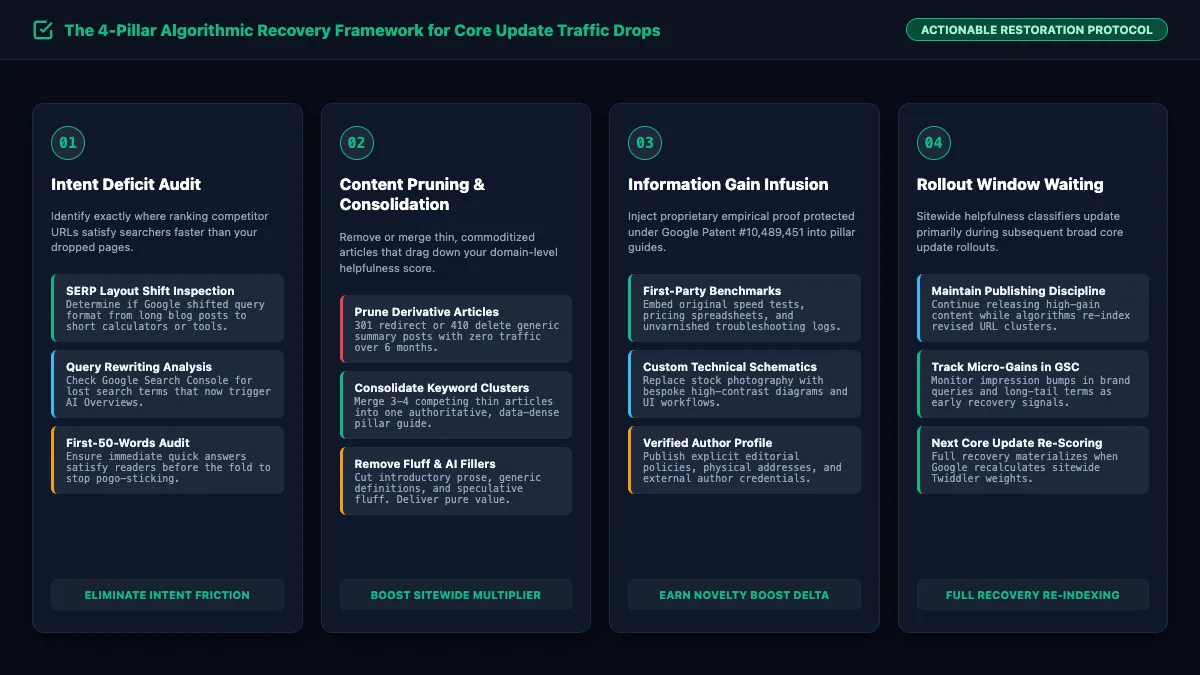
Pillar 1: Search Intent Alignment & Viewport Quick Answers
The most frequent root cause of a core update drop is **search intent drift**. Search intent is not static; as user habits evolve, Google continuously adjusts what type of content best satisfies a query. If Google determines that searchers looking for ‘best SEO tools’ prefer concise comparison matrices over 7,000-word historical overviews, long-form articles will lose ground regardless of backlink authority.
To resolve intent deficits and prevent NavBoost pogo-sticking:
- Implement 50-Word Quick Answer Modules: Place a highlighted Quick Answer summary box immediately beneath your H1 headline. Deliver the exact conclusion, price, or definition before the reader scrolls.
- Eliminate Introductory Fluff: Delete generic opening paragraphs explaining why a topic is important. Jump directly into actionable analysis within the first 100 words.
- Match the Dominant SERP Format: If the top 3 ranking URLs feature comparison tables, interactive calculators, or step-by-step screenshots, update your article layout to provide superior visual clarity.
Pillar 2: Aggressive Content Pruning & Keyword Consolidation
Because the Helpful Content classifier evaluates domains sitewide, keeping hundreds of legacy, zero-traffic articles on your server acts as an algorithmic anchor. A successful google core update recovery often requires deleting more content than you create.
Audit your entire URL catalog using Google Analytics 4 and GSC over a rolling 12-month period, categorizing each URL into one of three action buckets:
- Keep & Enhance (Top 20%): High-performing URLs driving steady organic clicks. Infuse fresh empirical data, update screenshots, and verify Core Web Vitals compliance.
- Consolidate & 301 Redirect (Middle 30%): Thin, overlapping articles targeting fractured keyword variations. Merge 3 to 4 related posts into a single 5,000-word authoritative master guide, setting 301 redirects from the deprecated URLs.
- Prune & Delete (Bottom 50%): Outdated news recaps, commoditized AI-generated drafts, or expired event announcements that earned fewer than 10 clicks over the past year. Delete them with a clean 410 Gone HTTP status code to remove them from Google’s crawl budget.
When executing content pruning in WordPress, follow this exact technical procedure to avoid crawl budget waste or soft-404 indexing errors:
- Audit External Backlink Equity: Before deleting any URL, inspect its backlink profile in Ahrefs or Google Search Console. If the page possesses high-authority referring domains, do NOT 410-delete it. Instead, apply a 301 redirect to the most topically relevant active pillar article to preserve link equity.
- Return Explicit 410 Gone Status Codes: For thin, obsolete pages with zero external backlinks, configure your server (via Nginx, Apache, or a redirection plugin) to issue an explicit HTTP
410 Goneheader rather than a standard404 Not Found. Search engine crawlers interpret a 410 status as an intentional, permanent removal, de-indexing the page significantly faster. - Purge Internal Links and XML Sitemaps: Immediately update your WordPress navigation menus, in-content internal links, and category archives to eliminate broken link references. Regenerate your Rank Math XML sitemap to ensure the removed URLs are purged from indexation feeds.
Pillar 3: First-Party Empirical Research Infusion (Information Gain)
To satisfy Google Patent #10,489,451 and elevate your domain above AI content mills, every revised pillar article must contribute original empirical facts. You cannot outrank competitors by merely summarizing what they already wrote.
Incorporate these verified Information Gain elements into your core content assets:
- Proprietary Benchmark Stress Tests: Conduct real performance tests (e.g., testing server Time to First Byte across five global regions) and publish unvarnished latency tables.
- First-Person Troubleshooting Logs: Document real error messages, configuration bugs, and exact command-line fixes encountered during hands-on testing.
- Custom Workflow Diagrams & Visual Schematics: Embed custom technical blueprints and high-contrast infographics rather than generic stock photography.
- Verified Author Profiles & Structured Schema: Display accredited author credentials, link to external Wikidata entities via
sameAsarrays, and publish explicit editorial testing methodologies.
Pillar 4: Rollout Window Discipline & Next-Cycle Re-Scoring
One of the most challenging aspects of modern search engine optimization is the reality of the **recovery timeline**. Unlike technical crawling errors that resolve immediately upon indexation, sitewide helpfulness scores do not update instantaneously.
Google’s documentation explicitly confirms that websites recovering from a sitewide helpfulness demotion must demonstrate sustained content quality over several months. Full recovery typically materializes during the *subsequent* broad google core update or major quality recalibration cycle. Maintaining editorial discipline and continuing to publish superior content while algorithms re-index your catalog is essential for complete traffic restoration.
Core Web Vitals INP as a Re-Ranking Gatekeeper During Core Rollouts
While Google core updates are primarily characterized as content quality evaluations, technical page experience functions as an essential gatekeeper during the post-retrieval Twiddler stage. Candidate documents that satisfy topical relevance and intent completeness can still suffer severe ranking suppression if their mobile technical performance fails basic usability thresholds.
In March 2024, Google completed the deprecation of First Input Delay (FID), elevating Interaction to Next Paint (INP) to an official Core Web Vitals metric. INP measures the latency of every user tap, click, and keypress across the entire lifecycle of a page visit. If an article features bloated third-party advertising scripts, unoptimized tracking pixels, or heavy JavaScript bundles that block the browser main thread for more than 200 milliseconds, users experience sluggish, frozen touch responses.
During an active google core update, the Twiddler re-ranking layer evaluates 75th percentile mobile field data from the Chrome User Experience Report (CrUX). If your mobile INP exceeds 500ms (categorized as Poor), the algorithm applies a negative multiplier, preventing the URL from securing position 1 or position 2 in competitive commercial verticals regardless of backlink strength.
Disavow File vs Content Quality Overhaul: Debunking the Myth
One of the most persistent and counterproductive myths in search marketing is the belief that submitting a Google Disavow Links file can reverse a core update traffic drop. Following every major update announcement, webmasters waste hundreds of billable hours exporting backlink profiles and disavowing low-DR scraper links.
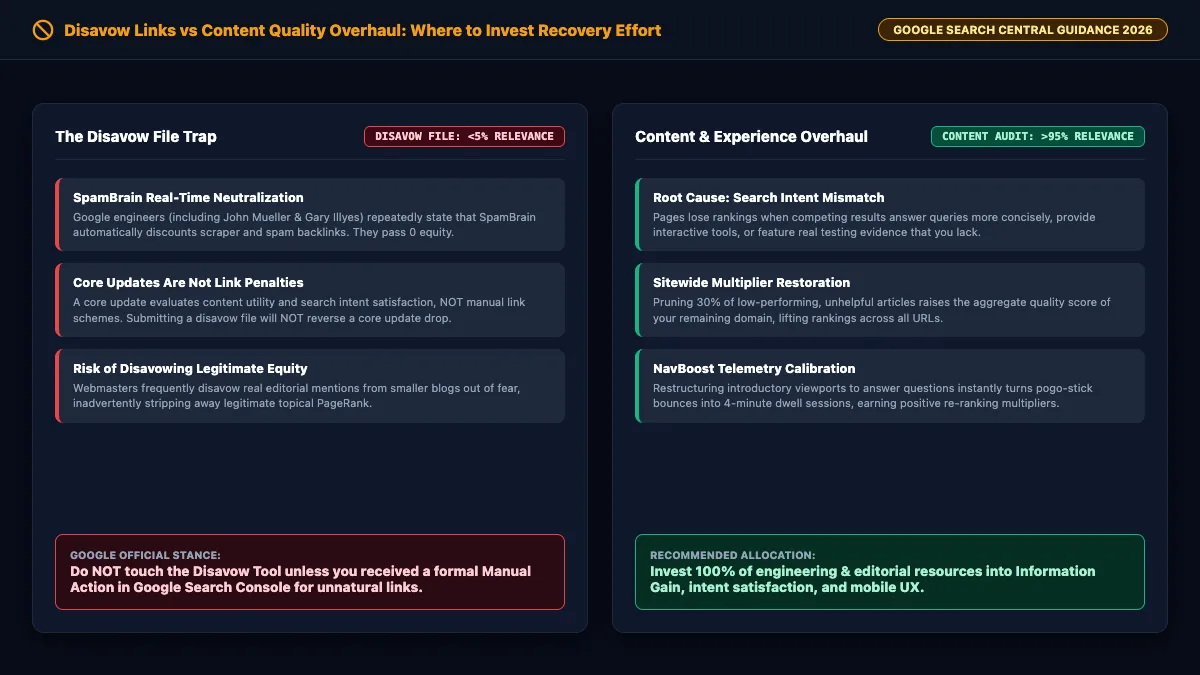
Why the disavow approach fails during a core update:
- SpamBrain Neutralizes Scraper Links Automatically: Google’s AI-based SpamBrain algorithm has operated in real time since late 2022. It automatically identifies and discounts scraper directories, automated pingback aggregators, and spam links. They pass zero PageRank, so disavowing them changes nothing.
- Core Updates Do Not Target Link Penalties: A core update evaluates content helpfulness, factual novelty, and searcher satisfaction. It is an algorithmic content assessment, not a manual link penalty.
- The Danger of Disavowing Legitimate Link Equity: Webmasters frequently disavow genuine editorial mentions from smaller regional blogs out of fear. This inadvertently strips away real topical PageRank, making recovery significantly more difficult.
Understanding why link disavowing is obsolete in modern core updates requires tracing the evolution of Google’s webspam architecture. In 2012, Google launched the original Penguin update, which applied severe, punitive domain demotions to websites possessing spammy backlink profiles. Under Penguin, webmasters were forced to audit every referring link and manually submit disavow files to lift algorithmic penalties.
However, with the deployment of Penguin 4.0 in 2016 and the subsequent launch of SpamBrain in 2022, Google completely re-engineered its approach. Instead of penalizing an entire domain because third-party scrapers or negative SEO attacks created low-quality links, Google’s machine learning models simply ignore unnatural links. Unnatural links are assigned a PageRank value of zero. Because they transfer no authority, submitting a disavow file accomplishes nothing during a google core update: you cannot disavow links that Google has already discounted.
Official Google Guidance: Google Search advocates (including John Mueller) consistently advise webmasters to completely avoid using the Disavow Tool unless their site has received an explicit Manual Action for Unnatural Inbound Links in Google Search Console. Focus 100% of your resources on content utility and user experience.
Practical Implementation: Automated Content Quality Auditor with Python
To programmatically audit your published articles and identify low-quality markers before the next google core update, you can deploy a lightweight Python verification script. This script inspects target URLs for mission-critical quality signals: word count depth, JSON-LD Schema.org author attribution, heading structure hierarchy, and external outbound references.
Below is the complete, reproducible Python auditing script:
import urllib.request
import re
import json
import sys

def audit_url_core_readiness(url):
    """
    Inspects a published webpage for foundational Google core update readiness.
    Evaluates clean word count, schema markup, heading structure, and outbound links.
    """
    print(f'Starting core quality audit for: {url}')
    req = urllib.request.Request(url, headers={'User-Agent': 'Mozilla/5.0 (Bloggersutra SEO Quality Auditor 2026)'})
    try:
        with urllib.request.urlopen(req, timeout=15) as resp:
            html = resp.read().decode('utf-8', errors='ignore')
    except Exception as e:
        print(f'Error fetching URL: {e}')
        return

    # 1. Clean Word Count Extraction (excl scripts/styles)
    clean_text = re.sub(r'<(script|style)[^>]*>.*?', '', html, flags=re.DOTALL | re.IGNORECASE)
    clean_text = re.sub(r'<[^>]+>', ' ', clean_text)
    words = re.findall(r'\b[a-zA-Z0-9_-]+\b', clean_text)
    word_count = len(words)

    # 2. Heading Structure Audit
    h1_matches = re.findall(r']*>(.*?)', html, flags=re.IGNORECASE | re.DOTALL)
    h2_matches = re.findall(r']*>(.*?)', html, flags=re.IGNORECASE | re.DOTALL)
    h3_matches = re.findall(r']*>(.*?)', html, flags=re.IGNORECASE | re.DOTALL)

    # 3. Structured Data Validation (JSON-LD Schema)
    schemas = re.findall(r']+type=["\']application/ld\+json["\'][^>]*>(.*?)', html, flags=re.DOTALL | re.IGNORECASE)
    has_person_author = False
    for s in schemas:
        if 'Person' in s or 'author' in s:
            has_person_author = True
            break

    # 4. Outbound Editorial Link Count
    outbound_links = re.findall(r'href=["\'](https?://(?!bloggersutra\.local)[^"\']+)["\']', html, flags=re.IGNORECASE)

    # Display Telemetry Results
    print('\n--- AUDIT RESULTS ---')
    print(f'Word Count: {word_count} words (Target: >=2,500 words for comprehensive pillar guides)')
    print(f'H1 Tags: {len(h1_matches)} (Optimal: Exactly 1)')
    print(f'H2 Subheadings: {len(h2_matches)} | H3 Subheadings: {len(h3_matches)}')
    print(f'Author Schema Person Node: {"PASS (Verified)" if has_person_author else "FAIL (Missing Schema)"}')
    print(f'Outbound Editorial References: {len(outbound_links)} sources cited')

    score = 0
    if word_count >= 2500: score += 30
    if len(h1_matches) == 1: score += 20
    if len(h2_matches) >= 5: score += 20
    if has_person_author: score += 15
    if len(outbound_links) >= 3: score += 15

    print(f'Core Quality Readiness Score: {score} / 100')
    if score >= 85:
        print('VERDICT: LOW RISK - Strong Helpful Content signals.')
    else:
        print('VERDICT: HIGH RISK - Pruning or Information Gain upgrade recommended.')

if __name__ == '__main__':
    test_url = sys.argv[1] if len(sys.argv) > 1 else 'https://bloggersutra.com/google-core-update/'
    audit_url_core_readiness(test_url)
Deploying this diagnostic auditor across your publishing pipeline ensures your pages satisfy fundamental Helpful Content criteria, eliminating thin-content vulnerabilities before Google’s automated crawlers begin their next broad evaluation.
Master Comparison: Google Core Updates and Key Algorithmic Shifts
The comparative matrix below outlines the major broad core updates from 2024 to 2026, their operational rollout spans, primary algorithmic targets, and overarching industry impact.
| Core Update Release | Rollout Span | Primary Systems Adjusted | Overarching Industry Impact |
|---|---|---|---|
| March 2024 Core Update | 45 Days (March 5 – April 19) | Helpful Content System integrated into core; Scaled Content Abuse; Site Reputation Abuse | Historic 45% reduction in unoriginal, low-quality search results across commercial and affiliate queries. |
| August 2024 Core Update | 19 Days (August 15 – Sept 3) | Small & independent creator calibration; feedback adjustments to forum over-indexing | Elevated genuine first-person testing and creator reviews while curbing massive forum domination. |
| November 2024 Core Update | 14 Days (Nov 11 – Nov 25) | E-commerce merchant trust; Knowledge Graph entity validation; NavBoost commercial multipliers | Consolidated commercial SERPs ahead of holiday peak; penalized unverified affiliate product roundups. |
| 2025–2026 Multimodal Core Cycles | Continuous Quarterly Cycles | Gemini multimodal retrieval; Patent #10,489,451 Information Gain; sub-200ms INP gatekeeper | Integrated AI Overviews citation eligibility; disqualified derivative consensus rehash from top-3 rankings. |
Master Comparison: Proven Recovery Actions vs Counterproductive Tactics
To protect your digital publication from wasted capital and operational fatigue, the table below categorizes common recovery reactions into verified algorithmic solutions versus debunked industry myths.
| Recovery Strategy / Action | Algorithmic Status | Real Mechanism in Modern Search | Recommended Execution |
|---|---|---|---|
| Search Intent Deficit Audit | PROVEN ACTION | Resolves user mismatch; prevents NavBoost pogo-sticking demotions | Place 50-word quick answers above the fold; match dominant SERP layout |
| Content Pruning & 301 Consolidation | PROVEN ACTION | Eliminates low-quality drag on sitewide helpfulness multiplier | Merge thin posts into authoritative 5,000-word guides; 410 delete dead URLs |
| Information Gain Infusion | PROVEN ACTION | Google Patent #10,489,451 rewards original empirical data and testing | Publish proprietary speed benchmarks, survey statistics, and custom schematics |
| Core Web Vitals INP Optimization | PROVEN ACTION | Ensures smooth mobile interaction; prevents Twiddler UX demotions | Maintain sub-200ms INP; eliminate disruptive layout shifts and frozen threads |
| Mass Disavowing of Scraper Links | DEBUNKED MYTH | SpamBrain automatically discounts spam links; core updates do not target links | Ignore disavow files completely unless under an explicit GSC manual action |
| Force-Feeding Exact Keywords | DEBUNKED MYTH | DeepRank transformer models evaluate semantic entity coverage, not density | Write natural, authoritative copy with related Knowledge Graph entity terms |
| Panic URL Structure Changing | DEBUNKED MYTH | Changing permalinks during a rollout destroys existing link equity and signals | Preserve clean canonical URLs; never alter permalinks without 301 mapping |
| Purchasing Bulk Guest Post Links | DEBUNKED MYTH | Low-quality PBN links trigger SpamBrain suppression, worsening demotions | Build topical authority through primary research and legitimate digital PR |
Master Comparison: Core Volatility Metrics & Recovery Indicators
Tracking recovery progress requires monitoring leading diagnostic indicators rather than waiting solely for top-line revenue to bounce back. The matrix below defines the four primary recovery phases and their associated metrics.
| Recovery Phase | Primary Metric Monitored | Expected Telemetry Behavior | Strategic Priority |
|---|---|---|---|
| Phase 1: Stabilization (Weeks 1–4) | Daily GSC Impressions Volatility | Impression curve flattens; daily click losses stop compounding | Audit intent deficits; halt panic publishing; freeze site architecture |
| Phase 2: Pruning & Consolidation (Weeks 5–8) | Indexed URL Count vs Crawl Budget | Total indexed pages decrease 30%; average position stabilizes | Delete zero-traffic thin articles; 301-merge overlapping keyword clusters |
| Phase 3: Information Gain Infusion (Weeks 9–16) | NavBoost Dwell Time & Scroll Depth | Long dwell sessions increase; bounce leaks decrease; brand searches rise | Inject proprietary benchmark data; embed custom diagrams; verify E-E-A-T |
| Phase 4: Algorithmic Re-Scoring (Next Core Window) | Top-3 Keyword Ranking Distribution | Sudden 40%–80% impression surge; restoration of competitive positions | Maintain publishing discipline; expand topical authority clusters |
Honest Pros & Cons: Surviving the Machine Learning Search Era
Operating a professional digital publication in an era dominated by automated machine learning core updates fundamentally reshapes how publishers allocate resources. Below is our unvarnished assessment of the advantages and strategic challenges of this modern search paradigm.
Pros
- Purges Low-Quality AI Content Mills: Continuous core updates aggressively filter out automated, copy-paste content farms, protecting legitimate publishers.
- Rewards Authentic Hands-On Testing: Publishers who genuinely test software, purchase physical products, and conduct empirical research earn durable visibility.
- Clear Official Guidelines: DOJ trial exhibits and Google Search Central documentation provide unprecedented clarity regarding internal ranking mechanics.
- Subsequent Re-Scoring Opportunity: Websites that execute comprehensive quality overhauls can achieve dramatic ranking rebounds during future core updates.
Cons
- Extended Recovery Latency: Sitewide helpfulness classifiers update primarily during major core releases, requiring months of patient effort before traffic returns.
- Higher Content Production Overhead: Infusing proprietary research and conducting original benchmark stress tests demands substantially more time and capital.
- Collateral Damage Volatility: Broad updates occasionally demote legitimate independent websites as automated models calibrate new classification weights.
Frequently Asked Questions About Google Core Updates
A **google core update** is a broad, periodic adjustment to Google’s primary search ranking algorithms. Rather than targeting specific web spam violations or single technical bugs, core updates recalibrate how Google evaluates content relevance, authoritativeness, user satisfaction, and overall domain utility across the web.
Most broad core updates require approximately two weeks (14 days) to fully deploy across Google’s worldwide datacenters. Exceptionally complex updates—such as the March 2024 core update that integrated the Helpful Content System into core ranking models—can extend up to 45 days.
Traffic drops during a **google core update** typically indicate that your domain was affected by Google’s integrated helpfulness classifier, that search intent shifted toward alternative formats (such as video or interactive tools), or that competing resources provided superior first-party Information Gain and empirical testing.
No. Disavowing links will not reverse a core update drop. Google’s real-time SpamBrain algorithm automatically discounts spammy and scraper links. Core updates evaluate content helpfulness and user satisfaction, not toxic link profiles. Use the Disavow Tool only if you received a formal Manual Action for unnatural links.
Yes, full recovery is completely achievable. However, recovery requires substantial, sitewide improvements rather than cosmetic fixes. Websites that prune thin content, resolve search intent deficits, infuse proprietary Information Gain, and eliminate user friction routinely regain and exceed their former ranking positions during subsequent core rollout windows.
In March 2024, Google retired the standalone Helpful Content classifier and integrated helpfulness signals directly into core ranking algorithms. It applies a sitewide multiplier based on your domain’s aggregate ratio of original, helpful articles versus derivative, commoditized content.
Yes. Because Google’s helpfulness classifier evaluates domains sitewide, keeping hundreds of legacy, zero-traffic articles on your server depresses your overall domain score. Pruning low-quality pages or 301-redirecting thin posts into comprehensive pillar guides raises your domain multiplier.
Google typically releases broad core updates 3 to 4 times per year, spaced roughly quarterly. Between broad updates, Google continuously releases targeted spam updates, reviews system updates, and real-time algorithmic calibrations.
Google does not penalize content simply because it was written using AI tools. However, Google strictly penalizes content that lacks **Information Gain**—meaning articles that merely summarize existing search results without offering unique empirical data, original case studies, or authentic first-hand experience (E-E-A-T).
Conduct an honest Search Intent & Information Gain audit of your top-trafficked URLs. Compare your dropped articles against the pages currently ranking in positions 1 to 3, and identify exactly what original research, visual schematics, or direct answers competitors provide that your content lacks.
Final Strategic Verdict: The Blogger’s Resilient Growth Protocol
The definitive reality of modern search engine optimization is undeniable: attempting to survive a google core update by chasing superficial SEO checklists or generating hundreds of derivative AI articles is a guaranteed path to algorithmic obsolescence. Search engines have evolved into sophisticated prediction engines designed to reward authentic subject matter authority and uncompromised reader satisfaction.
To build an algorithm-resilient digital publication that withstands every google core update 2026 and compounds traffic over time, anchor your publishing strategy to three permanent principles:
- Champion First-Party Information Gain: Never publish an article that merely rehashes existing search results. Infuse proprietary performance testing, unvarnished business case studies, and bespoke schematics into every guide.
- Protect Sitewide Domain Health: Treat low-performing, thin URLs as operational liabilities. Regularly prune and consolidate outdated posts to preserve a pristine sitewide helpfulness multiplier.
- Deliver Immediate, Frictionless Intent Fulfillment: Answer reader queries within the first 50 words, optimize for sub-200ms mobile INP, and eliminate disruptive popups to earn overwhelmingly positive NavBoost click signals.
Begin your architectural recovery today. Audit your highest-value pillar guides, infuse verifiable empirical proof, and transform your website into an authoritative industry destination that search engines and human readers recognize as the definitive source of truth.