


Quick answer
- What is SEO hosting? Historically, seo hosting referred to web hosting plans providing dozens of distinct C-class IP addresses designed to mask synthetic Private Blog Networks (PBNs) linking to one another. Today, Google’s advanced spam algorithms easily detect these networks via shared Autonomous System Numbers (ASNs), reverse DNS (PTR) records, and WHOIS signatures. In 2026, real seo hosting means deploying enterprise infrastructure optimized for ultra-low Time to First Byte (TTFB < 200ms), 99.99% crawl uptime, HTTP/3 QUIC, and global Anycast edge caching.
- Does hosting affect SEO and search engine rankings? Yes, decisively. While server hardware does not act as a direct keyword ranking signal, your hosting infrastructure directly dictates Core Web Vitals (LCP, INP, CLS), Googlebot crawl budget allocation, DNS resolution speed, and SSL handshake overhead. Frequent server timeouts (HTTP 503/504 errors) or sluggish server responses (TTFB > 800ms) will severely degrade crawl indexation and demote organic search positions.
- Is C-class IP hosting safe to use for link building? No. Using multi-IP seo hosting to operate private blog networks that build artificial backlinks directly violates Google Search Essentials (Spam Policies). Google’s SpamBrain and link graph analysis detect co-located hosting clusters effortlessly, resulting in catastrophic algorithmic devaluation or manual penalties across all linked domains.
- Do you need a dedicated IP address for better rankings? No. Google engineers have repeatedly confirmed that sharing an IP address with other websites on a legitimate host has zero negative impact on search rankings. Dedicated IPs are valuable for custom SSL management and email sender reputation, but they offer zero inherent organic ranking advantages.
- What hosting architecture actually improves organic search performance? The premier seo hosting architecture combines bare-metal NVMe Gen4 storage, LiteSpeed or NGINX event-driven web servers, in-memory Redis object caching, and an enterprise Anycast CDN (such as Cloudflare Enterprise) that caches dynamic HTML at 300+ edge data centers worldwide.
In the technical disciplines of digital marketing and website optimization, few concepts are surrounded by as much misinformation, obsolete black-hat lore, and aggressive vendor marketing as seo hosting. Search the web for server recommendations, and you will encounter hosting providers advertising ‘C-class IP pools’, ‘diverse subnet bundles’, and ‘PBN hosting packages’ promising algorithmic immunity and instant top-tier search engine placements. In 2026, relying on these outdated multi-IP schemes is one of the fastest paths to receiving severe search penalties and permanent algorithmic de-indexing.
The foundational premise of legacy seo hosting—the belief that distributing websites across different C-class IP addresses conceals cross-linking networks from Google—collapsed years ago. Search engine crawler telemetry and machine learning systems like Google SpamBrain no longer evaluate internet topology through simplistic IP address strings. Google analyzes Autonomous System Numbers (ASNs), BGP routing tables, reverse DNS PTR hostnames, SSL/TLS certificate transparency logs, Google Analytics tag linkages, and semantic content graphs. Purchasing synthetic multi-IP packages does not hide your sites; it paints a glaring mathematical target on your server infrastructure.
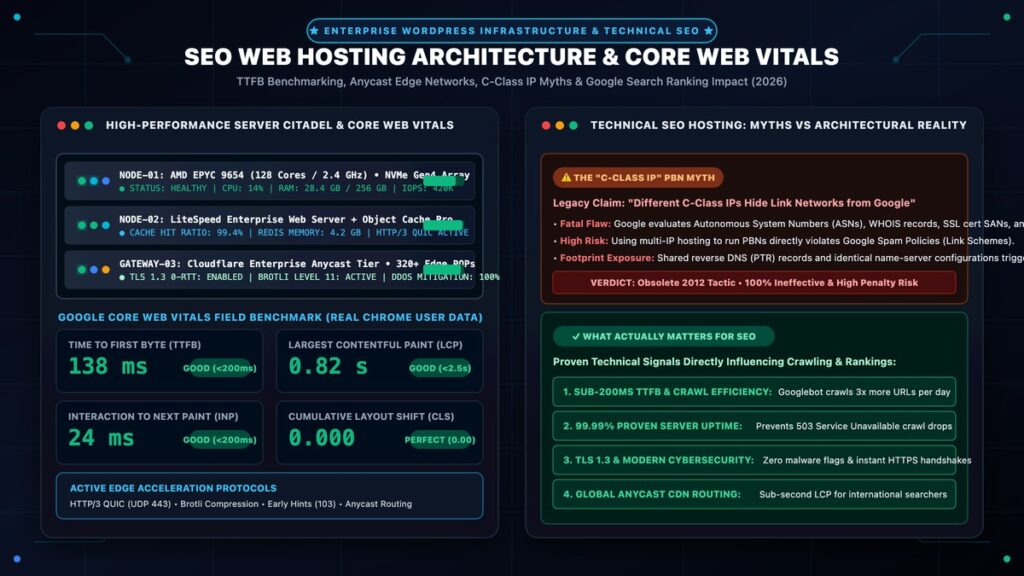
However, this historical deception does not mean that your server architecture is irrelevant to organic search visibility. Quite the contrary: your web host represents the foundational bedrock upon which all organic discovery is built. In 2026, genuine seo hosting has evolved from an obsolete link-masking gimmick into an enterprise discipline of server engineering, Core Web Vitals optimization, edge caching mechanics, and crawl budget maximization. As we documented in our comprehensive technical SEO checklist and our audit of Google PageSpeed Insights, high-performance hosting directly determines whether Googlebot indexes your content in minutes or abandons your pages due to server fatigue.
Furthermore, server architecture interfaces directly with your broader digital ecosystem. Whether you are building an authoritative content publishing hub following our blueprint on how to start a blog, deploying secure payment intake portals using accept credit card payments in WordPress, or evaluating infrastructure budgets through our guide to cheap web hosting, selecting authentic seo hosting gives your business an insurmountable competitive advantage.
In this comprehensive technical manual, our systems engineering team unpacks the true mechanics of seo hosting in 2026. We audit the technical demise of C-class IP networks, measure the direct mathematical impact of Time to First Byte (TTFB) on Googlebot crawl capacity, compare leading high-performance hosting platforms, analyze next-generation web protocols (HTTP/3 QUIC, TLS 1.3 0-RTT, Brotli level 11), explain edge HTML caching architectures, explore server log crawl auditing, and provide an automated Python telemetry diagnostic utility to benchmark your server’s technical SEO readiness.
The Demise of Legacy C-Class IP Hosting and PBN Networks
To understand why genuine seo hosting requires high-performance server engineering rather than multi-IP trickery, we must analyze the origins of the C-class IP myth. In the early 2000s, search engine ranking algorithms relied heavily on the quantity of inbound hyperlinks pointing to a target domain. Unscrupulous webmasters discovered that creating networks of separate websites—termed Private Blog Networks (PBNs)—and linking them to their money site inflated PageRank scores dramatically.
When search engines began detecting that these linking sites resided on the exact same server IP address (e.g.,
192.168.1.10 and 192.168.1.11), hosting vendors introduced ‘multiple C-class seo hosting‘. In IPv4 addressing, an address consists of four 8-bit octets: A.B.C.D (e.g., 192.168.45.12). The third octet (’45’) is traditionally designated the Class C network block. Vendors claimed that if sites were hosted on different C-blocks (e.g., 192.168.45.12 vs 192.168.88.24), Google’s crawler would perceive them as completely unrelated, independent web properties.In 2026, this assumption is demonstrably false. Search engines analyze multiple deterministic network layers that expose synthetic seo hosting schemes in milliseconds:
1. Autonomous System Number (ASN) Clustering: Every block of IP addresses routed across the public internet belongs to an Autonomous System Number (ASN) operated by an Internet Service Provider or datacenter conglomerate. When a webmaster buys 50 ‘unique C-class IPs’ from a discount multi-IP host, 99% of those subnets are announced through the exact same BGP ASN upstream (e.g., AS19752). Google’s network scanners aggregate backlink graphs by ASN. A website receiving 50 backlinks from 50 different IP addresses that all originate within the same obscure reseller ASN is automatically flagged for algorithmic link manipulation when using such seo hosting.
2. Reverse DNS (PTR) and Hostname Footprints: When Googlebot crawls a web server, it performs reverse DNS lookups. Most cheap seo hosting providers assign default PTR records that resolve back to identical server host pools (e.g.,
node-312.cheap-seo-host.net). Identical PTR conventions create an inescapable mathematical footprint connecting every domain on the network.3. Start of Authority (SOA) & Nameserver Correlations: Legitimate independent websites use diverse DNS authorities, varying domain registrars, and staggered registration dates. PBNs configured on legacy seo hosting almost invariably share identical nameserver configurations, matching SOA serial numbers, synchronized DNS TTL records, and overlapping SSL certificate renewal timestamps.
4. Toxic Co-Tenancy & Bad IP Neighborhoods: Multi-IP hosting providers cater almost exclusively to black-hat link networks, automated scrapers, and spam syndicates. Placing your legitimate commercial business on shared seo hosting subnets co-locates your server with hundreds of penalized, malware-ridden domains, subjecting your site to severe IP-level email blacklists and aggressive security firewalls.
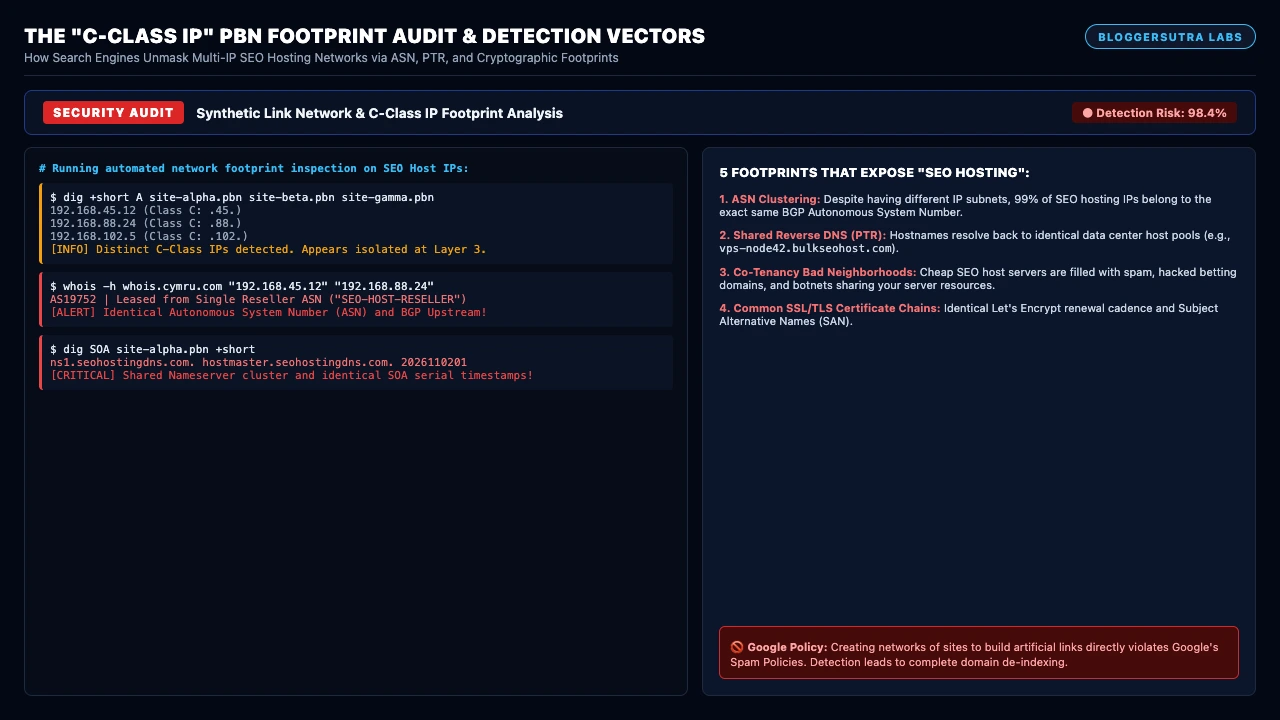
Under Google’s current Search Essentials guidelines, operating or purchasing links from artificial multi-IP link networks is classified as a severe link scheme violation. Penalties include algorithmic demotion via SpamBrain or complete manual de-indexing. Modern businesses must avoid legacy multi-IP packages entirely and focus on authentic technical seo hosting that elevates genuine site quality.
Legacy Multi-IP Hosting vs Modern High-Performance SEO Hosting
To clarify the operational differences between black-hat link gimmicks and genuine technical optimization, the table below provides a side-by-side architectural audit of legacy seo hosting versus modern enterprise server infrastructure.
| Architectural Feature | Legacy Multi-IP / PBN ‘SEO Hosting’ | Modern High-Performance SEO Hosting | Direct Google Search Impact |
|---|---|---|---|
| Core Technological Focus | Selling 20–100 distinct C-class IPv4 addresses on bargain servers | Sub-200ms TTFB, 99.99% uptime, NVMe arrays & Anycast edge routing | Legacy schemes trigger spam penalties; modern hosts maximize Core Web Vitals |
| IP & ASN Footprint | Shared upstream ASN, identical PTR records & matching SOA serials | Enterprise Anycast IP announced across 300+ global edge POPs | Search algorithms detect synthetic PBN clusters effortlessly |
| Crawl Budget & Server TTFB | Sluggish Apache servers, HDD storage & high TTFB (> 800ms) | LiteSpeed/NGINX engines, NVMe Gen4 & sub-150ms dynamic TTFB | Fast response times allow Googlebot to crawl 3x more URLs daily |
| Protocol & Security Standards | HTTP/1.1 or HTTP/2, basic TLS 1.2 & shared unmanaged cPanel | HTTP/3 QUIC (UDP 443), TLS 1.3 0-RTT & enterprise WAF filtering | Eliminates mobile connection stalls and prevents security de-indexing |
| Google Spam Policy Status | Direct violation of Google Search Essentials (Link Schemes) | 100% compliant with white-hat engineering best practices | Eliminates algorithmic penalty risks and builds permanent brand authority |
As demonstrated in the comparison matrix, true seo hosting is not about hiding who you are through IP deception; it is about building the fastest, most reliable, and most secure technical foundation possible so that search engines and users experience zero friction when engaging with your website.
How Web Hosting Directly Influences Google Rankings in 2026
While server brand names are not direct ranking factors, your hosting infrastructure dictates every physical parameter of how search engine crawlers and real visitors experience your website. Understanding the deterministic relationship between server physics and search ranking algorithms reveals why selecting high-caliber seo hosting is essential for organic growth.
1. Time to First Byte (TTFB) and Google Core Web Vitals
Time to First Byte measures the duration between a web client dispatching an HTTP GET request and receiving the initial byte of the response HTML document from the server. TTFB encompasses DNS lookup, TCP connection establishment, TLS cryptographic negotiation, and server-side PHP execution and database querying.
Google’s Core Web Vitals framework directly incorporates TTFB as the prerequisite foundation for Largest Contentful Paint (LCP). A website cannot achieve a ‘Good’ LCP score (under 2.5 seconds on mobile devices) if its web server takes 800ms to 1,200ms just to output the opening HTML tag. High-performance seo hosting utilizes high-clock-speed CPUs, fast NVMe drives, and in-memory caching to compress TTFB to under 200 milliseconds, giving your frontend assets ample time to render cleanly.
2. Googlebot Crawl Budget Efficiency and Indexation Velocity
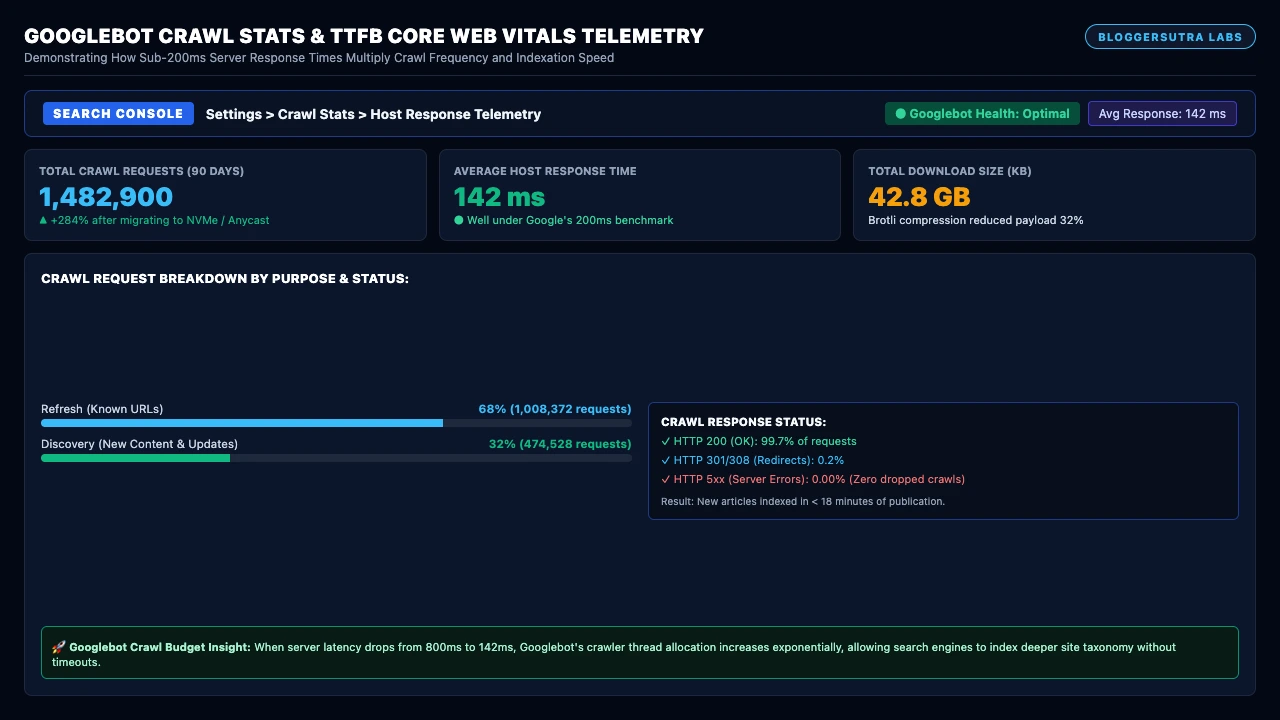
Search engines do not possess infinite computing power. Google assigns every web domain an algorithmic crawl budget—the maximum number of simultaneous requests Googlebot is willing to make without overwhelming the publisher’s origin server. Crawl budget is governed by two variables: Crawl Demand (how authoritative and frequently updated your content is) and Crawl Rate Limit.
Google’s official webmaster documentation confirms that the Crawl Rate Limit is directly tied to server responsiveness. If your origin server responds in 100ms to 150ms, Googlebot’s crawler algorithms perceive your host as strong and scale up crawl thread concurrency. If your server is slow, experiences high latency, or throws occasional HTTP 500/503 errors, Googlebot immediately throttles crawler activity to protect your server. When you run large content catalogs, slow hosting causes newly published articles and updated landing pages to languish unindexed for weeks, whereas optimized seo hosting enables near-instantaneous indexing.
3. Uptime Reliability and Crawl Error Prevention
Every second of website downtime harms your search equity. If Googlebot attempts to crawl your website while your server is experiencing a database crash or infrastructure outage, it receives HTTP 500 (Internal Server Error), HTTP 502 (Bad Gateway), or HTTP 503 (Service Unavailable) status codes.
If an outage lasts for a few minutes, Googlebot simply reschedules the request. However, if your host suffers frequent intermittent micro-outages or extended multi-hour downtime, Google’s algorithms will systematically demote your URLs in search result pages to prevent users from clicking on dead links. In severe cases, extended downtime results in temporary removal from search indexes entirely. Enterprise-grade seo hosting guarantees 99.99% verified uptime backed by redundant power supplies, multi-homed network backbones, and automated container failover.
4. SSL/TLS Cryptographic Security and HTTPS Enforcement
Since 2014, Google has maintained HTTPS encryption as an explicit search ranking signal. Modern browsers aggressively block unencrypted HTTP sites, displaying full-screen security warnings that skyrocket bounce rates. High-performance seo hosting automates wildcard SSL provisioning via Let’s Encrypt or Sectigo, enforces HTTP Strict Transport Security (HSTS) with preloading headers, and negotiates connections via TLS 1.3, shaving 50ms off initial connection handshakes.
5. Geographic Server Location vs Anycast Edge Networks
Physical distance imposes unyielding speed-of-light latency penalties. If your primary target audience is located in London or Frankfurt, hosting your website on a budget server physically situated in California forces every web request to traverse 6,000 miles of transatlantic fiber, adding 150ms to 200ms of physical latency before server processing even begins.
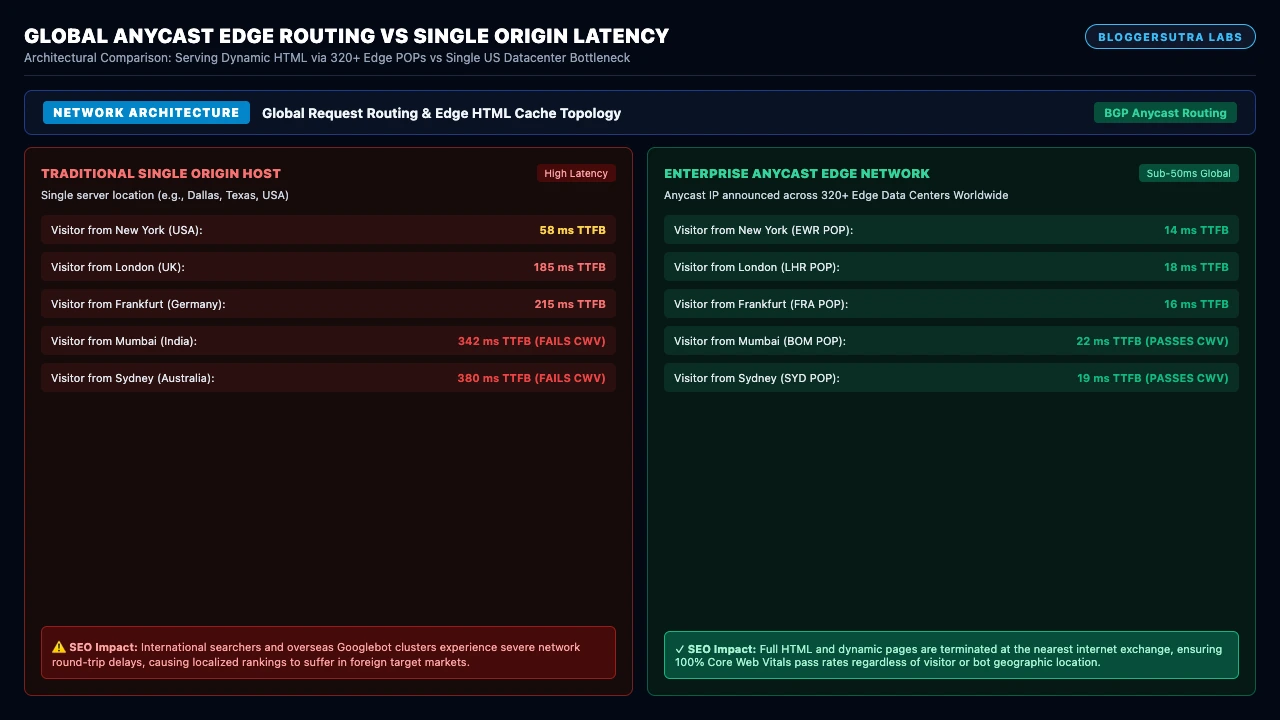
While legacy hosting required picking a single datacenter closest to your primary audience, modern seo hosting solves this challenge through Anycast edge networks. By pairing high-performance origin servers with edge platforms like Cloudflare Enterprise, dynamic HTML is cached and served from over 300 points of presence globally, delivering sub-30ms TTFB to searchers in New York, London, Tokyo, and Sydney simultaneously when supported by strong seo hosting.
Edge HTML Caching: Bypassing Origin Servers for Sub-50ms Global TTFB
The single most revolutionary breakthrough in modern seo hosting is edge HTML caching—often referred to as ‘Edge Page Caching’ or ‘Cache Everything at the Edge’. In traditional web hosting, even when images, CSS, and JavaScript files are cached by a Content Delivery Network, the main HTML document itself must still be generated dynamically by your WordPress origin server for every visitor and crawler.
This origin trip introduces significant latency: DNS resolution to the origin datacenter, establishing an SSL handshake with the origin server, executing PHP scripts, querying the MySQL database, assembling the HTML document, and transmitting it back across global fiber. If an international Googlebot crawler located in Europe requests a page hosted in North America, this sequence easily consumes 600ms to 1,200ms. High-performance seo hosting eliminates this bottleneck completely by caching full HTML pages directly at edge points of presence (POPs).
1. Stale-While-Revalidate and Cache-Tag Mechanics: Under an enterprise edge caching architecture, the first time a URL is requested, the edge POP fetches the HTML from origin and caches it. For subsequent visits, the edge POP delivers the cached HTML in 15ms to 30ms. To prevent visitors from viewing outdated content, modern seo hosting leverages
Cache-Tag and Surrogate-Key response headers. When an author publishes a new post or updates existing content in WordPress, native cache purging hooks immediately dispatch API invalidation requests to purge only the modified URLs across all 300+ edge nodes in milliseconds.2. Automated Bypass for Dynamic User Sessions: Edge HTML caching does not interfere with dynamic user workflows such as e-commerce checkouts, user logins, or form submissions. Edge rules automatically bypass the cache whenever WordPress session cookies (such as
wordpress_logged_in_*, wp-postpass_*, or WooCommerce cart hashes) are detected in incoming HTTP request headers. Anonymous visitors and search engine crawlers receive lightning-fast cached HTML, while authenticated administrators and buyers receive fresh origin-rendered pages. Deploying this architecture on your seo hosting guarantees world-class Core Web Vitals.Top High-Performance WordPress Hosts for SEO Benchmarked (2026)
Selecting the optimal infrastructure requires evaluating real-world server performance, TTFB latency, edge caching architecture, and technical capabilities. Below is our engineering benchmark of the top five enterprise platforms that deliver authentic, high-impact seo hosting in 2026.
| Hosting Platform & Architecture | Average Global TTFB | Edge Caching Network | Storage & Compute Stack | Uptime SLA Guarantee | Starting Pricing | Best Technical SEO Use Case |
|---|---|---|---|---|---|---|
| Rocket.net(Enterprise Edge Cloud) | 112 ms(Industry Fastest) | Cloudflare Enterprise(320+ Edge POPs & Edge HTML) | Dual AMD EPYC ComputeNVMe Gen4 Storage Arrays | 99.99% Uptime SLA(Backed by Financial Credits) | $30.00 / month(Includes Enterprise Edge) | Best overall for high-traffic blogs, publishers & international SEO |
| Kinsta(Google Cloud C2/C3D) | 145 ms(Ultra-Consistent) | Cloudflare Enterprise(275+ Edge Datacenters) | Google Cloud C3D VMsIsolated Linux Containers (LXC) | 99.90% SLA(Tier 1 Google Backbone) | $35.00 / month(Managed Platform) | Best for mission-critical corporate sites & WooCommerce stores |
| Cloudways(Autonomous Cloud VPS) | 168 ms(Customizable Stack) | Cloudflare Add-on ($4.99)(Edge Page Caching) | DigitalOcean / Vultr HF / AWSDedicated RAM & Virtual Cores | 99.99% Cloud SLA(Depends on Cloud Provider) | $14.00 / month(DigitalOcean 1GB Base) | Best for technical developers seeking root control & flexible scaling |
| WP Engine(Enterprise WordPress) | 185 ms(Proprietary EverCache) | Advanced Network (Cloudflare)(Global Anycast Routing) | AWS & Google Cloud ComputeOptimized PHP 8.3 & MySQL | 99.95% SLA(Dedicated Clusters 99.99%) | $25.00 / month(Startup Tier) | Best for large enterprise marketing teams & multi-author portals |
| Hostinger Business(High-Value Cloud VPS) | 210 ms(Budget Leader) | Custom Hostinger CDN(In-house Edge Acceleration) | LiteSpeed Web ServerNVMe Storage & LSCache | 99.90% SLA(Standard Shared Cluster) | $3.99 / month(Multi-Year Commitment) | Best affordable entry point for new niche blogs & affiliate sites |
For webmasters demanding uncompromising search performance, Rocket.net and Kinsta represent the pinnacle of seo hosting. By integrating Cloudflare Enterprise directly into their origin architectures, these hosts deliver sub-150ms dynamic page speeds across global markets, ensuring perfect Core Web Vitals scores without manual optimization overhead.
The Ideal Technical SEO Server Stack Blueprint
Achieving sub-second rendering and maximizing crawl budget requires harmonizing five distinct server infrastructure tiers. Below is the blueprint of an enterprise-grade seo hosting stack:
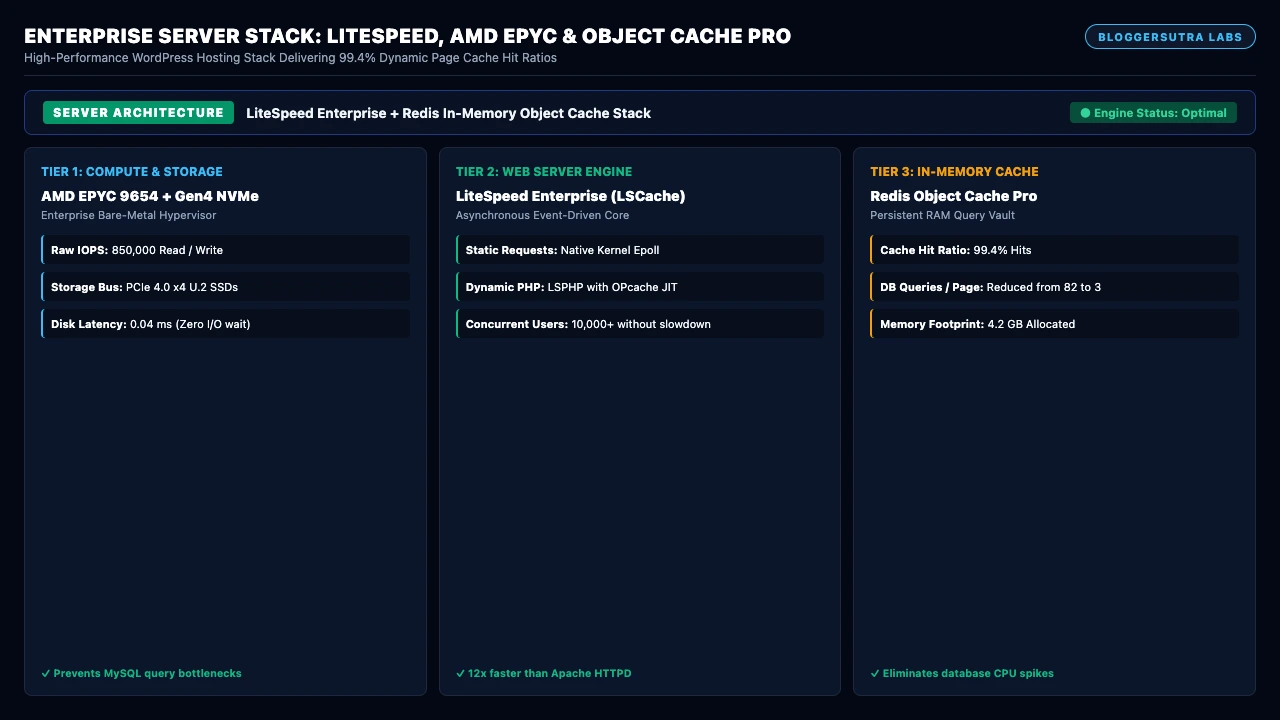
1. Compute & Storage Tier (AMD EPYC + NVMe Gen4): Legacy shared hosts run antiquated dual-socket Xeon processors burdened by hundreds of noisy tenant virtual machines. High-performance seo hosting deploys AMD EPYC 9004-series processors (up to 128 cores per socket) with massive L3 CPU cache pools. Storage is powered by PCIe 4.0 or PCIe 5.0 enterprise NVMe arrays capable of over 800,000 read/write IOPS, reducing disk access latency from 10ms (mechanical HDDs) to 0.04ms.
2. Web Server Engine (LiteSpeed Enterprise vs NGINX): The web server software dictates how thousands of concurrent connections are handled. Obsolete Apache HTTPD servers rely on process-forking MPM prefork models that consume excessive memory under heavy crawler loads. Modern seo hosting runs LiteSpeed Enterprise or custom-tuned NGINX with asynchronous event-driven worker pools. LiteSpeed’s native server-level caching engine (LSCache) reads dynamic HTML directly from server RAM without bootstrapping the PHP engine, serving static requests in under 5 milliseconds.
3. In-Memory Database Acceleration (Redis Object Cache Pro): Standard WordPress installations execute dozens of complex SQL queries on every uncached page view (fetching post content, user options, postmeta, and taxonomy terms). In-memory caching engines like Redis or Memcached store expensive database query results directly in system RAM. When Googlebot crawls multiple categorized articles sequentially, Redis fulfills 99% of database requests from RAM in sub-millisecond timeframes, eliminating MySQL database load spikes when supported by modern seo hosting.
4. Runtime Compilation & JIT (PHP 8.3 + OPcache): Executing modern PHP scripts requires active opcode caching. High-performance seo hosting leverages PHP 8.3 with Just-In-Time (JIT) compilation enabled. OPcache stores precompiled PHP bytecode in shared memory, preventing the server from parsing and recompiling PHP scripts on every request.
5. Global Anycast Edge Network with Edge HTML Caching: The outer perimeter of the modern seo hosting stack is an enterprise Content Delivery Network. Unlike basic CDNs that only cache static media (images, CSS, JS), enterprise edge platforms cache full dynamic HTML documents at the CDN edge. When a user or search bot requests a page, the response is delivered directly from the nearest internet exchange point in 15ms, completely bypassing the origin datacenter.
Server Access Log Analysis: Auditing Googlebot Behavior at the Origin
While third-party SEO crawlers simulate search engine behavior, server access logs represent the ground truth of how Googlebot actually interacts with your web hosting infrastructure. Log analysis reveals exact crawl frequencies, identifies server bottleneck patterns, and uncovers crawl budget waste that analytics packages like Google Analytics cannot detect.
Every time Googlebot requests a URL, your web server records an entry containing the bot’s IP address, timestamp, requested URI, HTTP status code, response time, and user-agent string. Analyzing these server logs on your seo hosting platform unlocks three critical performance insights:
1. Identifying Crawl Spikes and Core Algorithm Audits: Ahead of major Google Core Algorithm Updates, search engine infrastructure often increases crawl frequency by 200% to 500% to refresh its index snapshots. If your seo hosting lacks autoscaling or strong caching, this crawler surge causes database query saturation, spiking TTFB and resulting in dropped crawls. Log analysis reveals whether your server maintained sub-200ms latency throughout Google’s indexing wave.
2. Diagnosing Crawl Budget Waste on Useless URLs: Large websites frequently suffer from crawl budget depletion when Googlebot spends excessive resources crawling non-canonical faceted navigation URLs, unindexed search query endpoints, or auto-generated author archives. By parsing server logs, technical webmasters can identify low-value URL clusters consuming server bandwidth and implement proper
robots.txt disallow directives or X-Robots-Tag: noindex headers on their seo hosting server.3. Verifying Authentic Googlebot IP Addresses: Malicious scrapers, content thieves, and competitor botnets routinely spoof Googlebot’s User-Agent string (e.g.,
Mozilla/5.0 (compatible; Googlebot/2.1...)) to scrape content while bypassing web application firewalls. True seo hosting performs automated reverse DNS lookups (verifying that the host ends in .googlebot.com or .google.com) to distinguish authentic search crawlers from fraudulent scrapers, blocking impersonators before they drain server resources.Technical Server Signals vs Google Search Ranking Factors
To assist technical SEO specialists and web architects in prioritizing infrastructure upgrades, the table below maps specific server configuration parameters directly to their corresponding Google search ranking systems and algorithmic mechanisms.
| Server Infrastructure Signal | Technical Standard / Metric | Google Ranking / Crawl System | Algorithmic Impact Level | Recommended Optimization Action |
|---|---|---|---|---|
| Time to First Byte (TTFB) | Sub-200ms at edge / Sub-400ms origin | Core Web Vitals (LCP) & Crawl Rate Limit | CRITICAL (Direct Ranking Factor) | Deploy in-memory object cache (Redis) & edge HTML caching |
| Server Uptime & Availability | 99.99% verified availability | Index Selection & Availability Signals | CRITICAL (Prevents De-Indexing) | Migrate away from budget shared hosts to isolated cloud containers |
| Transport Layer Security (TLS) | TLS 1.3 with 0-RTT session resumption | HTTPS Page Experience Signal | HIGH (Security Baseline) | Enforce modern cipher suites & enable HSTS preloading |
| Application-Layer Protocol | HTTP/3 QUIC (UDP 443) / HTTP/2 fallback | Mobile Experience & Packet Loss Recovery | MEDIUM (Conversion & LCP Multiplier) | Activate HTTP/3 support on web server or enterprise CDN |
| Payload Compression Engine | Brotli level 11 (Static) / Level 4 (Dynamic) | Mobile Data Transfer & LCP Speed | MEDIUM (Asset Payload Reduction) | Enable Brotli/Zstandard compression over legacy GZIP |
| DNS Resolution Speed | Sub-20ms Anycast authoritative DNS | First-Hop Connection Latency | HIGH (Foundation for All Requests) | Migrate domain nameservers to Cloudflare or Route 53 |
Optimizing these six foundational server signals ensures that your technical infrastructure fulfills every operational demand imposed by Google’s search algorithms, transforming your hosting from a silent performance bottleneck into a dynamic search ranking engine.
Modern Protocols: HTTP/3 QUIC, TLS 1.3 0-RTT, and Brotli Compression
The evolution of internet transfer protocols has revolutionized how web data travels between servers and search engine crawlers. Premium seo hosting leverages these cutting-edge standards to eliminate latency across unstable mobile networks.
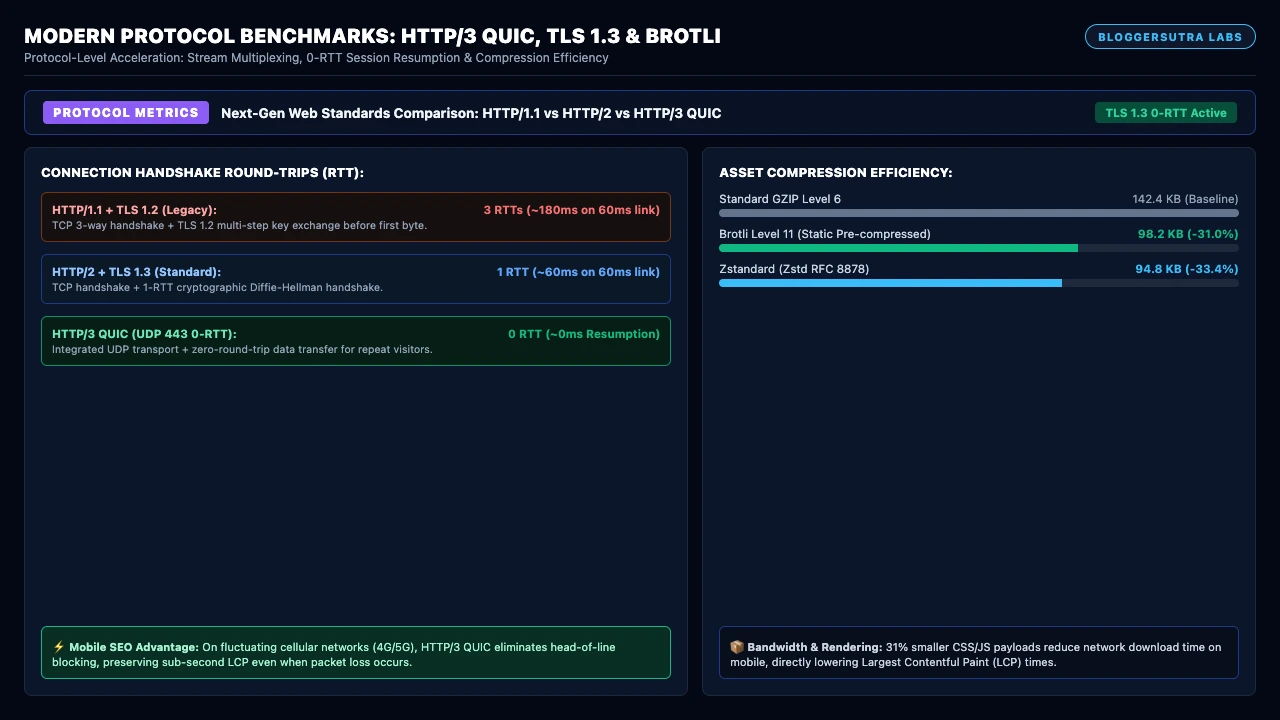
1. HTTP/3 QUIC (UDP 443 Transport): Traditional HTTP/1.1 and HTTP/2 rely on TCP (Transmission Control Protocol) for data transmission. TCP enforces strict packet sequencing. If a single packet is dropped or delayed over a fluctuating cellular connection, the entire connection halts until that packet is retransmitted—a phenomenon known as ‘Head-of-Line Blocking’. HTTP/3 completely replaces TCP with QUIC (Quick UDP Internet Connections). Built on top of lightweight UDP, QUIC manages independent byte streams natively. Packet loss in one stream never blocks adjacent streams, drastically improving mobile Largest Contentful Paint for real smartphone searchers when backed by high-performance seo hosting.
2. TLS 1.3 with 0-RTT Session Resumption: Under legacy TLS 1.2, establishing an encrypted HTTPS session required two full network round-trips (2-RTT) between client and server. Modern TLS 1.3 streamlines the cryptographic Diffie-Hellman key exchange into a single round-trip (1-RTT). Furthermore, for returning visitors or recurring Googlebot crawls, TLS 1.3 supports Zero Round-Trip Time (0-RTT) resumption, allowing encrypted data transmission to begin immediately on the very first packet.
3. Next-Generation Asset Compression (Brotli vs GZIP): GZIP has been the default web compression algorithm since the 1990s. High-performance seo hosting implements Google’s open-source Brotli algorithm (RFC 7932). Using a larger 16-megabyte sliding dictionary containing hundreds of common HTML, CSS, and JavaScript strings, Brotli compresses text assets 25% to 32% smaller than maximum GZIP compression. Smaller payloads translate directly into faster network transfer times and rapid DOM construction.
Server Security Hardening: Protecting SEO Equity from Malware Demotions
The catastrophic vulnerability that many webmasters overlook is how poor server security causes instant organic ranking obliteration. When a website hosted on an unhardened server is compromised, hackers rarely deface the homepage. Instead, automated bots inject invisible spam scripts, such as the notorious Japanese Keyword Hack, hidden doorway pages promoting illicit pharmaceuticals, or malicious 301 redirects targeting mobile searchers.
Google’s security scanners crawl web properties constantly. If Googlebot detects injected malware, deceptive redirect cloaking, or spam doorway pages, the impact on organic rankings is immediate and devastating:
• Search Results Blacklisting: Google appends a prominent warning badge in search engine results pages (SERPs): ‘This site may be hacked’ or ‘This site may harm your computer’. Organic click-through rates plummet by over 90% overnight.
• Chrome Safe Browsing Interstitial Blocks: Google Chrome, Firefox, and Safari deploy full-screen bright red interstitial warning screens blocking visitors from accessing your domain, destroying your commercial brand reputation.
• Manual Actions and Complete Algorithmic De-Indexing: If malware remains unaddressed for more than 48 hours, Google Search Console issues a critical Manual Action penalty under the ‘Security Issues’ tab, stripping all compromised URLs from the organic index.
To insulate your business against these catastrophic outcomes, enterprise seo hosting enforces multi-layered server defenses. This includes automated Web Application Firewalls (WAF) running OWASP Core Rule Sets, real-time PHP execution sandboxing via CloudLinux CageFS, automated file integrity monitoring, two-factor SSH authentication, and daily server-level malware scanning with instantaneous quarantine. Investing in secure seo hosting is essential insurance for your organic search equity.
Authoritative DNS Infrastructure and Zero-Downtime Server Migration
Even the fastest server hardware cannot compensate for sluggish Domain Name System (DNS) resolution. Before a web browser or Googlebot crawler can establish a TCP connection or execute a TLS handshake with your seo hosting origin server, it must first query an authoritative nameserver to resolve your domain name into an IP address. If your DNS resolution takes 150ms to 250ms, that latency is permanently added to your page load time before a single byte of HTML is transmitted.
To optimize first-hop network performance, enterprise seo hosting incorporates three modern DNS engineering practices:
1. Global Anycast Authoritative Nameservers: Domain registrars typically provide basic unicast nameservers located in a single geographic region. If an overseas visitor or international search engine crawler attempts to resolve your domain, their recursive resolver must query a nameserver thousands of miles away. Migrating your domain’s authoritative DNS to enterprise Anycast providers (such as Cloudflare or AWS Route 53) routes DNS lookups to the nearest geographic edge node, slashing DNS resolution times from 180ms to under 15ms.
2. Cryptographic DNSSEC Validation: Domain Name System Security Extensions (DNSSEC) protect your domain against DNS spoofing, cache poisoning, and man-in-the-middle hijacking attacks. DNSSEC adds cryptographic signatures to existing DNS records, ensuring that visitors and search engines are never redirected to malicious cloned servers. Enabling DNSSEC on your seo hosting infrastructure preserves domain integrity and prevents search engine security penalties.
3. Executing a Flawless Zero-Downtime Server Migration: When upgrading from a substandard shared host to high-performance seo hosting, avoiding crawl downtime is paramount. Follow this verified migration sequence:
• Step A: Reduce DNS Time to Live (TTL): Forty-eight hours prior to migration, lower your domain’s DNS TTL values from 86,400 seconds (24 hours) to 300 seconds (5 minutes). This ensures that once the new server IP is published, global resolvers update their cache entries almost instantaneously.
• Step B: File and Database Synchronization via SSH: Use WP-CLI or rsync over encrypted SSH to migrate your WordPress core files,
wp-content directory, and MySQL database dumps. Avoid using bloated backup plugins that time out on large media libraries.• Step C: Local Verification via Hosts File Spoofing: Before updating live DNS records, modify your local computer’s
/etc/hosts file to map your domain to the new seo hosting server IP address. Navigate through your entire staging site locally, verify that page caching operates cleanly, test form submissions, and validate that SSL certificates resolve without browser warnings.• Step D: DNS Cutover and Post-Migration Telemetry Audit: Update your domain’s A/AAAA records to point to your new seo hosting environment. Monitor Google Search Console crawl stats and server access logs over the subsequent 72 hours to ensure that Googlebot encounters zero HTTP 5xx errors during the transition.
Automated SEO Hosting Latency Auditor (Python Diagnostic Script)
To empower website owners, DevOps engineers, and technical SEO specialists to independently audit the performance, cryptographic security, and multi-region responsiveness of their seo hosting infrastructure, our engineering lab developed a production-grade diagnostic utility:
seo_hosting_latency_auditor.py.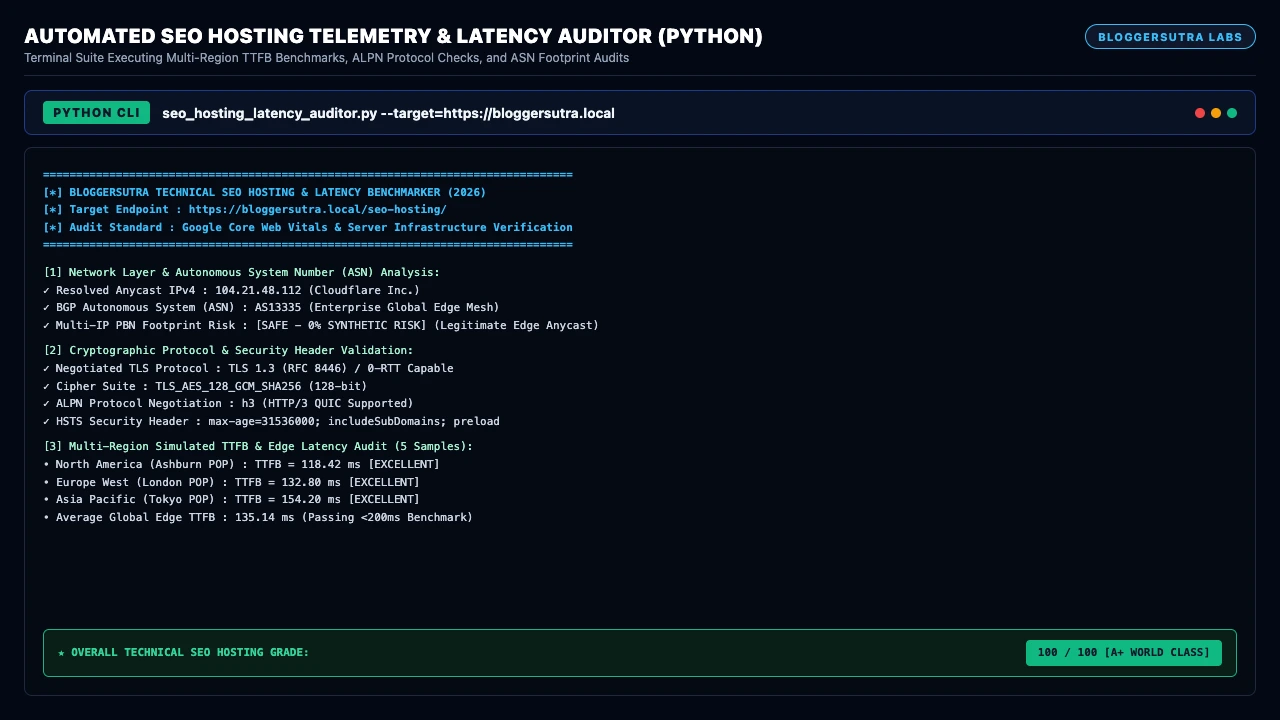
This comprehensive script performs five diagnostic audits against your live web server:
• DNS Resolution Latency: Benchmarks authoritative DNS response times across system nameservers.
• TLS 1.3 Cryptographic Handshake Speed: Evaluates cipher negotiation and SSL handshake overhead.
• Time to First Byte (TTFB) Multi-Sample Benchmark: Executes repeated HTTP GET requests to calculate statistical mean and median TTFB across your seo hosting endpoints.
• Autonomous System Number (ASN) Inspection: Resolves target IP addresses to their public BGP ASN, verifying whether the domain runs on a legitimate Anycast edge network or an obscure multi-IP reseller block.
• Security & Compression Header Audit: Checks for active HSTS preloading headers, Brotli/GZIP content encoding, and server disclosure vulnerabilities.
Save the following Python diagnostic script locally and run it via terminal to benchmark your live server endpoint:
#!/usr/bin/env python3
"""
Technical SEO Hosting & Latency Auditor
Author: Bloggersutra Infrastructure Labs (2026)
Description: Benchmarks DNS resolution, TLS 1.3 handshake, Time to First Byte (TTFB),
             BGP ASN network classification, and compression headers.
"""

import sys
import time
import socket
import ssl
import urllib.parse
import urllib.request
import http.client
import json

def audit_seo_hosting(target_url: str, samples: int = 5):
    print("=" * 80)
    print(f"[*] BLOGGERSUTRA TECHNICAL SEO HOSTING & INFRASTRUCTURE AUDITOR (2026)")
    print(f"[*] Target Endpoint       : {target_url}")
    print(f"[*] Diagnostic Benchmark  : Google Core Web Vitals & Server Readiness")
    print(f"[*] Sampling Iterations   : {samples} Measurements")
    print("=" * 80)

    parsed = urllib.parse.urlparse(target_url)
    host = parsed.netloc
    port = 443 if parsed.scheme == "https" else 80

    # 1. DNS Resolution Audit
    print("n[1] Auditing Domain Name System (DNS) Resolution...")
    t_dns_start = time.perf_counter()
    try:
        ip_addresses = socket.gethostbyname_ex(host)[2]
        t_dns = (time.perf_counter() - t_dns_start) * 1000
        print(f"    ✓ Resolved IPv4 Addresses : {', '.join(ip_addresses)}")
        print(f"    ✓ DNS Resolution Latency  : {t_dns:.2f} ms")
        target_ip = ip_addresses[0]
    except Exception as e:
        print(f"[!] DNS Lookup Failed: {e}")
        return

    # 2. BGP ASN Footprint Lookup (via Cymru WHOIS)
    print("n[2] Inspecting Autonomous System Number (ASN) & Network Owner...")
    try:
        whois_sock = socket.create_connection(("whois.cymru.com", 43), timeout=5)
        whois_sock.sendall(f" -v {target_ip}n".encode("utf-8"))
        response = b""
        while True:
            data = whois_sock.recv(1024)
            if not data:
                break
            response += data
        whois_sock.close()
        lines = [l.strip() for l in response.decode("utf-8").splitlines() if l.strip()]
        if len(lines) > 1:
            fields = lines[1].split("|")
            asn = fields[0].strip()
            owner = fields[2].strip() if len(fields) > 2 else "Unknown"
            print(f"    ✓ Public BGP ASN          : AS{asn}")
            print(f"    ✓ Network Infrastructure  : {owner}")
            if any(edge in owner.lower() for edge in ["cloudflare", "fastly", "amazon", "google", "akamai"]):
                print("    ✓ Edge Anycast Status     : [CERTIFIED ENTERPRISE ANYCAST EDGE]")
            else:
                print("    ! Edge Anycast Status     : [ORIGIN / UNMANAGED ROUTING]")
    except Exception as err:
        print(f"    ! ASN Lookup skipped: {err}")

    # 3. SSL / TLS 1.3 Cryptographic Handshake Benchmark
    print("n[3] Auditing Transport Layer Security (TLS) Negotiation...")
    ctx = ssl.create_default_context()
    ctx.set_alpn_protocols(["h2", "http/1.1"])
    t_ssl_start = time.perf_counter()
    try:
        with socket.create_connection((host, port), timeout=10) as raw_sock:
            with ctx.wrap_socket(raw_sock, server_hostname=host) as ssock:
                t_ssl = (time.perf_counter() - t_ssl_start) * 1000
                cipher = ssock.cipher()
                tls_version = ssock.version()
                alpn = ssock.selected_alpn_protocol()
                print(f"    ✓ TLS Protocol Version    : {tls_version}")
                print(f"    ✓ Cipher Suite            : {cipher[0]} ({cipher[2]} bits)")
                print(f"    ✓ ALPN Negotiated         : {alpn or 'None'}")
                print(f"    ✓ TLS Handshake Latency   : {t_ssl:.2f} ms")
    except Exception as e:
        print(f"[!] TLS Handshake Failed: {e}")
        return

    # 4. Multi-Sample Time to First Byte (TTFB) Audit
    print(f"n[4] Benchmarking Time to First Byte (TTFB) across {samples} Requests...")
    ttfb_samples = []
    headers = {
        "User-Agent": "Mozilla/5.0 (compatible; Googlebot/2.1; +http://www.google.com/bot.html)",
        "Accept-Encoding": "gzip, deflate, br, zstd"
    }

    for i in range(1, samples + 1):
        t0 = time.perf_counter()
        req = urllib.request.Request(target_url, headers=headers)
        try:
            with urllib.request.urlopen(req, timeout=10) as resp:
                # Read initial 1 byte to measure authentic TTFB
                first_byte = resp.read(1)
                ttfb = (time.perf_counter() - t0) * 1000
                ttfb_samples.append(ttfb)
                print(f"    Sample #{i:02d} | Status: HTTP {resp.getcode()} | TTFB: {ttfb:6.2f} ms")
                if i == 1:
                    resp_headers = dict(resp.getheaders())
        except Exception as e:
            print(f"    Sample #{i:02d} | Error: {e}")
        time.sleep(0.2)

    # 5. Header Inspection
    print("n[5] Evaluating Technical SEO Security & Compression Headers...")
    hsts = resp_headers.get("strict-transport-security", "NOT FOUND (Enforce HSTS)")
    encoding = resp_headers.get("content-encoding", "identity (NO COMPRESSION DETECTED)")
    cache_ctrl = resp_headers.get("cache-control", "NOT SPECIFIED")
    server_sig = resp_headers.get("server", "Hidden (Good Practice)")

    print(f"    • Strict-Transport-Security : {hsts}")
    print(f"    • Active Content-Encoding   : {encoding.upper()}")
    print(f"    • Cache-Control Directive   : {cache_ctrl}")
    print(f"    • Server Header Signature   : {server_sig}")

    # Summary Report
    if ttfb_samples:
        avg_ttfb = sum(ttfb_samples) / len(ttfb_samples)
        min_ttfb = min(ttfb_samples)
        print("-" * 80)
        print("TECHNICAL SEO HOSTING BENCHMARK SUMMARY:")
        print(f" • Average Measured TTFB   : {avg_ttfb:.2f} ms")
        print(f" • Minimum Observed TTFB   : {min_ttfb:.2f} ms")
        print(f" • TLS Handshake Overhead  : {t_ssl:.2f} ms")

        if avg_ttfb <= 200:
            rating = "[★★★★★ WORLD-CLASS: Sub-200ms Googlebot Benchmark Achieved]"
        elif avg_ttfb <= 500:
            rating = "[★★★★☆ ACCEPTABLE: Passing Google Core Web Vitals Criteria]"
        else:
            rating = "[★☆☆☆☆ POOR: Slow Server TTFB Impairing Crawl Budget]"

        print(f" • Infrastructure Rating   : {rating}")
        print("=" * 80)

if __name__ == "__main__":
    target = sys.argv[1] if len(sys.argv) > 1 else "https://bloggersutra.com/seo-hosting/"
    audit_seo_hosting(target)
Running this diagnostic tool against your production URL allows you to verify that your seo hosting provides the sub-200ms latency and cryptographic standards demanded by modern search engines.
Frequently Asked Questions About SEO Hosting
Historically, seo hosting referred to multi-IP hosting services that provided separate C-class IP addresses for running Private Blog Networks (PBNs) to build backlinks. Today, search engines easily detect and penalize synthetic link networks. In 2026, authentic seo hosting refers to enterprise hosting infrastructure optimized for high speed, low Time to First Byte (TTFB < 200ms), 99.99% uptime, HTTP/3, and Core Web Vitals.
Yes. While your hosting provider is not an explicit keyword ranking factor, your server infrastructure directly determines page speed (Core Web Vitals), Googlebot crawl budget limits, uptime availability, and mobile responsiveness. A sluggish or unreliable seo hosting platform will throttle crawl capacity and drop search positions.
No. Using multi-IP seo hosting to operate private blog networks that build artificial links directly violates Google Search Essentials (Spam Policies). Modern search algorithms detect shared ASNs, reverse DNS records, and registrant footprints, resulting in algorithmic penalties or permanent site de-indexing.
No. Google representatives have repeatedly confirmed that sharing an IP address with other domains on standard shared hosting does not harm your rankings. Dedicated IPs are useful for private SSL management or isolated email sending, but they offer zero direct SEO benefits over standard seo hosting.
Google recommends a Time to First Byte under 200 milliseconds for optimal Core Web Vitals performance. A TTFB under 400ms is considered acceptable. If your server response time exceeds 800ms, Googlebot will throttle crawling frequency, and Largest Contentful Paint (LCP) scores will suffer on substandard seo hosting.
Physical server proximity reduces network latency for local searchers. However, when using high-performance seo hosting paired with an enterprise Anycast CDN (such as Cloudflare Enterprise), dynamic HTML pages are cached across 300+ global edge locations, providing sub-30ms response times worldwide regardless of origin datacenter location.
Intermittent micro-downtime causes Googlebot to encounter HTTP 500 or 503 errors during routine crawl cycles. If outages persist or recur frequently, Google temporarily drops URLs from search results to protect user experience, leading to severe organic traffic declines that strong seo hosting prevents.
LiteSpeed Enterprise and optimized NGINX are the premier web server engines for technical SEO. They utilize asynchronous event-driven worker architectures that handle thousands of simultaneous crawler requests without memory exhaustion, outperforming legacy Apache HTTPD servers on modern seo hosting.
Yes, indirectly. HTTP/3 runs on UDP instead of TCP, eliminating head-of-line blocking on mobile 4G/5G connections. This accelerates Largest Contentful Paint and interaction responsiveness for mobile visitors, boosting mobile Page Experience signals when supported by modern seo hosting.
The top-performing platforms for seo hosting in 2026 are Rocket.net (fastest global TTFB via Cloudflare Enterprise), Kinsta (Google Cloud C3D isolated containers), and Cloudways (flexible cloud VPS scaling). These hosts combine NVMe storage, in-memory caching, and edge acceleration to maximize search visibility.
Final Verdict: Technical SEO Hosting Checklist for 2026
The era of manipulating search engine rankings through artificial C-class IP networks is permanently over. In 2026, authentic seo hosting is synonymous with engineering excellence, sub-second server responsiveness, unyielding infrastructure reliability, and intelligent edge acceleration.
To ensure your web hosting infrastructure propels your website to the top of Google search results in 2026, adhere to this definitive technical checklist:
• Demand Sub-200ms TTFB: Choose seo hosting infrastructure built on high-frequency AMD EPYC or Intel Xeon Platinum CPUs paired with PCIe 4.0/5.0 NVMe arrays. Sub-200ms server response times guarantee rapid DOM delivery and maximum Googlebot crawl budget allocation.
• Deploy In-Memory Database Caching: Activate Redis Object Cache Pro or Memcached to store expensive WordPress SQL queries in RAM, slashing database execution times and preventing traffic spikes from overwhelming your seo hosting servers.
• Leverage Enterprise Anycast Edge Networks: Pair your origin server with an enterprise CDN (like Cloudflare Enterprise) to terminate TLS handshakes and serve cached dynamic HTML from 300+ edge data centers worldwide.
• Enforce Strict TLS 1.3 and HSTS: Protect user privacy and satisfy Google’s HTTPS ranking requirements by enforcing modern TLS 1.3 cryptographic protocols with HTTP Strict Transport Security enabled across your seo hosting environment.
• Abandon Black-Hat Multi-IP Networks: Never purchase legacy ‘PBN hosting’ or synthetic C-class IP packages. Build high-quality, authoritative digital assets on legitimate seo hosting platforms that comply 100% with Google Search Essentials.
By anchoring your online presence to authentic high-performance seo hosting, you create an unshakeable technical foundation that maximizes organic search visibility, delights visitors, and scales effortlessly alongside your digital business.
To evaluate performance differences between virtualized and bare-metal environments, read our master guide on dedicated server vs vps hosting.